



الصفحة 1
الصفحة 1

Object-Oriented Software Engineering Using UML Patterns and Java
Shows students how to use both the principles of software engineering and the practices of various object-oriented tools, processes, and products. Using a step-by-step case study to illustrate the concepts and topics in each chapter, Bruegge and Dutoit emphasize learning object-oriented software engineer through practical experience: students can apply the techniques learned in class by implementing a real-world software project. The third edition addresses new trends, in particular agile project management (Chapter 14 Project Management) and agile methodologies (Chapter 16 Methodologies).

Cryptography and network security : principles and practices
Introduces students to the compelling and evolving field of cryptography and network security. In an age of viruses and hackers, electronic eavesdropping, and electronic fraud on a global scale, security is paramount. The purpose of this book is to provide a practical survey of both the principles and practice of cryptography and network security. In the first part of the book, the basic issues to be addressed by a network security capability are explored by providing a tutorial and survey of cryptography and network security technology. The latter part of the book deals with the practice of network security: practical applications that have been implemented and are in use to provide network security.

Computer organization and design, enhanced : The hardware / software interface ; 5th ed.
Contains new examples and material highlighting the emergence of mobile computing and the cloud. It explores this generational change with updated content featuring tablet computers, cloud infrastructure, and the ARM (mobile computing devices) and x86 (cloud computing) architectures. The book uses a MIPS processor core to present the fundamentals of hardware technologies, assembly language, computer arithmetic, pipelining, memory hierarchies and I/O.Because an understanding of modern hardware is essential to achieving good performance and energy efficiency, this edition adds a new concrete example, Going Faster, used throughout the text to demonstrate extremely effective optimization techniques. There is also a new discussion of the Eight Great Ideas of computer architecture.
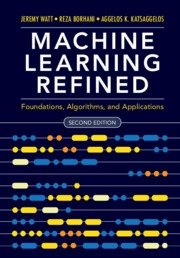
Machine Learning Refined : Foundations, Algorithms, and Applications
Provides students with the fundamental knowledge and practical tools needed to conduct research and build data-driven products. The authors prioritize geometric intuition and algorithmic thinking, and include detail on all the essential mathematical prerequisites, to offer a fresh and accessible way to learn. Practical applications are emphasized, with examples from disciplines including computer vision, natural language processing, economics, neuroscience, recommender systems, physics, and biology.

Machine learning refined : Foundations, algorithms, and applications
Providing a unique approach to machine learning, this text contains fresh and intuitive, yet rigorous, descriptions of all fundamental concepts necessary to conduct research, build products, tinker, and play. By prioritizing geometric intuition, algorithmic thinking, and practical real world applications in disciplines including computer vision, natural language processing, economics, neuroscience, recommender systems, physics, and biology, this text provides readers with both a lucid understanding of foundational material as well as the practical tools needed to solve real-world problems. With in-depth Python and MATLAB/OCTAVE-based computational exercises and a complete treatment of cutting edge numerical optimization techniques, this is an essential resource for students and an ideal reference for researchers and practitioners working in machine learning, computer science, electrical engineering, signal processing, and numerical optimization
