



الصفحة 1
الصفحة 1
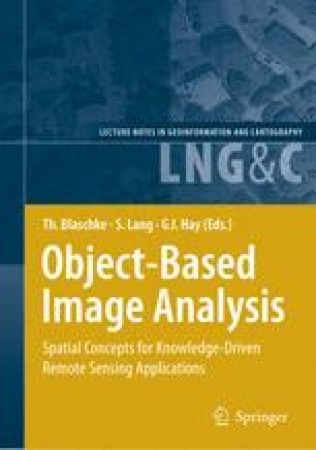
Object-Based Image Analysis : Spatial Concepts for Knowledge-Driven Remote Sensing Applications
This book discusses means, technologies and approaches related to the processing and analysis of multi-sensor, multi-resolution data with a focus on the generation, modelling and classification of objects. The applications also address the integration of Geographic Information and the concurrent developments of GIScience and vanquish limitations of pixelwise image processing by exploiting image information context-driven and "intelligently".
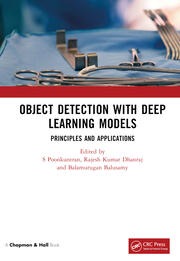
Object detection with deep learning models : Principles and applications
Discusses recent advances in object detection and recognition using deep learning methods, which have achieved great success in the field of computer vision and image processing. It provides a systematic and methodical overview of the latest developments in deep learning theory and its applications to computer vision, illustrating them using key topics, including object detection, face analysis, 3D object recognition, and image retrieval / A structured overview of deep learning in object detection / A diversified collection of applications of object detection using deep neural networks / Emphasize agriculture and remote sensing domains / Exclusive discussion on moving object detection

Nonlinear and Adaptive Control with Applications
Nonlinear and Adaptive Control with Applications provides a detailed treatment of the design of robust adaptive controllers for nonlinear systems with uncertainties. The authors employ a new tool based on the ideas of system immersion and manifold invariance.

New trends in computational vision and bio-inspired computing : Selected works presented at the ICCVBIC 2018, Coimbatore, India
Gathers selected, peer-reviewed original contributions presented at the International Conference on Computational Vision and Bio-inspired Computing (ICCVBIC) conference which was held in Coimbatore, India, on November 29-30, 2018. The works included here offer a rich and diverse sampling of recent developments in the fields of Computational Vision, Fuzzy, Image Processing and Bio-inspired Computing. The topics covered include computer vision; cryptography and digital privacy; machine learning and artificial neural networks; genetic algorithms and computational intelligence; the Internet of Things; and biometric systems, to name but a few. The applications discussed range from security, healthcare and epidemic control to urban computing, agriculture and robotics.

New frontiers in artificial intelligence ; JSAI-isAI International Workshops, JURISIN, AI-Biz, LENLS, Kansei-AI, Yokohama, Japan, November 10–12, 2019, Revised Selected Papers
This book constitutes extended, revised and selected papers from the 11th International Symposium of Artificial Intelligence supported by the Japanese Society for Artificial Intelligence, JSAI-isAI 2019. It was held in November 2019 in Yokohama, Japan. The 26 papers were carefully selected from 46 submissions and deal with topics of AI research and are organized into 4 sections, according to the 4 workshops: JURISIN 2019, AI-Biz 2019, LENLS 16, and Kansei-AI 2019.
New Frontiers in Applied Artificial Intelligence ; 21st International Conference on Industrial, Engineering and Other Applications of Applied Intelligent Systems, IEA/AIE 2008 Wrocław, Poland, June 18-20, 2008 Proceedings
The 75 revised full papers presented were carefully reviewed and selected from 302 submissions. The papers are organized in topical sections on computer vision, fuzzy system applications, robot and manufacturing, data mining and KDS, neural networks, machine learning, natural language processing, internet application and education, heuristic search, application systems, agent-based system, evolutionary and genetic algorithms, knowledge management, and other applications. The book concludes with 15 contributions from the following special sessions: knowledge driven manufacturing systems, joint session on adaptive networked systems and fuzzy knowledge bases, and software agents and multi-agent systems.

Neural Networks : Computational Models and Applications
Neural Networks: Computational Models and Applications covers a wealth of important theoretical and practical issues in neural networks, including the learning algorithms of feed-forward neural networks, various dynamical properties of recurrent neural networks, winner-take-all networks and their applications in broad manifolds of computational intelligence: pattern recognition, uniform approximation, constrained optimization, NP-hard problems, and image segmentation. By presenting various computational models, this book is developed to provide readers with a quick but insightful understanding of the broad and rapidly growing areas in the neural networks domain. Besides laying down fundamentals on artificial neural networks, this book also studies biologically inspired neural networks. Some typical computational models are discussed, and subsequently applied to objection recognition, scene analysis and associative memory. The studies of bio-inspired models have important implications in computer vision and robotic navigation, as well as new efficient algorithms for image analysis.

Neural Information Processing ; Vol. 4234 ; 13th International Conference, ICONIP 2006, Hong Kong, China, October 3-6, 2006, Proceedings, Part III
This book and its companion volumes constitute the Proceedings of the 13th - ternationalConferenceonNeuralInformationProcessing(ICONIP2006)heldin Hong Kong during October 3–6,2006. ICONIP is the annual ?agship conference oftheAsiaPaci?cNeuralNetworkAssembly(APNNA)withthepasteventsheld in Seoul (1994), Beijing (1995), Hong Kong (1996), Dunedin (1997), Kitakyushu (1998), Perth(1999), Taejon(2000), Shanghai(2001), Singapore(2002), Istanbul (2003), Calcutta(2004), andTaipei(2005). Overtheyears, ICONIPhasmatured into a well-established series of international conference on neural information processing and related ?elds in the Asia and Paci?cregions. Following the tra- tion, ICONIP 2006 provided an academic forum for the participants to diss- inate their new research ?ndings and discuss emerging areas of research.

Neural Information Processing ; Vol. 4233 ; 13th International Conference, ICONIP 2006, Hong Kong, China, October 3-6, 2006, Proceedings, Part II
The three volume set LNCS 4232, LNCS 4233, and LNCS 4234 constitutes the refereed proceedings of the 13th International Conference on Neural Information Processing, ICONIP 2006, held in Hong Kong, China in October 2006. The 386 revised full papers presented were carefully reviewed and selected from 1175 submissions.
Neural Information Processing ; Vol. 4232 ; 13th International Conference, ICONIP 2006, Hong Kong, China, October 3-6, 2006, Proceedings, Part I
This book and its companion volumes constitute the Proceedings of the 13th - ternationalConferenceonNeuralInformationProcessing(ICONIP2006)heldin Hong Kong during October 3–6,2006. ICONIP is the annual ?agship conference oftheAsiaPaci?cNeuralNetworkAssembly(APNNA)withthepasteventsheld in Seoul (1994), Beijing (1995), Hong Kong (1996), Dunedin (1997), Kitakyushu (1998), Perth(1999), Taejon(2000), Shanghai(2001), Singapore(2002), Istanbul (2003), Calcutta(2004), andTaipei(2005). Overtheyears, ICONIPhasmatured into a well-established series of international conference on neural information processing and related ?elds in the Asia and Paci?cregions. Following the tra- tion, ICONIP 2006 provided an academic forum for the participants to diss- inate their new research ?ndings and discuss emerging areas of research.
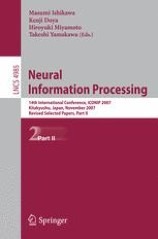
Neural Information Processing ; 14th International Conference, ICONIP 2007, Kitakyushu, Japan, November 13-16, 2007, Revised Selected Papers, Part II
The 228 revised full papers presented were carefully reviewed and selected from numerous ordinary paper submissions and 15 special organized sessions. The 116 papers of the first volume are organized in topical sections on computational neuroscience, learning and memory, neural network models ,supervised /unsupervised/reinforcement learning, statistical learning algorithms, optimization algorithms, novel algorithms, as well as motor control and vision. The second volume contains 112 contributions related to statistical and pattern recognition algorithms, neuromorphic hardware and implementations, robotics, data mining and knowledge discovery, real world applications, cognitive and hybrid intelligent systems, bioinformatics, neuroinformatics, brain-conputer interfaces, and novel approaches.

Natural Language Processing and Chinese Computing ; 9th CCF International Conference, NLPCC 2020, Zhengzhou, China, October 14–18, 2020, Proceedings, Part II
This two-volume set of LNAI 12340 and LNAI 12341 constitutes the refereed proceedings of the 9th CCF Conference on Natural Language Processing and Chinese Computing, NLPCC 2020, held in Zhengzhou, China, in October 2020. The 70 full papers, 30 poster papers and 14 workshop papers presented were carefully reviewed and selected from 320 submissions. They are organized in the following areas: Conversational Bot/QA; Fundamentals of NLP; Knowledge Base, Graphs and Semantic Web; Machine Learning for NLP; Machine Translation and Multilinguality; NLP Applications; Social Media and Network; Text Mining; and Trending Topics.

Natural language processing and chinese computing ; 9th CCF International conference, NLPCC 2020, Zhengzhou, China, October 14–18, 2020, Proceedings, Part I
This two-volume set of LNAI 12340 and LNAI 12341 constitutes the refereed proceedings of the 9th CCF Conference on Natural Language Processing and Chinese Computing, NLPCC 2020, held in Zhengzhou, China, in October 2020. The 70 full papers, 30 poster papers and 14 workshop papers presented were carefully reviewed and selected from 320 submissions. They are organized in the following areas: Conversational Bot/QA; Fundamentals of NLP; Knowledge Base, Graphs and Semantic Web; Machine Learning for NLP; Machine Translation and Multilinguality; NLP Applications; Social Media and Network; Text Mining; and Trending Topics.

Multi-Sensor Data Fusion : An Introduction
This textbook provides a comprehensive introduction to the theories and techniques of multi-sensor data fusion. It is aimed at advanced undergraduate and first-year graduate students in electrical engineering and computer science, as well as researchers and professional engineers. The book is intended to be self-contained. No previous knowledge of multi-sensor data fusion is assumed, although some familiarity with the basic tools of linear algebra, calculus and simple probability theory is recommended.
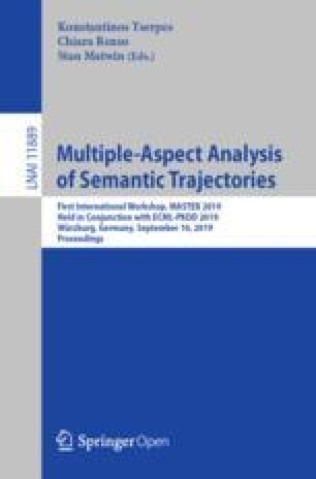
Multiple-Aspect Analysis of Semantic Trajectories ; First International Workshop, MASTER 2019, Held in Conjunction with ECML-PKDD 2019, Würzburg, Germany, September 16, 2019, Proceedings
This book constitutes the refereed post-conference proceedings of the First International Workshop on Multiple-Aspect Analysis of Semantic Trajectories, MASTER 2019, held in conjunction with the 19th European Conference on Machine Learning and Knowledge Discovery in Databases, ECML PKDD 2019, in Würzburg, Germany, in September 2019.
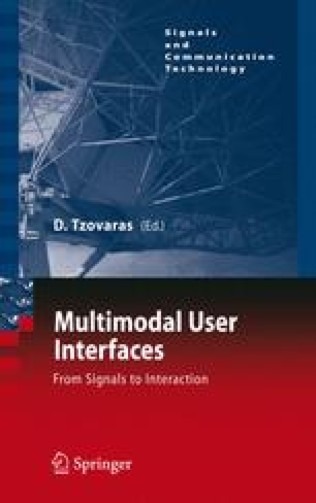
Multimodal User Interfaces : From Signals to Interaction
The book presents a common theoretical framework for fusion and fission of multimodal information using the most advanced signal processing algorithms constrained by HCI rules, described in detail and integrated in the context of a common distributed software platform for easy and efficient development and usability assessment of multimodal tools. The book also demonstrates the use of the multimodal framework for the development of a set of applications in the areas of edutainment, interfaces for disabled people and interfaces for medical applications.

Multimodal Technologies for Perception of Humans ; International Evaluation Workshops CLEAR 2007 and RT 2007, Baltimore, MD, USA, May 8-11, 2007, Revised Selected Papers
This book constitutes the thoroughly refereed joint post-workshop proceedings of two co-located events: the Second International Workshop on Classification of Events, Activities and Relationships, CLEAR 2007, and the 5th Rich Transcription 2007 Meeting Recognition evaluation, RT 2007, held in succession in Baltimore, MD, USA, in May 2007.The workshops had complementary evaluation efforts; CLEAR for the evaluation of human activities, events, and relationships in multiple multimodal data domains; and RT for the evaluation of speech transcription-related technologies from meeting room audio collections.
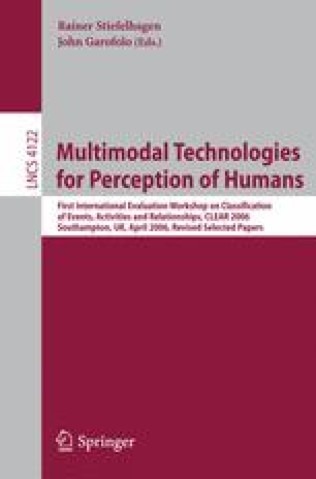
Multimodal Technologies for Perception of Humans ; 1st International Evaluation Workshop on Classification of Events, Activities and Relationships, CLEAR 2006, Southampton, UK, April 6-7, 2006, Revised Selected Papers
This book constitutes the thoroughly refereed post-proceedings of the First International CLEAR 2006 Evaluation Campaign and Workshop on Classification of Events, Activities and Relationships for evaluation of multimodal technologies for the perception of humans, their activities and interactions. The workshop was held in the UK in April 2006.
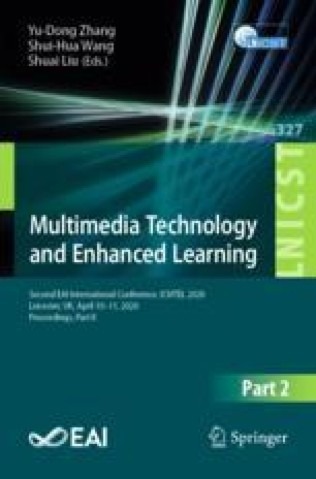
Multimedia technology and enhanced learning ; 2nd EAI International conference, ICMTEL 2020, Leicester, UK, April 10-11, 2020, Proceedings, Part II
This two-volume book constitutes the refereed proceedings of the Second International Conference on Multimedia Technology and Enhanced Learning, ICMTEL 2020, held in Leicester, United Kingdom, in April 2020. Due to the COVID-19 pandemic all papers were presented in YouTubeLive. The 83 revised full papers have been selected from 158 submissions. They describe new learning technologies which range from smart school, smart class and smart learning at home and which have been developed from new technologies such as machine learning, multimedia and Internet of Things.

Multimedia Technology and Enhanced Learning ; 2nd EAI International Conference, ICMTEL 2020, Leicester, UK, April 10-11, 2020, Proceedings, Part I
This two-volume book constitutes the refereed proceedings of the Second International Conference on Multimedia Technology and Enhanced Learning, ICMTEL 2020, held in Leicester, United Kingdom, in April 2020. Due to the COVID-19 pandemic all papers were presented in YouTubeLive. The 83 revised full papers have been selected from 158 submissions. They describe new learning technologies which range from smart school, smart class and smart learning at home and which have been developed from new technologies such as machine learning, multimedia and Internet of Things.
