



الصفحة 1
الصفحة 1
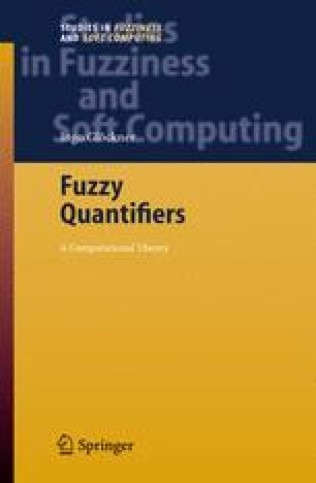
Fuzzy Quantifiers : A Computational Theory
Almost all", "many", "some": fuzzy quantifiers are vital for effective communication in natural language (NL). This monograph pursues an axiomatic method to achieve a reliable interpretation of these quantifiers in technical applications of fuzzy quantification. Unlike existing work in this area, it targets a much broader class of quantificational phenomena which includes all cases usually considered in linguistics. The topics addressed in the monograph run the gamut from the introduction of the theoretical framework for analysing fuzzy quantification, the formalization of semantical requirements on models of fuzzy quantification, the construction and detailed study of prototypical models which conform to the linguistic desiderata, the development of algorithms for implementing the main types of quantifiers in these models, and finally a preview to fuzzy branching quantifications which might be necessary for modelling NL sentences involving more than one quantifier.

Cellular automata ; 7th International conference on cellular automata for research and industry, ACRI 2006, Perpignan, France, September 20-23, 2006, Proceedings
This book constitutes the refereed proceedings of the 7th International Conference on Cellular Automata for Research and Industry, ACRI 2006. The book presents 53 revised full papers and 19 revised poster papers together with 6 invited lectures. Topical sections include CA theory and implementation, computational theory, population dynamics, physical modeling, urban, environmental and social modeling, traffic and boolean networks, multi-agents and robotics, as well as crowds and cellular automata, and more.
Architecture of advanced numerical analysis systems: designing a scientific computing system using ocaml
Applies the functional OCaml programming language to numerical or computational weighted data science, engineering, and scientific applications. This book is based on the authors' first-hand experience building and maintaining Owl, an OCaml-based numerical computing library. You'll first learn the various components in a modern numerical computation library. Then, you will learn how these components are designed and built up and how to optimize their performance. After reading and using this book, you'll have the knowledge required to design and build real-world complex systems that effectively leverage the advantages of the OCaml functional programming language.
