



الصفحة 1
الصفحة 1

Food Price Volatility and Its Implications for Food Security and Policy
This book provides fresh insights into concepts, methods and new research findings on the causes of excessive food price volatility. It also discusses the implications for food security and policy responses to mitigate excessive volatility. The approaches applied by the contributors range from on-the-ground surveys, to panel econometrics and innovative high-frequency time series analysis as well as computational economics methods. It offers policy analysts and decision-makers guidance on dealing with extreme volatility.

Emergent Macroeconomics : An Agent-Based Approach to Business Fluctuations
This book contributes substantively to the current state-of-the-art of macroeconomics by providing a method for building models in which business cycles and economic growth emerge from the interactions of a large number of heterogeneous agents. Drawing from recent advances in agent-based computational modeling, the authors show how insights from dispersed fields like the microeconomics of capital market imperfections, industrial dynamics and the theory of stochastic processes can be fruitfully combined to improve our understanding of macroeconomic dynamics. This book should be a valuable resource for all researchers interested in analyzing macroeconomic issues without recurring to a fictitious representative agent.

Dynamic General Equilibrium Modelling : Computational Methods and Applications
Modern business cycle theory and growth theory uses stochastic dynamic general equilibrium models. Many mathematical tools are needed to solve these models. The book presents various methods for computing the dynamics of general equilibrium models. In part I, the representative-agent stochastic growth model is solved with the help of value function iteration, linear and linear quadratic approximation methods, parameterised expectations and projection methods. In order to apply these methods, fundamentals from numerical analysis are reviewed in detail. Part II discusses methods for solving heterogeneous-agent economies. In such economies, the distribution of the individual state variables is endogenous. This part of the book also serves as an introduction to the modern theory of distribution economics. Applications include the dynamics of the income distribution over the business cycle or the overlapping-generations model.

Computing and Combinatorics ; Vol. 4112 ; 12th Annual International Conference, COCOON 2006, Taipei, Taiwan, August 15-18, 2006, Proceedings
The papers are organized in topical sections on computational economics, finance, and management, graph algorithms, computational complexity and computability, quantum computing, computational biology and medicine, computational geometry, graph theory, and more.

Computational Methods in Financial Engineering : Essays in Honour of Manfred Gilli
The focus of this book is the development of computational methods and analytical models in financial engineering that rely on computation. The book contains eighteen chapters written by leading researchers in the area on portfolio optimization and option pricing; estimation and classification; banking; risk and macroeconomic modelling. It explores and brings together current research tools and will be of interest to researchers, analysts and practitioners in policy and investment decisions in economics and finance. "This book collects frontier work by researchers in computational economics in a tribute to Manfred Gilli, a leading member of this community. Contributions cover many of the topics researched by Gilli during his career: portfolio optimization and option pricing, estimation and classification, as well as banking, risk and macroeconomic modeling. The editors have put together a remarkable panorama of the rapidly growing and diversifying field of computational economics and finance
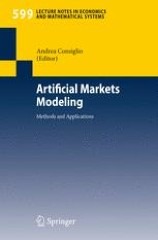
Artificial markets modeling : Methods and applications
Agent-based computational modeling with its intrinsic multidisciplinary approach is gaining increasing recognition in the social sciences, particularly in economics, business and finance. This volume is devoted to recent contributions to the field from both the social sciences and computer sciences.
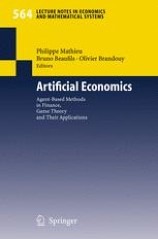
Artificial economics : Agent-based methods in finance, game theory and their applications
The purpose of this book is to give an up-to date view of the scientific production in the fields of Agent-based Computational Economics (mainly in Market Finance and Game Theory). Based on communications given at AE'2005 (Lille, USTL, France), this book offers a wide panorama of recent advances in ACE (both theoretical and methodological) that will interest academics as well as practitioners.
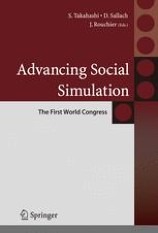
Advancing Social Simulation: The First World Congress
Agent-based modeling and social simulation have emerged as both developments of and challenges to the social sciences. The developments include agent-based computational economics and investigations of theoretical sociological concepts using formal simulation techniques. Among the challenges are the development of qualitative modeling techniques, implementation of agent-based models to investigate phenomena for which conventional economic, social, and organizational models have no face validity, and the application of physical modeling techniques to social processes. Bringing together diverse approaches to social simulation and research agendas.
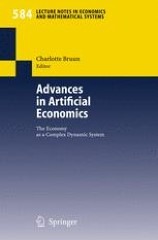
Advances in Artificial Economics : The Economy as a Complex Dynamic System
Perceiving the economy as a complex dynamic system, generates a need for new tools for its study. As a constructive simulation method, Agent-Based Computational Economics (ACE) has in recent years proven its strength and extensive applicability. Fields of study are widely spread within economics, with a cluster around financial markets. This book is based on communications given at AE’2006 (Aalborg, Denmark) – the second symposium on Artificial Economics, and covers both wellknown questions of economics, like the existence of market efficiency, as well as new questions raised by the new tools, for example questions related to networks of social interaction.
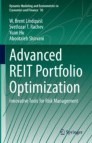
Advanced REIT Portfolio Optimization : Innovative Tools for Risk Management
This book provides an investor-friendly presentation of the premises and applications of the quantitative finance models governing investment in one asset class of publicly traded stocks, specifically real estate investment trusts (REITs). The models provide highly advanced analytics for REIT investment, including: portfolio optimization using both historic and predictive return estimation; model backtesting; a complete spectrum of risk assessment and management tools with an emphasis on early warning systems, risk budgeting, estimating tail risk, and factor analysis; derivative valuation; and incorporating ESG ratings into REIT investment.
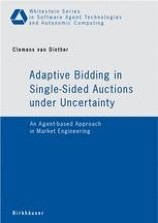
Adaptive Bidding in Single-Sided Auctions under Uncertainty : An Agent-based Approach in Market Engineering
In the last years electronic markets, especially online auctions, have become very popular and received more and more attention in both, business (B2B) as well as in public practice (B2C and C2C). Science, however, is still far from having studied all phenomena and effects which can be observed on electronic markets. This book shows that and how software agents can be used to simulate bidding behaviour in electronic auctions. The main emphasis of this book is to apply computational economics to market theory. It summarizes the most common and up-to-date agent-based simulation methods and tools and develops the simulation software AMASE. On basis of the introduced methods a model is established to simulate bidding behaviour under uncertainty.
