



الصفحة 1
الصفحة 1

Eukaryotic Membranes and Cytoskeleton : Origins and Evolution
Eukaryotic Membranes and Cytoskeleton: Origins and Evolution discusses the evolutionary origin and diversification of eukaryotic endomembranes and cytoskeleton from a cell biological and comparative genomic perspective. Many of the chapters present original research data from comparative genomic surveys. The presence/absence of gene families with central roles in endomembrane and cytoskeleton dynamics in a variety of eukaryotic taxa and an understanding of eukaryote phylogeny allow us to accurately reconstruct the cellular machineries present in the last common ancestor of eukaryotes. Such a reconstruction is fundamental if we are to understand eukaryotic diversification since this is the ancestral cell from which all diversity arose. Comparative genomics can likewise tell us which lineages expanded or reduced certain gene families and the associated cellular machineries.

Comparative genomics ; Vol.4205 ; RECOMB 2006 International Workshop, RECOMB-CG 2006, Montreal, Canada, September 24-26, 2006, Proceedings
The papers address a broad variety of aspects and components of the field of comparative genomics, ranging from new quantitative discoveries about genome structure and process to theorems on the complexity of computational problems inspired by genome comparison.
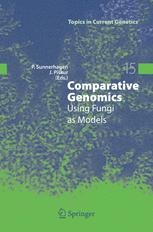
Comparative genomics ; Vol.15 : Using Fungi as Models
Fungal comparative genomics started in 2000 by the genome sequencing of several yeast species other than the canonical Saccharomyces cerevisiae. Since then, over 30 fungal genome sequences have become available. This set represents a total evolutionary divergence comparable to that between vertebrates and arthropods, but also contains closely related genomes. This volume describes how we can use this set of genomes to trace large and small-scale events in genome evolution, to extract information about highly conserved and less conserved sequence elements, and to develop novel methods in genomics that will have an impact on genomics at large.

Comparative genomics ; Vol. 3678 : RECOMB 2005 International Workshop, RCG 2005, Dublin, Ireland, September 18-20, 2005, Proceedings
This book constitutes the refereed proceedings of the RECOMB 2005 Satellite Workshop, the 3rd RECOMB Comparative Genomics meeting RCG 2005, held in Dublin, Ireland in September 2005. The 14 revised full papers presented were carefully reviewed and selected from 21 initial submissions. The papers address a broad variety of aspects and components of the field of comparative genomics, ranging from new quantitative discoveries about genome structure and process to theorems on the complexity of computational problems inspired by genome comparison.

Comparative genomics ; Vol. 3388 : RECOMB 2004 International Workshop, RCG 2004, Bertinoro, Italy, October 16-19, 2004, Revised Selected Papers
This papers investigates the problem of conservation of combinatorial structures in genome rearrangement scenarios. We give a characterization of a class of scenarios that conserve all common intervals, called commuting scenarios, and a characterization of permutations for which commuting scenarios exist. We show that measuring conservation of common intervals can be useful tool in assessing the quality of rearrangement scenarios, by investigating in detail three specific scenarios involving the mouse, rat and human X chromosomes.

Comparative genomics ; RECOMB 2007, International Workshop, RECOMB-CG 2007, San Diego, CA, USA, September 16-18, 2007, Proceedings
This book provides an evolutionary conceptual framework for comparative genomics, with the ultimate objective of understanding the loss and gain of genes during evolution, the interactions among gene products, and the relationship between genotype, phenotype and the environment. The many examples in the book have been carefully chosen from primary research literature based on two criteria: their biological insight and their pedagogical merit. The phylogeny-based comparative methods, involving both continuous and discrete variables, often represent a stumbling block for many students entering the field of comparative genomics. They are numerically illustrated and explained in great detail.
Comparative genomics ; International Workshop, RECOMB-CG 2008, Paris, France, October 13-15, 2008. Proceedings
This book constitutes the refereed proceedings of the 6th RECOMB Comparative Genomics Satellite Workshop, RECOMB-CG 2008, held in Paris, France, in October 2008.
Comparative genomics : Methods and protocols
Provides new and updated chapters covering computational and mathematical techniques and concepts related to the field of comparative genomics. The topics covered in the chapters range from those that address general techniques and concepts that apply to all organisms to others that are specialized and apply to specific biological systems such as viruses, bacteria, nematodes, and insects.
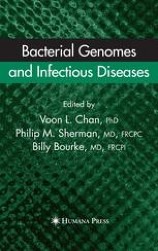
Bacterial Genomes and Infectious Diseases
This book imparts fundamental knowledge on the structure, organization, and evolution of bacterial genomes. The value and power of comparative genomics and proteomics, bioinformatics, microarrays, and knockout animal models in analyzing genomes, bacteria-host interactions and disease are demonstrated. Also discussed are the genomes of virulent and nonvirulent strains and species, origin and evolution of pathogens, different models of bacteria-host interactions, and diseases mechanisms.
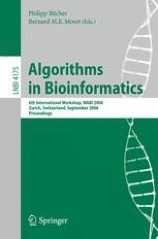
Algorithms in Bioinformatics ; Vol.4175 : 6th International Workshop, WABI 2006, Zurich, Switzerland, September 11-13, 2006, Proceedings
This book constitutes the refereed proceedings of the 6th International Workshop on Algorithms in Bioinformatics, WABI 2006, held in Zurich, Switzerland in September 2006 in the course of the ALGO 2006 conference meetings. The 36 revised full papers presented were carefully reviewed and selected from 100 submissions. All current issues of algorithms in bioinformatics are addressed, ranging from mathematical tools to experimental studies of approximation algorithms and reports on significant computational analyses. Numerous biological problems are dealt with, including genetic mapping, sequence alignment and sequence analysis, phylogeny, comparative genomics, and protein structure. For the first time also machine-learning approaches along with combinatorial optimization are covered.

Algorithms in Bioinformatics ; 7th International Workshop, WABI 2007, Philadelphia, PA, USA, September 8-9, 2007, Proceedings
All current issues of algorithms in bioinformatics are addressed, ranging from mathematical tools to experimental studies of approximation algorithms and reports on significant computational analyses. Numerous biological problems are dealt with, including genetic mapping, sequence alignment and sequence analysis, phylogeny, comparative genomics, and protein structure. Furthermore the papers feature high-performance computing approaches to computationally hard learning and optimization problems in bioinformatics and cover methods, software and dataset repositories for development and testing of such algorithms and their underlying models.
