



الصفحة 1
الصفحة 1

New Trends in Macroeconomics
This volume does exactly what its title says: it acquaints with 'New Trends in Macroeconomics'. More specifically, it contains eleven chapters covering different aspects of modern macroeconomics: short-run fluctuations, long-run growth, monetary economics, international finance, macroeconometrics and complex dynamics. All chapters break new grounds in their area while at the same time remain very accessible. The book contains also an excellent mixture of new techniques, interesting applications and methodological arguments. A valuable reference for both practitioners and researchers, it will also be of great help to gradutate students seeking to bring themselves to the frontier of one of the most fascinating fields of economics

Modern Econometric Analysis : Surveys on Recent Developments
The importance of empirical economics and econometric methods has greatly in creased during the last 20 years due to the availability of better data and the improved performance of computers. In an information-driven society such as ours we need quickly to obtain complete and convincing statistical results. This is only possible if the appropriate econometric methods are applied. Traditional econometric analysis concentrates on classical methods which are far from suitable for handling actual economic problems.

Introduction to Modern Time Series Analysis
This excellent textbook presents an introduction to the time series analysis. It provides a good source of information for graduate and master students in economics and statistics. It is a well-written and easy to read book, illustrated by 56 good examples. Also, many important references are listed at the end of each chapter.This book presents to beginners a readable and easily accessible introduction to modern developments in time series econometrics and financial time series with an emphasis on basic concepts and practical applications. The book is a textbook consisting of seven chapters the greatest merit of this textbook is that it enables readers to grasp the basic framework of time-series econometrics without relying on extensive reading
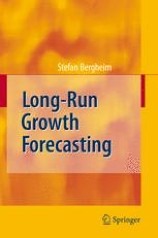
Long-Run Growth Forecasting
Explores how to set up an empirical model that helps with forecasting long-term economic growth in a large number of countries. It offers a systematic approach to models of potential GDP that can also be used for forecasts of more than a decade. It is an attempt to fill the wide gap between the high demand for such models by commercial banks, international organizations, central banks and governments on the one hand and the limited supply on the other hand. Frequent forecast failures in the past (e.g. Japan 1990, Asia 1997) and the heavy economic losses they produced motivated the work. The book assesses the large number of different theories of economic growth, the drivers of economic growth, the available datasets and the empirical methods on offer. A preference is shown for evolutionary models and an augmented Kaldor model. The book uses non-stationary panel techniques to find pair-wise cointegration among GDP per capita and its main correlates such as physical capital, human capital and openness.
