



الصفحة 1
الصفحة 1

Intelligent Network Management and Control : Intelligent Security, Multi-criteria Optimization, Cloud Computing, Internet of Vehicles, Intelligent Radio
The management and control of networks can no longer be envisaged without the introduction of artificial intelligence at all stages. Deals with topical issues related mainly to intelligent security of computer networks, deployment of security services in SDN (software-defined networking), optimization of networks using artificial intelligence techniques and multi-criteria optimization methods for selecting networks in a heterogeneous environment. Focuses on selecting cloud computing services, intelligent unloading of calculations in the context of mobile cloud computing, intelligent resource management in a smart grid-cloud system for better energy efficiency, new architectures for the Internet of Vehicles (IoV), the application of artificial intelligence in cognitive radio networks and intelligent radio input to meet the on-road communication needs of autonomous vehicles.

Frontiers in Hardware Security and Trust : Theory, design and practice
The footprint and power constraints imposed on internet-of-things end-points, smart sensors, mobile and ad hoc network devices make traditional and software based cryptographic solutions that require a general-purpose processor increasingly unfeasible. The fact that security is not the primary functionality of these devices means that only a small portion of their limited processing power and storage is available for security, driving the need for alternative security solutions. Hardware security - including hardware obfuscation, hardware security primitives, side-channel attacks and so on - is therefore becoming an increasingly active research area in both academia and industry.

Dynamic Spectrum Management : From Cognitive Radio to Blockchain and Artificial Intelligence
This book, authored by a world-leading researcher in this field, describes fundamentals of dynamic spectrum management, provides a systematic overview on the enabling technologies covering cognitive radio, blockchain, and artificial intelligence, and offers valuable guidance for designing advanced wireless communications systems.

Cognitive Wireless Networks : Concepts, Methodologies and Visions Inspiring the Age of Enlightenment of Wireless Communications
Cognition, a continuous process involving sensing, reasoning, understanding and reacting, can be applied to wireless networks in order to adapt the system to the highly dynamic wireless ecosystem. The ultimate goals are to enhance the efficiency in the use of radio resources as well as to improve both link and network performance. This book presents a detailed overview of a rapidly emerging topic in modern communications: cognitive wireless networks. The key aspects of cognitive and cooperative principles in wireless networks are discussed in this book. Furthermore, Cognitive Wireless Networks advocates the concept of breaking up the cellular communication architecture by introducing cooperative strategies among wireless devices. Cognitive wireless networking is the key to success in handling the upcoming dynamic network configurations and exploiting this cross-over to the fullest extent.

Cognitive Wireless Communication Networks
this book offers a wide range of information on the subject. Topics covered include the fundamental challenges and issues in designing cognitive radio systems to the information-theoretic analysis of such systems, spectrum sensing and co-existence issues, adaptive physical layer protocols and link adaptation techniques for cognitive radio, orthogonal frequency division multiple access (OFDM) and ultra wide band (UWB)-based cognitive radio, different techniques for spectrum access by distributed cognitive radio, cognitive medium access control (MAC) protocols, decentralized learning-based dynamic spectrum access methods as well as macroeconomic models for spectrum management in cognitive radio.

Cognitive Radio, Software Defined Radio, and Adaptive Wireless Systems
This book is aimed to discuss the cognitive radio, software defined radio (SDR), and adaptive radio concepts from several aspects. Cognitive radio and cognitive networks will be investigated from a broad aspect of wireless communication system enhancement while giving special emphasis on better spectrum utilization. Applications of cognitive radio, SDR and cognitive radio architectures, spectrum efficiency and soft spectrum usage, adaptive wireless system design, measurements and awareness of various parameters including interference temperature and geo-location information are some of the important topics that will be covered in this book.
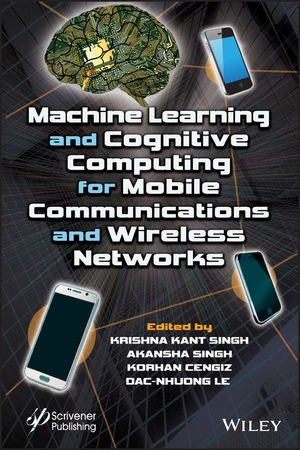
Machine Learning and Cognitive Computing for Mobile Communications and Wireless Networks
Communication and network technology has witnessed recent rapid development and numerous information services and applications have been developed globally. These technologies have high impact on society and the way people are leading their lives. The advancement in technology has undoubtedly improved the quality of service and user experience yet a lot needs to be still done. Some areas that still need improvement include seamless wide-area coverage, high-capacity hot-spots, low-power massive-connections, low-latency and high-reliability and so on. Thus, it is highly desirable to develop smart technologies for communication to improve the overall services and management of wireless communication. Machine learning and cognitive computing have converged to give some groundbreaking solutions for smart machines. With these two technologies coming together, the machines can acquire the ability to reason similar to the human brain. The research area of machine learning and cognitive computing cover many fields like psychology, biology, signal processing, physics, information theory, mathematics, and statistics that can be used effectively for topology management. Therefore, the utilization of machine learning techniques like data analytics and cognitive power will lead to better performance of communication and wireless systems.

Artificial Intelligent Techniques for Wireless Communication and Networking
Wireless communication and networking based on AI concepts and techniques are explored in this book, specifically focusing on the current research in the field by highlighting empirical results along with theoretical concepts. The possibility of applying AI mechanisms towards security aspects in the communication domain is elaborated; also explored is the application side of integrated technologies that enhance AI-based innovations, insights, intelligent predictions, cost optimization, inventory management, identification processes, classification mechanisms, cooperative spectrum sensing techniques, ad-hoc network architecture, and protocol and simulation-based environments.
