



الصفحة 1
الصفحة 1

Introduction to Relativistic Continuum Mechanics
This mathematically-oriented introduction takes the point of view that students should become familiar, at an early stage, with the physics of relativistic continua and thermodynamics within the framework of special relativity. Therefore, in addition to standard textbook topics such as relativistic kinematics and vacuum electrodynamics, the reader will be thoroughly introduced to relativistic continuum and fluid mechanics. Emphasis in the presentation is on the 3+1 splitting technique, widely used in general relativity for introducing the relative observers point of view.

Gravity, Black Holes, and the Very Early Universe : An Introduction to General Relativity and Cosmology
In the early 1900s, Albert Einstein formulated two theories that would forever change the landscape of physics: the Special Theory of Relativity and the General Theory of Relativity. By 1925, quantum mechanics had been born out of the dissection of these two theories, and shortly after that, relativistic quantum field theory. We now had in place some important ties between the laws of physics and the types of particle interactions the new physics was uncovering. Gravity is one of the four types of forces that are found throughout the universe. In fact, although it is a relatively weak force, it operates at huge distances, and so must be accounted for in any cosmological system. Unfortunately, gravity continues to defy our neat categorization of how all the forces in nature work together.

Galaxy Formation
This second edition of Galaxy Formation is an up-to-date text on astrophysical cosmology, expounding the structure of the classical cosmological models from a contemporary viewpoint. This forms the background to a detailed study of the origin of structure and galaxies in the Universe. The derivations of many of the most important results are derived by simple physical arguments which illuminate the results of more advanced treatments. A very wide range of observational data is brought to bear upon these problems, including the most recent results from WMAP, the Hubble Space Telescope, galaxy surveys like the Sloan Digital Sky Survey and the 2dF Galaxy Redshift Survey, studies of Type 1a supernovae, and many other observations.

First Light in the Universe : Saas-Fee Advanced Course 36. Swiss Society for Astrophysics and Astronomy
The exploration of the first billion years of the history of the Universe, from the so-called Dark Ages to cosmic reionisation, represents one of the great challenges of contemporary astrophysics and one of the main drivers for future observational facilities. The book contains the elaborated notes of lectures given at the 36th Saas-Fee Advanced Course "First Light in the Universe" by three eminent scientists in the field: Abraham Loeb, Andrea Ferrara, and Richard Ellis. The formation of the first stars and black holes, the initial mass function, feedback effects, early dust formation, the history of cosmic star formation, distant galaxies, cosmic reionisation and the cosmic infrared background are the main topics treated. This book provides an accessible and up-to-date review of the field and will be useful to graduate students of astronomy, cosmologists, physicists and researchers.
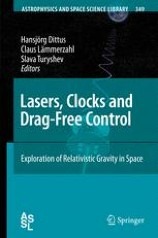
Lasers, Clocks and Drag-Free Control : Exploration of Relativistic Gravity in Space
Over the next decade the gravitational physics community will benefit from dramatic improvements in many technologies critical to testing gravity. Highly accurate deep space navigation, interplanetary laser communication, interferometry and metrology, high precision frequency standards, precise pointing and attitude control, together with drag-free technologies, will revolutionize the field of experimental gravitational physics. The centennial of the general theory of relativity in 2015 will motivate a significant number of experiments designed to test this theory with unprecedented accuracy.
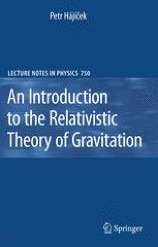
An Introduction to the Relativistic Theory of Gravitation
The geometric interpretation of gravitation is one of the major foundations of modern theoretical physics. This primer introduces classical general relativity with emphasis on the clarity of conceptual structure and on the basic mathematical methods to build up systematically application skills. The wealth of physical phenomena entailed by the Einstein‘s equations is revealed with the help of specific models describing gravitomagnetism, gravitational waves, cosmology, gravitational collapse and black holes. End-of-chapter exercises complete the main text.
