



الصفحة 1
الصفحة 1

New Aspects of Zirconium Containing Organic Compounds
Metal carbene complexes have made their way from organometallic curiosities to valuable reagents and catalysts. They offer novel synthetic opportunities in carbon-carbon bond formation based on either carbene-centered reactions or on metal-templated processes which makes them indispensable in modern synthetic methodology. The most prominent metal carbenes are now either commercially available or easy to synthesize and handle with modern laboratory techniques. This volume organized in eight chapters written by the leading scientists in the field illustrates the theoretical background, non-classical nucleophilic and cycloaddition patterns, chromium-templated benzannulation and photo-induced reactions, rhodium-catalyzed carbene transfer as well as the principles and applications of olefin metathesis which has coined the progress in synthetic methodology over the past decade. Designed for researchers in academia and industry as well as graduate students it presents the state-of-the-art potential of carbene complexes in modern organic synthesis.
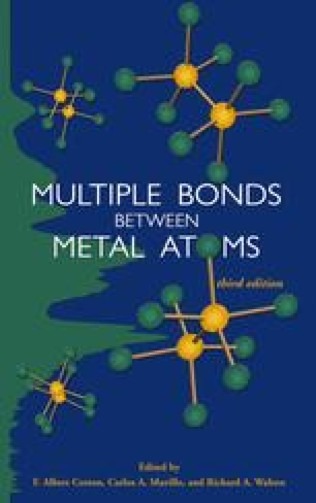
Multiple Bonds between Metal Atoms
The 3rd edition of the Multiple Bonds between Metal Atoms deals with one of the most active fields of inorganic chemistry … . It presents an extensive, critical review and discussion of preparations, reactions, bonding, and physical properties of more than 4000 compounds … heartily recommend it to inorganic and materials chemists, and to all scientists concerned with the synthesis, spectroscopy, and structures of transition-metal compounds. It also belongs in academic, industrial, and government research libraries.

Metals in Society and in the Environment : A Critical Review of Current Knowledge on Fluxes, Speciation, Bioavailability and Risk for Adverse Effects of Copper, Chromium, Nickel and Zinc
In 2002, the Swedish Metal Information Task Force (MITF) engaged the Environmental Research Group (MFG) to update previous monographs on copper, zinc and major alloying metals (such as chromium, nickel and molybdenum) in society and in the environment. This book presents new results on metal fluxes from society to the environment, on metal speciation in water, soil and sediment, and its interpretation in terms of mobility, biological uptake and toxicity. The scientific fundamentals of new approaches, like the Acid Volatile Sulphide (AVS) concept to predict metal bioavailability in sediments, and the Biotic Ligand Model (BLM) to calculate the toxicity of metals to aquatic organisms, are critically evaluated, with a focus on copper, nickel, zinc, and, in part, chromium.
