



الصفحة 1
الصفحة 1

Money, Banking, and Financial Markets : A Modern Introduction to Macroeconomics
Introduction to money, banking, and financial markets, with a special emphasis on the importance of confidence and trust in the macroeconomic system. It also presents the theory of endogenous money creation, in contrast to the standard money multiplier and fractional reserve explanation found in other textbooks. The U.S. economy and financial institutions are used to explain the theoretical and practical framework, with international examples weaved in throughout the text. It covers key topics including monetary policy, fiscal policy, accounting principles, credit creation, central banks, and government treasuries. Additionally, the book considers the international economy, including exchange rates, the Eurozone, Chinese monetary policy, and reserve currencies. Taking a broad look at the financial system, it also looks at banking regulation, cryptocurrencies, real estate, and the oil and gold commodity markets. Students are supported with chapter objectives, key terms, and problems.

Introduction to Central Banking
This book gives a concise introduction to the practical implementation of monetary policy by modern central banks. It describes the conventional instruments used in advanced economies and the unconventional instruments that have been widely adopted since the financial crisis of 2007–2008. Illuminating the role of central banks in ensuring financial stability and as last resort lenders, it also offers an overview of the international monetary framework. A flow-of-funds framework is used throughout to capture this essential dimension in a consistent and unifying manner, providing a unique and accessible resource on central banking and monetary policy, and its integration with financial stability.

Hot Property : The Housing Market in Major Cities
This book discusses booming housing markets in cities around the globe, and the resulting challenges for policymakers and central banks. Cities are booming everywhere, leading to a growing demand for urban housing. In many cities this demand is out-pacing supply, which causes house prices to soar and increases the pressure on rental markets. These developments are posing major challenges for policymakers, central banks and other authorities responsible for ensuring financial stability, and economic well-being in general. This volume collects views from high-level policymakers and researchers, providing essential insights into these challenges, their impact on society, the economy and financial stability, and possible policy responses. The respective chapters address issues such as the popularity of cities, the question of a credit-fueled housing bubble, the role of housing supply frictions and potential policy solutions. Given its scope, the book offers a revealing read and valuable guide for everyone involved in practical policymaking for housing markets, mortgage credit and financial stability.
Long-Run Growth Forecasting
Explores how to set up an empirical model that helps with forecasting long-term economic growth in a large number of countries. It offers a systematic approach to models of potential GDP that can also be used for forecasts of more than a decade. It is an attempt to fill the wide gap between the high demand for such models by commercial banks, international organizations, central banks and governments on the one hand and the limited supply on the other hand. Frequent forecast failures in the past (e.g. Japan 1990, Asia 1997) and the heavy economic losses they produced motivated the work. The book assesses the large number of different theories of economic growth, the drivers of economic growth, the available datasets and the empirical methods on offer. A preference is shown for evolutionary models and an augmented Kaldor model. The book uses non-stationary panel techniques to find pair-wise cointegration among GDP per capita and its main correlates such as physical capital, human capital and openness.

IT Security Controls : A Guide to Corporate Standards and Frameworks
Gives an overview of the major standards and frameworks, and a proposed architecture to meet them. The book identifies and describes the necessary controls and processes that must be implemented in order to secure your organization's infrastructure. The book proposes a comprehensive approach to the implementation of IT security controls with an easily understandable graphic implementation proposal to comply with the most relevant market standards (ISO 27001, NIST, PCI-DSS, and COBIT) and a significant number of regulatory frameworks from central banks across the World (European Union, Switzerland, UK, Singapore, Hong Kong, India, Qatar, Kuwait, Saudi Arabia, Oman, etc.). You will learn: Understand corporate IT security controls, including governance, policies, procedures, and security awareness Know cybersecurity and risk assessment techniques such as penetration testing, red teaming, compliance scans, firewall assurance, and vulnerability scans Understand technical IT security controls for unmanaged and managed devices, and perimeter controls Implement security testing tools such as steganography, vulnerability scanners, session hijacking, intrusion detection, and more
Challenges for Central Banks in an Enlarged EMU
In this book, a set of internationally renowned economists from both sides of the Atlantic analyse the challenges that lie in front of the EU as it used to be, the hurdles that have to be cleared by possible candidates, and the impact of these developments on important economic sectors like the financial markets, etc. The scientists are supported by Central Bankers from current and future Euro-zone members who give their views on the problems and chances of Euro-accession. The book is thus providing an overall view of the major developments regarding the Euro in the years to come.
Challenges at the bank for international settlements : An economist's (Re)View
This book reveals, next to monetary policy and financial crisis, less well known topics such as insolvency, collective action clauses, international mediation and management of central banks.
Building a Cashless Society : The Swedish Route to the Future of Cash Payments
This book tells the story of how Sweden is becoming a virtually cashless society. Its goal is to improve readers’ understanding of what is driving this transition, and of the factors that are fostering and hampering it. In doing so, the book covers the role of central banks, political factors, needs for innovation, and the stakeholders involved in developing a cashless ecosystem. Adopting a historical standpoint, and drawing on a unique dataset, it presents an academic perspective on Sweden’s leading role in this global trend. The global interest in the future of cash payments makes the Swedish case particularly interesting. As a country that is close to becoming a cashless economy, it offers a role model for many other countries to learn from - whether they want to stimulate or reduce the use of cash. This highly topical book will be of interest to politicians, researchers, businesses, financial service providers and payment service providers, as well as fintech start-ups, regulators and other authorities.
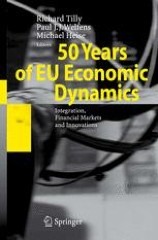
50 Years of EU Economic Dynamics : Integration, Financial Markets and Innovations
On the occasion of the 50th anniversary of the European Union experts present their analyses of historical developments and new economic challenges for the EU. After a reflection on historical dynamics, the contributors point out the dramatic economic shifts between Europe, Asia and the US. Representatives from major central banks (including the ECB), other leading banks, and academia analyze the dynamics of the Eurozone and financial market integration in the context of globalization and economic growth. Furthermore, the authors discuss the challenges of information and communication technologies by means of various country analyses. Moreover, the Schumpeterian prospects for Europe and the Lisbon Agenda, the long-term challenges of EU pension reforms, emission trading systems in the EU, and options for a new EU constitution are highlighted. At the bottom line of this EU analysis are major implications for investors, managers, policy-makers and the public at large in both the EU and the global economy.
