



الصفحة 1
الصفحة 1
Methods of Celestial Mechanics: Vol. I: Physical, Mathematical, and Numerical Principles
G. Beutler's Methods of Celestial Mechanics is a coherent textbook for students in physics, mathematics and engineering as well as an excellent reference for practitioners. This Volume I gives a thorough treatment of celestial mechanics and presents all the necessary mathematical details that a professional would need. After a brief review of the history of celestial mechanics, the equations of motion (Newtonian and relativistic versions) are developed for planetary systems (N-body-problem), for artificial Earth satellites, and for extended bodies (which includes the problem of Earth and lunar rotation). Perturbation theory is outlined in an elementary way from generally known mathematical principles without making use of the advanced tools of analytical mechanics. The variational equations associated with orbital motion - of fundamental importance for parameter estimation (e.g., orbit determination), numerical error propagation, and stability considerations - are introduced and their properties discussed in considerable detail. Numerical methods, especially for orbit determination and orbit improvement, are discussed in considerable depth. The algorithms may be easily applied to objects of the planetary system and to Earth satellites and space debris.

Methods of Celestial Mechanics ; Vol. II : Application to Planetary System, Geodynamics and Satellite Geodesy
G. Beutler's Methods of Celestial Mechanics is a coherent textbook for students as well as an excellent reference for practitioners. Volume II is devoted to the applications and to the presentation of the program system CelestialMechanics. Three major areas of applications are covered: (1) Orbital and rotational motion of extended celestial bodies. The properties of the Earth-Moon system are developed from the simplest case (rigid bodies) to more general cases, including the rotation of an elastic Earth, the rotation of an Earth partly covered by oceans and surrounded by an atmosphere, and the rotation of an Earth composed of a liquid core and a rigid shell (Poincaré model). (2) Artificial Earth Satellites. The oblateness perturbation acting on a satellite and the exploitation of its properties in practice is discussed using simulation methods (CelestialMechanics) and (simplified) first order perturbation methods. The perturbations due to the higher-order terms of the Earth's gravitational potential and resonant perturbations are considered thereafter. Special attention is paid to satellites of the Global Navigation Satellite Systems and to geostationary satellites. The characteristics of and models for the two most important non-gravitational forces, atmospheric drag and radiation pressure, are presented as well as the most relevant forces acting on high- and low-orbiting satellites. (3) Evolution of the Planetary System. The outer planetary system consisting of the planets Jupiter to Pluto is studied over long time intervals using simulation methods and spectral analysis (CelestialMechanics). The properties of the inner systems, in particular of the Earth's orbit, are made visible by integrating the entire system over long time intervals relevant for climate change. The distribution of minor planets and their orbital properties, regular orbits, and chaotic orbits are easily generated and analyzed using CelestialMechanics. The volume concludes with the discussion of important mathematical tools of the program system and of the principles of spectral analysis.

Mécanique céleste et contrôle des véhicules spatiaux = Celestial mechanics and spacecraft control
The textbook contains two parts: Part 1 is an introduction to celestial mechanics, and part II is devoted to the control of cosmic vehicles motion.The book is written in a clear mathematical style-Definition-Proposition-Lemma-Theorem-Corollary-and is almost self contained.

Introduction to Planetary Science : The Geological Perspective
This textbook is intended to be used in a lecture course for college students majoring in the Earth Sciences. Planetary Science provides an opportunity for these students to apply a wide range of subject matter pertaining to the Earth to the study of other planets of the solar system and their principal satellites. As a result, students gain a wider perspective of the different worlds that are accessible to us and they are led to recognize the Earth as the only oasis in space where we can live without life-support systems.The subject matter is presented in 24 chapters that lead the reader through the solar system starting with historical perspectives on space exploration and the development of the scientific method. The presentations concerning the planets and their satellites emphasize that their origin and subsequent evolution can be explained by applications of certain basic principles of physics, chemistry, and celestial mechanics and that the surface features of the solid bodies in the solar system can be interpreted by means of the principles of geology.

Integrable Systems in Celestial Mechanics
This work presents a unified treatment of three important integrable problems relevant to both Celestial and Quantum Mechanics. Under discussion are the Kepler (two-body) problem and the Euler (two-fixed center) problem, the latter being the more complex and more instructive, as it exhibits a richer and more varied solution structure. Further, because of the interesting investigations by the 20th century mathematical physicist J.P. Vinti, the Euler problem is now recognized as being intimately linked to the Vinti (Earth-satellite) problem. Here the analysis of these problems is shown to follow a definite shared pattern yielding exact forms for the solutions. A central feature is the detailed treatment of the planar Euler problem where the solutions are expressed in terms of Jacobian elliptic functions, yielding analytic representations for the orbits over the entire parameter range.

Dynamics of extended celestial bodies and rings
Taking both a theoretical and observational perspective, this book is an introduction to recent developments in the field of celestial mechanics. It emphasizes the application to extended celestial bodies and devotes much attention to rotational aspects. In particular, it explains the state of art for accurate modelling of the rotation of celestial bodies such as the Earth, the Moon, and Mercury, which involves principles related to hydrodynamics and geodesy. Comparisons between the light curves of the asteroids and their rotational state are made and spatial techniques leading to the determination of the Earth's gravitational field are explained. Also, the book provides a general overview of the collisional processes in the solar system and of the dynamics of the rings. It is addressed to graduate students and researchers in space sciences and celestial dynamics.

Construction of Mappings for Hamiltonian Systems and Their Applications
Based on the method of canonical transformation of variables and the classical perturbation theory, this innovative book treats the systematic theory of symplectic mappings for Hamiltonian systems and its application to the study of the dynamics and chaos of various physical problems described by Hamiltonian systems. It develops a new, mathematically-rigorous method to construct symplectic mappings which replaces the dynamics of continuous Hamiltonian systems by the discrete ones. Applications of the mapping methods encompass the chaos theory in non-twist and non-smooth dynamical systems, the structure and chaotic transport in the stochastic layer, the magnetic field lines in magnetically confinement devices of plasmas, ray dynamics in waveguides, etc. The book is intended for postgraduate students and researches, physicists and astronomers working in the areas of plasma physics, hydrodynamics, celestial mechanics, dynamical astronomy, and accelerator physics. It should also be useful for applied mathematicians involved in analytical and numerical studies of dynamical systems.

Computer algebra in scientific computing ; 22nd International Workshop, CASC 2020, Linz, Austria, September 14–18, 2020, Proceedings
This book constitutes the refereed proceedings of the 22nd International Workshop on Computer Algebra in Scientific Computing, CASC 2020, held in Linz, Austria, in September 2020. The conference was held virtually due to the COVID-19 pandemic. The 34 full papers presented together with 2 invited talks were carefully reviewed and selected from 41 submissions. They deal with cutting-edge research in all major disciplines of computer algebra. The papers cover topics such as polynomial algebra, symbolic and symbolic-numerical computation, applications of symbolic computation for investigating and solving ordinary differential equations, applications of CAS in the investigation and solution of celestial mechanics problems, and in mechanics, physics, and robotics.

Comets : Nature, Dynamics, Origin, and their Cosmogonical Relevance
The book covers the most recent ideas about the nature and dynamics of comets, including a thorough discussion on Oort cloud dynamics which has not received due attention in other books on the subject. It also discusses the most relevant aspects of the physics and chemistry of comet nuclei, highlighting their importance as relics of the protoplanetary disk and, perhaps, as carriers of water and organics that permitted the development of life on Earth. The book contains several tables with useful data, and an ample bibliography covering the most recent work as well as some historical key contributions to the subject. It may be suitable as a textbook for graduate students with some basic knowledge of celestial mechanics and astrophysics, as well as a consult book for comet researchers, or researchers from other related fields willing to start working on comets, or get an updated view of the subject.
Mathematical Aspects of Classical and Celestial Mechanics
In this book we describe the basic principles, problems, and methods of clssical mechanics. Our main attention is devoted to the mathematical side of the subject. Although the physical background of the models considered here and the applied aspects of the phenomena studied in this book are explored to a considerably lesser extent, we have tried to set forth first and foremost the “working” apparatus of classical mechanics. This apparatus is contained mainly in Chapters 1, 3, 5, 6, and 8. Chapter 1 is devoted to the basic mathematical models of classical - chanics that are usually used for describing the motion of real mechanical systems. Special attention is given to the study of motion with constraints and to the problems of realization of constraints in dynamics. In Chapter 3 we discuss symmetry groups of mechanical systems and the corresponding conservation laws. We also expound various aspects of ord- reduction theory for systems with symmetries, which is often used in appli- tions. Chapter 4 is devoted to variational principles and methods of classical mechanics. They allow one, in particular, to obtain non-trivial results on the existence of periodic trajectories. Special attention is given to the case where the region of possible motion has a non-empty boundary. Applications of the variational methods to the theory of stability of motion are indicated.
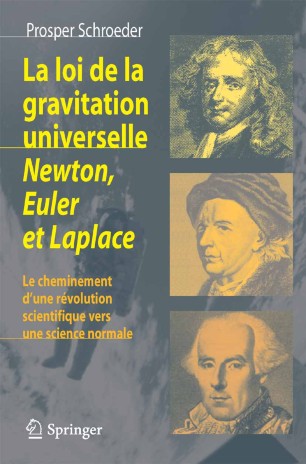
La loi de la gravitation universelle Newton, Euler et Laplace : Le cheminement d’une révolution scientifique vers une science normale = The law of universal gravitation Newton, Euler and Laplace : The progress of a scientific revolution towards a normal science
An analysis of Newton's ideas dismisses this hypothesis by the simple fact that the Principia sought to demonstrate the fallacy of earlier approaches. However, Newton suffered a failure in the application of his theory of gravitation to the explanation of the movement of the Moon, failure which marked the development of celestial mechanics throughout the 18th century. Clairaut, d'Alembert and Euler doubted the validity of Newtonian law almost at the same time and their ideas advanced celestial mechanics which reached the state of "normal science" with Laplace's treatise on celestial mechanics, a century after Newton.
Chaos and Stability in Planetary Systems
This book is intended as an introduction to the field of planetary systems at the postgraduate level. It consists of four extensive lectures on Hamiltonian dynamics, celestial mechanics, the structure of extrasolar planetary systems and the formation of planets. As such, this volume is particularly suitable for those who need to understand the substantial connections between these different topics.
Celestial Mechanics : The Waltz of the Planets
Contents are divided into major topics where the three "souls" of modern celestial mechanics (dynamical systems, Solar System and stellar systems, spaceflight dynamics) play a major role.
Canonical Perturbation Theories, Degenerate Systems, and Resonance
Canonical Perturbation Theories, Degenerate Systems and Resonance presents the foundations of Hamiltonian Perturbation Theories used in Celestial Mechanics, emphasizing the Lie Series Theory and its application to degenerate systems and resonance. This book is the complete text on the subject including advanced topics in Hamiltonian Mechanics, Hori’s Theory, and the classical theories of Poincaré, von Zeipel-Brouwer, and Delaunay.
African Cultural Astronomy : Current Archaeoastronomy and Ethnoastronomy research in Africa
Astronomy is the science of studying the sky using telescopes and light collectors such as photographic plates or CCD detectors. However, people have always studied the sky and continue to study the sky without the aid of instruments this is the realm of cultural astronomy. This is the first scholarly collection of articles focused on the cultural astronomy of Africans. It weaves together astronomy, anthropology, and Africa. The volume includes African myths and legends about the sky, alignments to celestial bodies found at archaeological sites and at places of worship, rock art with celestial imagery, and scientific thinking revealed in local astronomy traditions including ethnomathematics and the creation of calendars. Authors include astronomers Kim Malville, Johnson Urama, and Thebe Medupe; archaeologist Felix Chami, and geographer Michael Bonine, and many new authors.

A Comparison of the Dynamical Evolution of Planetary Systems ; Proceedings of the Sixth Alexander von Humboldt Colloquium on Celestial Mechanics Bad Hofgastein (Austria), 21-27 March 2004
The papers in this volume cover a wide range of subjects covering the most recent developments in Celestial Mechanics from the theoretical point of nonlinear dynamical systems to the application to real problems. We emphasize the papers on the formation of planetary systems, their stability and also the problem of habitable zones in extrasolar planetary systems. A special topic is the stability of Trojans in our planetary system, where more and more realistic dynamical models are used to explain their complex motions: besides the important contribution from the theoretical point of view, the results of several numerical experiments unraveled the structure of the stable zone around the librations points. This volume will be of interest to astronomers and mathematicians interested in Hamiltonian mechanics and in the dynamics of planetary systems.
