



الصفحة 1
الصفحة 1

Introduction to Stochastic Integration
The theory of stochastic integration, also called the Ito calculus, has a large spectrum of applications in virtually every scientific area involving random functions, but it can be a very difficult subject for people without much mathematical background. The Ito calculus was originally motivated by the construction of Markov diffusion processes from infinitesimal generators. Previously, the construction of such processes required several steps, whereas Ito constructed these diffusion processes directly in a single step as the solutions of stochastic integral equations associated with the infinitesimal generators. Moreover, the properties of these diffusion processes can be derived from the stochastic integral equations and the Ito formula. This introductory textbook on stochastic integration provides a concise introduction to the Ito calculus

Interacting Stochastic Systems
The Research Network on "Interacting stochastic systems of high complexity" set up by the German Research Foundation aimed at exploring and developing connections between research in infinite-dimensional stochastic analysis, statistical physics, spatial population models from mathematical biology, complex models of financial markets or of stochastic models interacting with other sciences. This book presents a structured collection of papers on the core topics, written at the close of the 6-year programme by the research groups who took part in it. The structure chosen highlights the interweaving of certain themes and certain interconnections discovered through the joint work.

In Memoriam Paul-André Meyer - Séminaire de Probabilités XXXIX
The 39th volume of Séminaire de Probabilités is a tribute to the memory of Paul André Meyer. His life and achievements are recalled in this book, and tributes are paid by his friends and colleagues. This volume also contains mathematical contributions to classical and quantum stochastic calculus, the theory of processes, martingales and their applications to mathematical finance and Brownian motion. These contributions provide an overview on the current trends of stochastic calculus.

In and Out of Equilibrium 2
The intersection of probability and physics has been a rich and explosive area of growth in the past three decades, specifically covering such subjects as percolation theory, random walks in random environment, disordered systems, interacting particle systems and their many connections to statistical mechanics. The last decade was particularly fruitful for all these topics. This book reflects this development and marks also the first decade of the Brazilian School of Probability. This volume consists of a collection of invited articles, written by some of the most distinguished probabilists, most of whom have been personally responsible for advances in the various subfields of probability.

Fractional-in-time semilinear parabolic equations and applications
This book provides a unified analysis and scheme for the existence and uniqueness of strong and mild solutions to certain fractional kinetic equations. This class of equations is characterized by the presence of a nonlinear time-dependent source, generally of arbitrary growth in the unknown function, a time derivative in the sense of Caputo and the presence of a large class of diffusion operators. The global regularity problem is then treated separately and the analysis is extended to some systems of fractional kinetic equations, including prey-predator models of Volterra–Lotka type and chemical reactions models, all of them possibly containing some fractional kinetics.

Financial Markets in Continuous Time
In modern financial practice, asset prices are modelled by means of stochastic processes, and continuous-time stochastic calculus thus plays a central role in financial modelling. This approach has its roots in the foundational work of the Nobel laureates Black, Scholes and Merton. Asset prices are further assumed to be rationalizable, that is, determined by equality of demand and supply on some market. This approach has its roots in the foundational work on General Equilibrium of the Nobel laureates Arrow and Debreu and in the work of McKenzie. This book has four parts.

Extreme Value Theory : An Introduction
Extreme Value Theory offers a careful, coherent exposition of the subject starting from the probabilistic and mathematical foundations and proceeding to the statistical theory. The book covers both the classical one-dimensional case as well as finite- and infinite-dimensional settings. All the main topics at the heart of the subject are introduced in a systematic fashion so that in the final chapter even the most recent developments in the theory can be understood. The treatment is geared toward applications. The presentation concentrates on the probabilistic and statistical aspects of extreme values such as limiting results, domains of attraction and development of estimators without emphasizing related topics such as point processes, empirical distribution functions and Brownian motion.

Einstein, 1905-2005 : Poincaré Seminar 2005
This volume is devoted to Einstein's 1905 papers and their legacy. After a presentation of Einstein's epistemological approach to physics, and the genesis of special relativity, a centenary perspective is offered. The geometry of relativistic spacetime is explained in detail. Single photon experiments are presented, as a spectacular realization of Einstein's light quanta hypothesis. A previously unpublished lecture by Einstein, which presents an illuminating point of view on statistical physics in 1910, at the dawn of quantum mechanics, is reproduced. The volume ends with an essay on the historical, physical and mathematical aspects of Brownian motion.

Controlled Nanoscale Motion : Nobel Symposium 131
This volume provides an introduction to the state-of-the-art of controlled nanoscale motion in biological and artificial systems. Topics include the control and function of protein motors, the physics of non-equilibrium Brownian motion, and the physics and fabrication of synthetic molecular motors.

Continuous time processes for finance : Switching, self-exciting, fractional and other recent dynamics
This book explores recent topics in quantitative finance with an emphasis on applications and calibration to time-series. This last aspect is often neglected in the existing mathematical finance literature while it is crucial for risk management. The first part of this book focuses on switching regime processes that allow to model economic cycles in financial markets. After a presentation of their mathematical features and applications to stocks and interest rates, the estimation with the Hamilton filter and Markov Chain Monte-Carlo algorithm (MCMC) is detailed. A second part focuses on self-excited processes for modeling the clustering of shocks in financial markets.

Combinatorial Stochastic Processes : Ecole d'Eté de Probabilités de Saint-Flour XXXII - 2002
This volume contains the course “Combinatorial stochastic processes” of Professor Pitman. We cordially thank the author for his performance in Saint-Flour and for these notesThere is particular focus on the theory of random combinatorial structures such as partitions, permutations, trees, forests, and mappings, and connections between the asymptotic theory of enumeration of such structures and the theory of stochastic processes like Brownian motion and Poisson processes.

Markov Processes, Brownian Motion, and Time Symmetry
The book consists of two parts. Part I,This part introduces strong Markov processes and their potential theory. In particular,it studies Brownian motion, and shows how it generates classical potential theory.Part II, focus on the effects of time reversal, duality, and time-symmetry on potential theory. Certain theorems in Part I are re-proved in Part II under slightly weaker hypotheses. The volume is very useful for people who wish to learn Markov processes but it seems to the reviewer that it is also of great interest to specialists in this area who could derive much stimulus from it. One can be convinced that it will receive wide circulation." (Mathematical Reviews)
Malliavin Calculus for Lévy Processes with Applications to Finance
While the original works on Malliavin calculus aimed to study the smoothness of densities of solutions to stochastic differential equations, this book has another goal. It portrays the most important and innovative applications in stochastic control and finance, such as hedging in complete and incomplete markets, optimisation in the presence of asymmetric information and also pricing and sensitivity analysis. In a self-contained fashion, both the Malliavin calculus with respect to Brownian motion and general Lévy type of noise are treated. Besides, forward integration is included and indeed extended to general Lévy processes. The forward integration is a recent development within anticipative stochastic calculus that, together with the Malliavin calculus, provides new methods for the study of insider trading problems.
Lectures on Probability Theory and Statistics : Ecole d'Eté de Probabilités de Saint-Flour XXXIII - 2003
Contains two of the three lectures that were given at the 33rd Probability Summer School in Saint-Flour (July 6-23, 2003). Amir Dembo’s course is devoted to recent studies of the fractal nature of random sets, focusing on some fine properties of the sample path of random walk and Brownian motion. In particular, the cover time for Markov chains, the dimension of discrete limsup random fractals, the multi-scale truncated second moment and the Ciesielski-Taylor identities are explored. Tadahisa Funaki’s course reviews recent developments of the mathematical theory on stochastic interface models, mostly on the so-called nabla varphi interface model. The results are formulated as classical limit theorems in probability theory, and the text serves with good applications of basic probability techniques.
Aspects of Mathematical Finance
Considering the stupendous gain in importance, in the banking and insurance industries since the early 1990’s, of mathematical methodology, especially probabilistic methodology, it was a very natural idea for the French "Académie des Sciences" to propose a series of public lectures, accessible to an educated audience, to promote a wider understanding for some of the fundamental ideas, techniques and new tools of the financial industries. These lectures were given at the "Académie des Sciences" in Paris by internationally renowned experts in mathematical finance, and later written up for this volume which develops, in simple yet rigorous terms, some challenging topics such as risk measures, the notion of arbitrage, dynamic models involving fundamental stochastic processes like Brownian motion and Lévy processes.
Aspects of Brownian motion
Stochastic calculus and excursion theory are very efficient tools to obtain either exact or asymptotic results about Brownian motion and related processes. The emphasis of this book is on special classes of such Brownian functionals as: - Gaussian subspaces of the Gaussian space of Brownian motion; - Brownian quadratic funtionals; - Brownian local times, - Exponential functionals of Brownian motion with drift; - Winding number of one or several Brownian motions around one or several points or a straight line, or curves; - Time spent by Brownian motion below a multiple of its one-sided supremum.
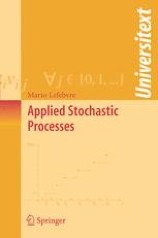
Applied Stochastic Processes
Applied Stochastic Processes uses a distinctly applied framework to present the most important topics in the field of stochastic processes.
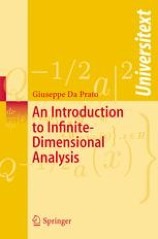
An Introduction to Infinite-Dimensional Analysis
In this revised and extended version of his course notes from a 1-year course at Scuola Normale Superiore, Pisa, the author provides an introduction – for an audience knowing basic functional analysis and measure theory but not necessarily probability theory – to analysis in a separable Hilbert space of infinite dimension.Starting from the definition of Gaussian measures in Hilbert spaces, concepts such as the Cameron-Martin formula, Brownian motion and Wiener integral are introduced in a simple way. These concepts are then used to illustrate some basic stochastic dynamical systems (including dissipative nonlinearities) and Markov semi-groups, paying special attention to their long-time behavior: ergodicity, invariant measure. Here fundamental results like the theorems of Prokhorov, Von Neumann, Krylov-Bogoliubov and Khas'minski are proved. The last chapter is devoted to gradient systems and their asymptotic behavior.
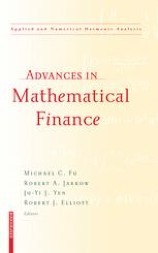
Advances in Mathematical Finance
This volume brings together a collection of chapters by some of the most distinguished researchers and practitioners in the fields of mathematical finance and financial engineering. Presenting state-of-the-art developments in theory and practice.
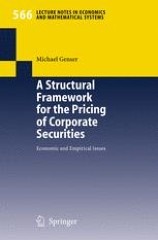
A Structural Framework for the Pricing of Corporate Securities : Economic and Empirical Issues
This book is the first comprehensive treatment, of structural credit risk models for the simultaneous and consistent pricing of corporate securities. Through the development of a flexible economic framework based on the firm's EBIT, the reader is taken from the economic principles of firm value models to the empirical implementation. Analytical solutions are provided, if EBIT follows an arithmetic or geometric Brownian motion.
