



الصفحة 1
الصفحة 1

Neutrinos and Explosive Events in the Universe
“Neutrinos and Explosive Events in the Universe” brought together experts from diverse disciplines to offer a detailed view of the exciting new work in this part of High Energy Astrophysics. Sponsored by NATO as an Advanced Study Institute, and coordinated under the auspices of the International School of Cosmic Ray Astrophysics (14th biennial course), the ASI featured a full program of lectures and discussion in the ambiance of the Ettore Majorana Centre in Erice, Italy, including visits to the local Dirac and Chalonge museum collections as well as a view of the cultural heritage of southern Sicily. Enri- ment presentations on results from the Spitzer Infrared Space Telescope and the Origin of Complexity complemented the program. This course was the best attended in the almost 30 year history of the School with 121 participants from 22 countries. The program provided a rich ex- rience, both introductory and advanced, to fascinating areas of observational Astrophysics Neutrino Astronomy, High Energy Gamma Ray Astronomy, P- ticle Astrophysics and the objects most likely responsible for the signals - plosions and related phenomena, ranging from Supernovae to Black Holes to the Big Bang. Contained in this NATO Science Series volume is a summative formulation of the physics and astrophysics of this newly emerging research area that already has been, and will continue to be, an important contributor to understanding our high energy universe.

Growing Black Holes: Accretion in a Cosmological Context ; Proceedings of the MPA/ESO/MPE/USM Joint Astronomy Conference Held at Garching, Germany, 21-25 June 2004
Supermassive black holes are now believed to play an important role in the evolution of the Universe. Every respectable galaxy hosts in its center a black hole that appears to regulate the growth of the galaxy itself. In this book, leading experts in the field review the most recent theoretical and observational results on the following topics: * formation and growth of the first black holes in the Universe and their role in the formation and evolution of galaxies * the physics of black-hole accretion and the production of relativistic jets * binary black-hole mergers and gravitational radiation. Theoretical work is supplemented by the most recent exciting results from space and ground based observatories. This volume is useful research and reference tool for the entire astrophysical community.

Gravity, Black Holes, and the Very Early Universe : An Introduction to General Relativity and Cosmology
In the early 1900s, Albert Einstein formulated two theories that would forever change the landscape of physics: the Special Theory of Relativity and the General Theory of Relativity. By 1925, quantum mechanics had been born out of the dissection of these two theories, and shortly after that, relativistic quantum field theory. We now had in place some important ties between the laws of physics and the types of particle interactions the new physics was uncovering. Gravity is one of the four types of forces that are found throughout the universe. In fact, although it is a relatively weak force, it operates at huge distances, and so must be accounted for in any cosmological system. Unfortunately, gravity continues to defy our neat categorization of how all the forces in nature work together.

General Relativity
This book offers an alternative to other textbooks on the subject, providing a more specific discussion of numerous general relativistic effects for readers who have knowledge of classical mechanics and electrodynamics, including special relativity. Coverage includes gravitational lensing, signal retardation in the gravitational field of the Sun, the Reissner-Nordström solution, selected spin effects, the resonance transformation of an electromagnetic wave into a gravitational one, and the entropy and temperature of black holes. The book includes numerous problems at various levels of difficulty, making it ideal also for independent study by a broad readership of advanced students and researchers.

Galaxies in Turmoil : The Active and Starburst Galaxies and the Black Holes That Drive Them
Active galaxies involve some of the most extreme conditions and some of the most intriguing phenomena found anywhere in the universe. Research students - and even established research astronomers - will also find this book invaluable as a quick reference to the properties of, and phenomena within, those types of active galaxies that may be outside their specialisms.
From X-ray Binaries to Quasars : Black Holes on All Mass Scales
This volume brings together contributions from many of the world's leading authorities on black hole accretion. The papers within represent part of a new movement to make use of the relative advantages of studying stellar mass and supermassive black holes and to bring together the knowledge gained from the two approaches. The topics discussed here run the gamut of the state of the art in black hole observational and theoretical work-variability, spectroscopy, disk-jet connections, and multi-wavelength campaigns on black holes are all covered.

First Light in the Universe : Saas-Fee Advanced Course 36. Swiss Society for Astrophysics and Astronomy
The exploration of the first billion years of the history of the Universe, from the so-called Dark Ages to cosmic reionisation, represents one of the great challenges of contemporary astrophysics and one of the main drivers for future observational facilities. The book contains the elaborated notes of lectures given at the 36th Saas-Fee Advanced Course "First Light in the Universe" by three eminent scientists in the field: Abraham Loeb, Andrea Ferrara, and Richard Ellis. The formation of the first stars and black holes, the initial mass function, feedback effects, early dust formation, the history of cosmic star formation, distant galaxies, cosmic reionisation and the cosmic infrared background are the main topics treated. This book provides an accessible and up-to-date review of the field and will be useful to graduate students of astronomy, cosmologists, physicists and researchers.

Ernst Equation and Riemann Surfaces : Analytical and Numerical Methods
Exact solutions to Einstein`s equations have been useful for the understanding of general relativity in many respects. They have led to physical concepts as black holes and event horizons and helped to visualize interesting features of the theory. In addition they have been used to test the quality of various approximation methods and numerical codes. The most powerful solution generation methods are due to the theory of Integrable Systems. In the case of axisymmetric stationary spacetimes the Einstein equations are equivalent to the completely integrable Ernst equation. In this volume the solutions to the Ernst equation associated to Riemann surfaces are studied in detail and physical and mathematical aspects of this class are discussed both analytically and numerically.

Einsteins General Theory of Relativity : With Modern Applications in Cosmology
Einstein’s General Theory of Relativity: With Modern Applications in Cosmology by Oyvind Gron and Sigbjorn Hervik is about gravity and the concept of gravity as Albert Einstein saw it- curved spaces, four-dimensional manifolds and geodesics. The book starts with the 1st principals of relativity and an introduction to Einstein’s field equations. Next up are the three classical tests of the relativity theory and an introduction to black holes.

Einsteins Enigma or Black Holes in My Bubble Bath
Einstein's Enigma or Black Holes in My Bubble Bath tells the story of gravitation theory from the early historic origins to the latest developments in astrophysics, focusing on Albert Einstein's theory of general relativity and black-hole physics. Through engaging conversations and napkin-scribbled diagrams come tumbling the rudiments of relativity, spacetime and much of modern physics, narrated with high didactic and literary talent, and each embedded in casual lessons given by a worldly astrophysicist to his friend Alfie, a freelance organiser of proposals. Join the intellectual fun and exalt in the frothy ideas while vicariously taking relaxing baths in this magical bathtub.
Lectures on Quantum Gravity
A primary goal was to foster interaction and communication between participants from different cultures, both in the layman’s sense of the term and in terms of approaches to quantum gravity. We hope that the links formed by students and the school will persist throughout their professional lives, continuing to promote interaction and the essential exchange of ideas that drives research forward. This volume contains improved and updated versions of the lectures given at the School. It has been prepared both as a reminder for the participants, and so that these pedagogical introductions can be made available to others who were unable to attend. We expect them to serve students of all ages well.
Compact objects in astrophysics : White dwarfs, neutron stars and Black Holes
Camenzind's Compact Objects in Astrophysics gives a comprehensive introduction and up-to-date overview about the physical processes behind these objects, covering the field from the beginning to most recent results, including all relevant observations.

Buchi neri nel mio bagno di schiuma : L’enigma di Einstein = Black holes in my bubble bath : Einstein's riddle
Einstein's Enigma, or black holes in my foam bath, tells the story of the theory of gravitation, from its beginnings to the latest developments in astrophysics, focusing on Albert Einstein's theory of general relativity and the physics of black holes. Through engaging conversations and diagrams scribbled on paper napkins, the rudiments of relativity, space-time and many aspects of modern physics follow one another. In skits narrated with pedagogical skill and remarkable literary talent, the reader will come across the informal lessons that a cosmopolitan astrophysicist gives to his friend Alfie, a free lance organizer of research projects. Join in the intellectual fun and get excited with sparkling ideas, while with your imagination you enjoy a relaxing soak in this magical tub!
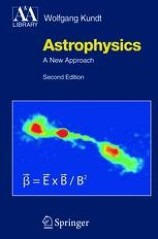
Astrophysics : A new approach
For a quantitative understanding of the physics of the universe - from the solar system through the milky way to clusters of galaxies all the way to cosmology - these edited lecture notes are perhaps among the most concise and also among the most critical ones: Astrophysics has not yet stood the redundancy test of laboratory physics, hence should be wary of early interpretations. Special chapters are devoted to magnetic and radiation processes, supernovae, disks, black-hole candidacy, bipolar flows, cosmic rays, gamma-ray bursts, image distortions, and special sources. At the same time, planet earth is viewed as the arena for life, with plants and animals having evolved to homo sapiens during cosmic time. -- This text is unique in covering the basic qualitative and quantitative tools, formulae as well as numbers, needed for the precise interpretation of frontline phenomena in astrophysical research. The author compares mainstream interpretations with new and even controversial ones he wishes to emphasize.
An Introduction to the Relativistic Theory of Gravitation
The geometric interpretation of gravitation is one of the major foundations of modern theoretical physics. This primer introduces classical general relativity with emphasis on the clarity of conceptual structure and on the basic mathematical methods to build up systematically application skills. The wealth of physical phenomena entailed by the Einstein‘s equations is revealed with the help of specific models describing gravitomagnetism, gravitational waves, cosmology, gravitational collapse and black holes. End-of-chapter exercises complete the main text.
100 years of relativity : Space-time structure - Einstein and beyond
Contains contributions from leading researchers, worldwide, who have thought deeply about the nature and consequences of this interplay. The articles take a long-range view of the subject and distill the most important advances in broad terms, making them easily accessible to non-specialists. The first part is devoted to a summary of how relativity theories were born (J Stachel). The second part discusses the most dramatic ramifications of general relativity, such as black holes (P Chrusciel and R Price), space-time singularities (H Nicolai and A Rendall), gravitational waves (P Laguna and P Saulson), the large scale structure of the cosmos (T Padmanabhan); experimental status of this theory (C Will) as well as its practical application to the GPS system (N Ashby). The last part looks beyond Einstein and provides glimpses into what is in store for us in the 21st century.
