



الصفحة 1
الصفحة 1

Introduction to Optics
Since the discovery of the laser in 1960 and optical fibers in 1970, optics has undergone dramatic changes that accentuate its multi-disciplinary character. This text covers essential concepts and reports the key developments and progress in current knowledge in the field. Inspired by the style of Richard Feynman, the method of presentation emphasizes "telling" optics, rather than deducing it from fundamental laws, as well as tactfully using mathematical tools so as not to obscure the physical phenomena of interest. For its excellent teaching approach, the book received the Arnulf-Francon Award of the French Optical Society. The concepts are formulated in a way such that the necessary mathematical tools do not hinder comprehension of the phenomena. Global in vision, the book can also be used as a reference. In addition to the traditional aspects of optics, it includes the tools and methods currently used by researchers and engineers, as well as explanation and implications of the most recent developments.
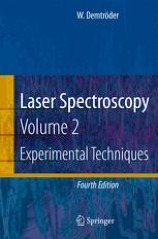
Laser Spectroscopy : Vol.2 Experimental Techniques
Keeping abreast of the latest techniques and applications, this new edition of the standard reference and graduate text on laser spectroscopy has been completely revised and expanded. While the general concept is unchanged, the new edition features a broad array of new material, e.g. frequency doubling in external cavities, reliable cw-parametric oscillators, tunable narrow-band UV sources, more sensitive detection techniques, tunable femtosecond and sub-femtosecond lasers (X-ray region and the attosecond range), control of atomic and molecular excitations, frequency combs able to synchronize independent femtosecond lasers, coherent matter waves, and still more applications in chemical analysis, medical diagnostics, and engineering.
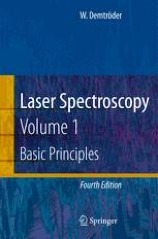
Laser Spectroscopy : Vol.1 Basic Principles
Keeping abreast of the latest techniques and applications, this new edition of the standard reference and graduate text on laser spectroscopy has been completely revised and expanded. While the general concept is unchanged, the new edition features a broad array of new material, e.g., frequency doubling in external cavities, reliable cw-parametric oscillators, tunable narrow-band UV sources, more sensitive detection techniques, tunable femtosecond and sub-femtosecond lasers (X-ray region and the attosecond range), control of atomic and molecular excitations, frequency combs able to synchronize independent femtosecond lasers, coherent matter waves, and still more applications in chemical analysis, medical diagnostics, and engineering.
