



الصفحة 1
الصفحة 1

Numerical Mathematics
Numerical mathematics is the branch of mathematics that proposes, develops, analyzes and applies methods from scientific computing to several fields including analysis, linear algebra, geometry, approximation theory, functional equations, optimization and differential equations. Other disciplines, such as physics, the natural and biological sciences, engineering, and economics and the financial sciences frequently give rise to problems that need scientific computing for their solutions. As such, numerical mathematics is the crossroad of several disciplines of great relevance in modern applied sciences, and can become a crucial tool for their qualitative and quantitative analysis.

Introduction to Partial Differential Equations: A Computational Approach
Mathematics is playing an ever more important role in the physical and biological sciences, provoking a blurring of boundaries between scientific disciplines and a resurgence of interest in the modern as well as the cl- sical techniques of applied mathematics. This renewal of interest, both in research and teaching, has led to the establishment of the series: Texts in Applied Mathematics (TAM). The development of new courses is a natural consequence of a high level of excitement on the research frontier as newer techniques, such as numerical and symbolic computer systems, dynamical systems, and chaos mix with and reinforce the traditional methods of applied mathematics. Thus, the purpose of this textbook series is to meet the current and future needs of these advances and encourage the teaching of new courses.

Hot house : Global climate change and the human condition
Global warming is extremely complex because it deals with so many different characteristics of the Earth and their complex interactions. It is addressed by almost all sciences including many aspects of geosciences, atmospheric, the biological sciences, and even astronomy. It has recently become the concern of other diverse disciplines such as economics, agriculture, demographics and population statistics, medicine, engineering, and political science. This book attempts to address these complex interactions, integrate them, and derive meaningful conclusions and possible solutions.

Guide to Effective Grant Writing : How to Write a Successful NIH Grant Application
Guide to Effective Grant Writing: How to Write a Successful NIH Grant is written to help the 100,000+ post-graduate students and professionals who need to write effective proposals for grants. There is little or no formal teaching about the process of writing grants for NIH, and many grant applications are rejected due to poor writing and weak formulation of ideas. Procuring grant funding is the central key to survival for any academic researcher in the biological sciences; thus, being able to write a proposal that effectively illustrates one's ideas is essential. Covering all aspects of the proposal process, from the most basic questions about form and style to the task of seeking funding, this volume offers clear advice backed up with excellent examples. Included are a number of specimen proposals to help shed light on the important issues surrounding the writing of proposals. The Guide is a clear, straight-forward, and reader-friendly tool.

Green Chemistry and Sustainable Technology : Biological, Pharmaceutical, and Macromolecular Systems
Taking an interdisciplinary approach, this new volume brings together innovative research, new concepts, and novel developments in the application of new tools in green chemistry and sustainable technology. The diverse coverage includes chapters on ionic liquids as green solvents, an environmentally friendly approach to the synthesis and biological evaluation of α-aminophosphonate derivatives, the application of nanotechnology in biological sciences and green chemistry, ecofriendly polymers, the effect of global warming and greenhouse gases on environmental system, and more.

FASTtrack : Pharmaceutics - dosage form and design
Discusses an array of major dosage forms that are commonly encountered by pharmacists in professional practice. Essential information concerning the formulation of these dosage forms is delivered in a format that will aid your understanding and remove the complexities of the various topics.

Evolutionary computation, machine learning and data mining in bioinformatics ; 5th European Conference, EvoBIO 2007, Valencia, Spain, April 11-13, 2007, Proceedings
This book Covers brings together experts in computer science with experts in bioinformatics and the biological sciences. It presents contributions on fundamental and theoretical issues along with papers dealing with different applications areas.

Ethical and Philosophical Consideration of the Dual-Use Dilemma in the Biological Sciences
This book examines the kinds of life-science experiments that give rise to the dual-use dilemma and provides philosophical analysis of the ethical issues and policy options surrounding dual-use research. this is the first book-length treatment of the topic by professional ethicists. It also challenges, and offers an alternative perspective to, the hugely influential U.S. National Research Council position on the dual-use dilemma.

Environmental Effects of Afforestation in North-Western Europe : From Field Observations to Decision Support
Recognising the need for effective decision making in relation to land-use change, this timely book develops a series of tools for estimating the environmental impacts of afforestation. It also presents guidelines and decision support systems (DSS) to enable both policy makers and forest managers to maximize the benefits and minimize the adverse effects of afforestation. This book will provide a valuable resource for both graduate students and researchers in forest, environmental and biological sciences, as well as for landscape planners and policy makers involved in afforestation projects at local, regional and international levels.

Endodontic Microbiology ; 2nd ed.
Presents a comprehensive reference to the microbiology, pathogenesis, management, and healing of endodontic pathosis, emphasizing the importance of biological sciences in understanding and managing endodontic disease and its interaction with systemic health. Provides a major revision to the first book to focus on the problems related to microbes in the root canal and periapical tissues. Updates current knowledge in endodontic pathosis, especially regarding next generation sequencing and microbial virulence. Presents useful diagrams, images, radiographs, and annotated histological images to illustrate the concepts. Emphasizes the importance of biological science in understanding and managing endodontic disease. Includes contributions from the leading researchers and educators in the field

DNA manipulation and analysis
Details technologies on recombinant DNA and nucleic acid manipulation that underpin much of the biological sciences and instructions on how to conduct them successfully. Chapters guide the reader through the basics of oligonucleotide synthesis and DNA sequencing; recombinant DNA plasmid work; cell-free experiments and the latest developments in CRISPR approaches to genome modification.

Digital Noise Monitoring of Defect Origin
Digital Noise Monitoring of Defect Origin is for both academics and professionals in the fields of engineering, biological sciences, physical science, and automation with particular emphasis on power engineering, oil-and-gas extraction, and aviation among others. The focus of the book is on determining defect origins. The author divides the process into the stages of monitoring the defect origin, identification of the defect and its stages, and control of the defect. The significance of this work is also connected to the possibility of using the noise as a data carrier for creating technologies that detect the initial stage of changes in objects.
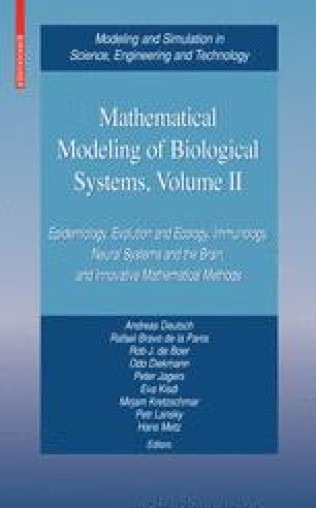
Mathematical Modeling of Biological Systems ; Vol. II : Epidemiology, Evolution and Ecology,Immunology, Neural Systems and the Brain, and Innovative Mathematical Methods
This two-volume, interdisciplinary work is a unified presentation of a broad range of state-of-the-art topics in the rapidly growing field of mathematical modeling in the biological sciences. Highlighted throughout both works are mathematical and computational approaches to examine central problems in the life sciences, ranging from the organizational principles of individual cells to the dynamics of large populations.

Mathematical Modeling of Biological Systems ; Vol. I : Cellular Biophysics, Regulatory Networks, Development, Biomedicine, and Data Analysis
This two-volume, interdisciplinary work is a unified presentation of a broad range of state-of-the-art topics in the rapidly growing field of mathematical modeling in the biological sciences. Highlighted throughout both works are mathematical and computational approaches to examine central problems in the life sciences, ranging from the organizational principles of individual cells to the dynamics of large populations.

Lippincott illustrated review immunology
Offers a highly visual presentation of essential immunology material, with all the popular features of the series: over 300 full-color annotated illustrations, an outline format, chapter summaries, review questions, and case studies that link basic science to real-life clinical situations.

Lifestyle psychiatry through the lens of behavioral medicine
Lifestyle medicine is a practice which adopts evidence-based lifestyle interventions as a primary modality to prevent, treat, and reverse chronic diseases. The six main pillars of this specialty include physical activity, nutrition, stress resilience, cessation or risk reduction of substance use, quality sleep, and connectivity. Lifestyle psychiatry is a rapidly emerging area within healthcare informed by rigorous research within the social and biological sciences, public health, and medicine. A volume in the Lifestyle Medicine series, this book uses a comprehensive biopsychosocial approach to prevent and treat psychiatric disorders and promote mental and physical well-being through evidence-based lifestyle interventions.
Cell-Cell Channels
The biological sciences are dominated by the idea that cells are the functionally autonomous, physically separated, discrete units of life. This concept was propounded in the 19th century by discoveries of the cellular structuring of both plants and animals. Moreover, the ap parent autonomy of unicellular eukaryotes, as well as the cellular basis of the mammalian brain (an organ whose anatomy for a long while defied attempts to validate the idea of the cellular nature of its neurons), seemed to provide the final conclusive evidence for the completeness of *cell theory', a theory which has persisted in an almost dogmatic form up to the present day. However, it is very obvious that there are numerous observations which indicate that it is not the cells which serve as the basic units of biological life but that this property falls to some other, subcellular assemblage. To deal with this intricate problem concerning the fundamental unit of living matter, we proposed the so-called Cell Body concept which, in fact, devel ops an exceedingly original idea proposed by Julius Sachs at the end of the 19th century. In the case of eukaryotic cells, DNA-enriched nuclei are intimately associated with a microtubular cytoskeleton. In this configuration—as a Cell Body—these two items comprise the fundamental functional and struc tural unit of eukaryotic living matter. The Cell Body seems to be inherent to all cells in all organisms.
CADD and informatics in drug discovery
Updates knowledge on recent advances in computational and bioinformatics tools/techniques and their practical applications in modern drug design and discovery programme. Also it encompasses fundamental principles, advanced methodologies and applications of various CADD approaches including several cutting-edge areas / presenting recent developments covering ongoing trends in the field of computer-aided drug discovery. Having contributions by a global team of experts, the book is expected to be an ideal resource for drug discovery scientists, medicinal chemists, pharmacologists, toxicologists, phytochemists, biochemists, biologists, RandD personnel, researchers, students, teachers and those working in the field of drug discovery. It will fill the knowledge gaps that exist in the current CADD approaches and methodologies/ protocols being widely used in both academic and research practices. Further, a special focus on current status of various computational drug design approaches (SBDD, LBDD, De-novo drug design, Pharmacophore-based search), bioinformatics tools and databases, computational screening and modeling of phytochemicals/natural products, artificial intelligence and machine learning, and network pharmacology and system biology would certainly guide researchers, students or readers to conduct their research in the emerging area(s) of interest. It is also expected to be highly beneficial to different stakeholders working in the pharmaceutical and biotechnology industries (RandD), the academic as well as research sectors. .

Applied Physical Pharmacy
Presents an introduction to physical pharmacy. This book begins with a review of key biopharmaceutics concepts of drug liberation, absorption, distribution, metabolism, and excretion
Applications of Synchrotron Radiation : Micro Beams in Cell Micro Biology and Medicine
This book demonstrates the applications of synchrotron radiation in certain aspects of cell microbiology, specifically non-destructive elemental analyses, chemical-state analyses and imaging (distribution) of the elements within a cell. The basics for understanding and applications of synchrotron radiation are also described to make the contents easier to be understood for a wide group of researchers in medical and biological sciences who might not be familiar with the physics of synchrotron radiation. The two main techniques that are discussed in this book are the x-ray fluorescence spectroscopy (XRF) and the x-ray fine structure analysis (XAFS).
