



الصفحة 1
الصفحة 1

Neutrinos and Explosive Events in the Universe
“Neutrinos and Explosive Events in the Universe” brought together experts from diverse disciplines to offer a detailed view of the exciting new work in this part of High Energy Astrophysics. Sponsored by NATO as an Advanced Study Institute, and coordinated under the auspices of the International School of Cosmic Ray Astrophysics (14th biennial course), the ASI featured a full program of lectures and discussion in the ambiance of the Ettore Majorana Centre in Erice, Italy, including visits to the local Dirac and Chalonge museum collections as well as a view of the cultural heritage of southern Sicily. Enri- ment presentations on results from the Spitzer Infrared Space Telescope and the Origin of Complexity complemented the program. This course was the best attended in the almost 30 year history of the School with 121 participants from 22 countries. The program provided a rich ex- rience, both introductory and advanced, to fascinating areas of observational Astrophysics Neutrino Astronomy, High Energy Gamma Ray Astronomy, P- ticle Astrophysics and the objects most likely responsible for the signals - plosions and related phenomena, ranging from Supernovae to Black Holes to the Big Bang. Contained in this NATO Science Series volume is a summative formulation of the physics and astrophysics of this newly emerging research area that already has been, and will continue to be, an important contributor to understanding our high energy universe.

In Search of Dark Matter
The dark matter problem is one of the most fundamental and profoundly difficult to solve problems in the history of science. Not knowing what makes up most of the known universe goes to the heart of our understanding of the Universe and our place in it. In Search of Dark Matter is the story of the emergence of the dark matter problem, from the initial erroneous ‘discovery’ of dark matter by Jan Oort to contemporary explanations for the nature of dark matter and its role in the origin and evolution of the Universe. Written for the educated non-scientist and scientist alike, it spans a variety of scientific disciplines, from observational astronomy to particle physics. Concepts that the reader will encounter along the way are at the cutting edge of scientific research. However the themes are explained in such a way that no prior understanding of science beyond a high school education is necessary.

Gravity, Black Holes, and the Very Early Universe : An Introduction to General Relativity and Cosmology
In the early 1900s, Albert Einstein formulated two theories that would forever change the landscape of physics: the Special Theory of Relativity and the General Theory of Relativity. By 1925, quantum mechanics had been born out of the dissection of these two theories, and shortly after that, relativistic quantum field theory. We now had in place some important ties between the laws of physics and the types of particle interactions the new physics was uncovering. Gravity is one of the four types of forces that are found throughout the universe. In fact, although it is a relatively weak force, it operates at huge distances, and so must be accounted for in any cosmological system. Unfortunately, gravity continues to defy our neat categorization of how all the forces in nature work together.

Frontiers of Fundamental Physics ; Proceedings of the Sixth International Symposium "Frontiers of Fundamental and Computational Physics", Udine, Italy, 26-29 September 2004
The Sixth International Symposium "Frontiers of Fundamental and Computational Physics", Udine, Italy, 26-29 September 2004, aimed at providing a platform for a wide range of physicists to meet and share thoughts on the latest trends in various, mainly cross-disciplinary research areas. This includes the exploration of frontier lines in High Energy Physics, Theoretical Physics, Gravitation and Cosmology, Astrophysics, Condensed Matter Physics, Fluid Mechanics. Such frontier lines were unified by the use of computers as an, often primary, research instruments, or dealing with issues related to information theory.

Frontiers of Cosmology ; Proceedings of the NATO ASI on The Frontiers of Cosmology, Cargese, France from 8 - 20 September 2003
Contains this book lectures by world experts in the various branches of this field corresponding to lectures presented during the School "Frontiers of the Universe" at the IESC, (Corsica, France). These pedagogical lectures cover major subjects relevant to the field, providing introductory material appropriate to PhD students.
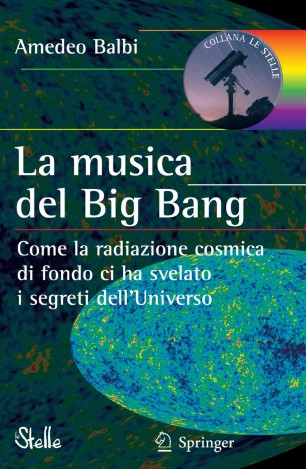
La musica del Big Bang : Come la radiazione cosmica di fondo ci ha svelato i segreti dell’Universo = The music of the Big Bang : How the cosmic background radiation revealed the secrets of the Universe to us
Cosmic microwave background radiation is the residue of the great heat following the Big Bang. A tenuous sign, over 13 billion years old, in which the answers to many of the questions about the nature of our Universe are hidden. Discovered by chance in 1964, in the last forty years this fossil trace of the origins of the Cosmos has been explored with every available means. Two Nobel Prizes in physics have already been awarded for research involving it, the last in 2006 for the results of the COBE satellite. Much of the information encoded in the cosmic background radiation was impressed by the superimposition of acoustic waves present in the early Universe: a "music" of the Big Bang, which cosmologists have tried for years to reconstruct, using techniques similar to those that allow to distinguish the sound of different musical instruments. Only recently have the first notes of this extraordinary cosmic symphony finally been revealed, but the investigation is not over yet. This book illustrates, with a language suitable even for non-specialists, the theories, observations and discoveries that have brought cosmology into a new era.
La correspondance entre Henri Poincaré et les physiciens, chimistes et ingénieurs = The correspondence between Henri Poincaré and physicists, chemists and engineers
Cosmic microwave background radiation is the residue of the great heat following the Big Bang. A tenuous sign, over 13 billion years old, in which the answers to many of the questions about the nature of our Universe are hidden. Discovered by chance in 1964, in the last forty years this fossil trace of the origins of the Cosmos has been explored with every available means. Two Nobel Prizes in physics have already been awarded for research involving it, the last in 2006 for the results of the COBE satellite. Much of the information encoded in the cosmic background radiation was impressed by the superimposition of acoustic waves present in the early Universe: a "music" of the Big Bang, which cosmologists have tried for years to reconstruct, using techniques similar to those that allow to distinguish the sound of different musical instruments. Only recently have the first notes of this extraordinary cosmic symphony finally been revealed, but the investigation is not over yet. This book illustrates, with a language suitable even for non-specialists, the theories, observations and discoveries that have brought cosmology into a new era.

Chemical abundances and mixing in stars in the milky way and its satellites ; Proceedings of the ESO-Arcetrie Workshop held in Castiglione della Pescaia, Italy, 13-17 September, 2004
The proceedings of this book cover topics from chemical abundances in the different components of the Milky Way and in local group galaxies, via observational and theoretical papers on mixing in stars to big bang nucleosynthesis and galaxy formation and evolution. As all volumes in this series of ESO Astrophysics Symposia this one gives a comprehensive state-of-the-art overview of the forefront of research in its area. It is thus a valuable reference for both students specializing in the field and researchers alike.
Calibrating the Cosmos : How Cosmology Explains Our Big Bang Universe
Calibrating the Cosmos describes hard science, but is gently written. It explains in clear, non-mathematical language the measurements and the interpretation of the resulting data that have led to the current understanding of the origin, evolution and properties of our expanding Big Bang universe. Many people have a sketchy idea of the work of cosmologists, but Professor Levin’s experience in teaching both scientific and liberal arts students has enabled him to impart much of our current thinking without resorting to difficult mathematics. Theoretical concepts are emphasized, in particular the symmetries of homogeneity and isotropy enjoyed by our universe on the largest scales, how these symmetries lead to only one quantity being needed to describe the growth of the universe from its infancy to the present time, and how the so-called parameters of the universe are the ingredients used to construct the model universes to which ours – the real thing – is compared.
Astroparticle physics
The book describes the branch of astrophysics in which processes in the universe are investigated with experimental methods known from particle physics experiments. After a historical introduction to the basics of elementary particles, their interactions and the relevant detection techniques are described. The main body of the book concerns cosmic rays. The modern aspects of astroparticle physics are described in a chapter on cosmology. The book provides an orientation in the field of astroparticle physics that many beginners might look for. The physics issues are presented with little mathematics, and the results are illustrated by many diagrams. The reader has a chance to enter this field of astrophysics with a book that closes the gap between expert and popular level.
