



الصفحة 1
الصفحة 1

Multiple Classifier Systems ; 7th International Workshop, MCS 2007, Prague, Czech Republic, May 23-25, 2007, Proceedings
These proceedings are a record of the Multiple Classifier Systems Workshop, MCS 2007, held at the Institute of Information Theory and Automation, Czech Academy of Sciences, Prague in May 2007. the workshop achieved its objective of bringing together researchers from diverse communities (neural networks, pattern rec- nition, machine learning and statistics) concerned with this research topic.

Modeling Decisions for Artificial Intelligence ; Vol.3885 ; 3rd International Conference, MDAI 2006, Tarragona, Spain, April 3-5, 2006, Proceedings
This book constitutes the refereed proceedings of the Third International Conference on Modeling Decisions for Artificial Intelligence, MDAI 2006, held in Tarragona, Spain, in April 2006.

Intelligent information processing III ; IFIP TC12 International Conference on Intelligent Information Processing (IIP 2006), September 20-23, Adelaide, Australia
The IFIP series publishes state-of-the-art results in the sciences and technologies of information and communication. The principal aim of the IFIP series is to encourage education and the dissemination and exchange of information about all aspects of computing.
Intelligent Algorithms in Ambient and Biomedical Computing
The rapid growth in electronic systems in the past decade has boosted research in the area of computational intelligence. As it has become increasingly easy to generate, collect, transport, process, and store huge amounts of data, the role of intelligent algorithms has become prominent in order to visualize, manipulate, retrieve, and interpret the data. For instance, intelligent search techniques have been developed to search for relevant items in huge collections of web pages, and data mining and interpretation techniques play a very important role in making sense out of huge amounts of biomolecular measurements. As a result, the added value of many modern systems is no longer determined by hardware only, but increasingly by the intelligent software that supports and facilitates the user in realizing his or her objectives.

Innovations in Bayesian Networks : Theory and Applications
Bayesian networks currently provide one of the most rapidly growing areas of research in computer science and statistics. In compiling this volume we have brought together contributions from some of the most prestigious researchers in this field.
Inductive logic programming ; 18th International Conference, ILP 2008 Prague, Czech Republic, September 10-12, 2008 Proceedings
This book constitutes the refereed proceedings of the 18th International Conference on Inductive Logic Programming, ILP 2008, held in Prague, Czech Republic, in September 2008.The 20 revised full papers presented together with the abstracts of 5 invited lectures were carefully reviewed and selected during two rounds of reviewing and improvement from 46 initial submissions. All current topics in inductive logic programming are covered, ranging from theoretical and methodological issues to advanced applications. The papers present original results in the first-order logic representation framework, explore novel logic induction frameworks, and address also new areas such as statistical relational learning, graph mining, or the semantic Web.
Inductive logic programming ; 16th International Conference, ILP 2006, Santiago de Compostela, Spain, August 24-27, 2006, Revised Selected Papers
This book constitutes the thoroughly refereed post-proceedings of the 16th International Conference on Inductive Logic Programming, ILP 2006, held in Santiago de Compostela, Spain, in August 2006. The papers address all current topics in inductive logic programming, ranging from theoretical and methodological issues to advanced applications.
Inductive logic programming ; 15th International Conference, ILP 2005, Bonn, Germany, August 10-13, 2005, Proceedings
“Change is inevitable.” Embracing this quote we have tried to carefully exp- iment with the format of this conference, the 15th International Conference on Inductive Logic Programming, hopefully making it even better than it already was. But it will be up to you, the inquisitive reader of this book, to judge our success. The major changes comprised broadening the scope of the conference to include more diverse forms of non-propositional learning, to once again have tutorials on exciting new areas, and, for the ?rst time, to also have a discovery challenge as a platform for collaborative work. This year the conference was co-located with ICML 2005, the 22nd Inter- tional Conference on Machine Learning, and also in close proximity to IJCAI 2005, the 19th International Joint Conference on Arti?cial Intelligence. - location can be tricky, but we greatly bene?ted from the local support provided by Codrina Lauth, Michael May, and others. We were also able to invite all ILP and ICML participants to shared events including a poster session, an invited talk, and a tutorial about the exciting new area of “statistical relational lea- ing”. Two more invited talks were exclusively given to ILP participants and were presented as a kind of stock-taking—?ttingly so for the 15th event in a series—but also tried to provide a recipe for future endeavours.

Hierarchical Bayesian Optimization Algorithm : Toward a New Generation of Evolutionary Algorithms
This book provides a framework for the design of competent optimization techniques by combining advanced evolutionary algorithms with state-of-the-art machine learning techniques. The book focuses on two algorithms that replace traditional variation operators of evolutionary algorithms by learning and sampling Bayesian networks: the Bayesian optimization algorithm (BOA) and the hierarchical BOA (hBOA). BOA and hBOA are theoretically and empirically shown to provide robust and scalable solution for broad classes of nearly decomposable and hierarchical problems. A theoretical model is developed that estimates the scalability and adequate parameter settings for BOA and hBOA. The performance of BOA and hBOA is analyzed on a number of artificial problems of bounded difficulty designed to test BOA and hBOA on the boundary of their design envelope.

Fundamental approaches to software engineering ; 11th International Conference, FASE 2008, Held as Part of the Joint European conferences on theory and practice of software, ETAPS 2008, Budapest, Hungary, March 29-April 6, 2008. Proceedings
The fve main conferences received 571 submissions, 147 of which were accepted, giving an overall acceptance rate of less than 26%, with each conference below 27%.Congratulationsthereforetoallthe authorswhomadeittothe alprogramme! I hope that most of the other authors will still have found a way of participating in this exciting event, and that you will all continue submitting to ETAPS and contributing to make of it the best conference in the area،The events that comprise ETAPS address various aspects of the system velopment process,including specifcation, design, implementation, analysis and improvement.

Fundamental approaches to software engineering ; 10th International Conference, FASE 2007 Held as part of the joint European conference on theory and practice of software, ETAPS 2007 Braga, Portugal, March 24 - April 1, 2007 Proceedings
This book constitutes the refereed proceedings of the 10th International Conference on Fundamental Approaches to Software Engineering, FASE 2007, held in Braga, Portugal in March/April 2007 as part of ETAPS 2007, the Joint European Conferences on Theory and Practice of Software.

Enterprise Information Systems V
ICEIS focuses on real world applications and aims at bringing together researchers, engineers and practitioners interested in the advances and business applications of information systems. As in previous years, ICEIS’2003 held four simultaneous tracks covering different aspects of enterprise computing: Databases and Information Systems Integration, Artificial Intelligence and Decision Support Systems, Information Systems Analysis and Specification and Software Agents and Internet Computing. Although ICEIS’2003 received 546 paper submissions from over 50 countries, only 80 were accepted as full papers and presented in 30-minutes oral presentations. With an acceptance rate of 15%, these numbers demonstrate the intention of preserving a high quality forum for future editions of this conference. From the articles accepted as long papers for the conference, only 32 were selected for inclusion in this book Additional keynote lectures, tutorials and industrial sessions were also held during ICEIS’2003, and, for the first time this year, the 1st Doctoral Consortium on Enterprise Information Systems gave PhD students an opportunity to present their work to an international audience of experts in the field of information systems.

Discovery science ; Vol. 3735 ; 8th International Conference, DS 2005, Singapore, October 8-11, 2005, Proceedings
This book constitutes the refereed proceedings of the 8th International Conference on Discovery Science, DS 2005, held in Singapore in October 2005, co-located with the International Conference on Algorithmic Learning Theory (ALT 2005). The 21 revised long papers and the 6 revised regular papers presented together with 9 project reports and 5 invited papers were carefully reviewed and selected from 112 submissions. The papers cover all issues in the area of automating scientific discovery or working on tools for supporting the human process of discovery in science.

Digital Document Processing : Major Directions and Recent Advances
With the advent of the Digital Library initiative, web document processing and biometric aspects of digital document processing, together with new techniques of printed and handwritten Optical Character Recognition (OCR), a good overview of this fast-developing field is invaluable. In this book, all the major and frontier topics in the field of document analysis are brought together into a single volume creating a unique reference source.

Design computing and cognition 06 ; 1st ed. ; Proceedings of the 2nd International conference on design computing and cognition
This is the second volume of the new conference series Design Computing and Cognition (DCC) that takes over from and subsumes the successful series Artificial Intelligence in Design (AID) published by Kluwer since 1992. The AID volumes have become standard reference texts for the field. It is expected that the DCC volumes will perform the same role.

Defence Applications of Multi-Agent Systems; International Workshop, DAMAS 2005, Utrecht, The Netherlands, July 25, 2005, Revised and Invited Papers
This book constitutes the thoroughly refereed post-proceedings of the International Workshop on Defence Applications of Multi-Agent Systems, DAMAS 2005, held in Utrecht, The Netherlands in July 2005 as an associated event of AAMAS 2005, the main international conference on autonomous agents and multi-agent systems. The 10 revised full papers presented together with 1 invited article are organized in topical sections on decision support and simulation, unmanned aerial vehicles, as well as on systems and security.

Data mining and Knowledge discovery handbook
Data Mining and Knowledge Discovery Handbook organizes all major concepts, theories, methodologies, trends, challenges and applications of data mining (DM) and knowledge discovery in databases (KDD) into a coherent and unified repository. This book first surveys, then provides comprehensive yet concise algorithmic descriptions of methods, including classic methods plus the extensions and novel methods developed recently. This volume concludes with in-depth descriptions of data mining applications in various interdisciplinary industries including finance, marketing, medicine, biology, engineering, telecommunications, software, and security.
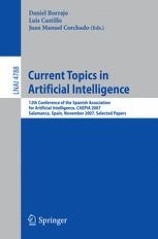
Current aopics in artificial intelligence ; 12th Conference of the Spanish Association for Artificial Intelligence, CAEPIA 2007, Salamanca, Spain, November 12-16, 2007, Selected Papers
The book presented address all current issues of artificial intelligence ranging from methodological and foundational aspects to advanced applications in various fields.

Conditionals, Information, and Inference
Conditionals are fascinating and versatile objects of knowledge representation. On the one hand, they may express rules in a very general sense, representing, for example, plausible relationships, physical laws, and social norms. On the other hand, as default rules or general implications, they constitute a basic tool for reasoning, even in the presence of uncertainty. In this sense, conditionals are intimately connected both to information and inference. Due to their non-Boolean nature, however, conditionals are not easily dealt with. They are not simply true or false — rather, a conditional “if A then B” provides a context, A, for B to be plausible (or true) and must not be confused with “A entails B” or with the material implication “not A or B.” This ill- trates how conditionals represent information, understood in its strict sense as reduction of uncertainty. To learn that, in the context A, the proposition B is plausible, may reduce uncertainty about B and hence is information. The ab- ity to predict such conditioned propositions is knowledge and as such (earlier) acquired information. The ?rst work on conditional objects dates back to Boole in the 19th c- tury, and the interest in conditionals was revived in the second half of the 20th century, when the emerging Arti?cial Intelligence made claims for appropriate formaltoolstohandle“generalizedrules.”Sincethen,conditionalshavebeenthe topic of countless publications, each emphasizing their relevance for knowledge representation, plausible reasoning, nonmonotonic inference, and belief revision.

Computer vision approaches to medical image analysis ; 2nd International ECCV Workshop, CVAMIA 2006, Graz, Austria, May 12, 2006, Revised Papers
This was the second time that a satellite workshop,solely devoted to medical image analysis issues, was held in conjunction with the European Conference on Computer Vision (ECCV). We received 38 full-length paper submissions to the second Computer Vision Approaches to Medical Image Analysis (CVAMIA) Workshop, out of which 10 were accepted for oral and 11 for poster presentation after a rigorous peer-review process. In addition, the workshop included three invited talks.
