



الصفحة 1
الصفحة 1
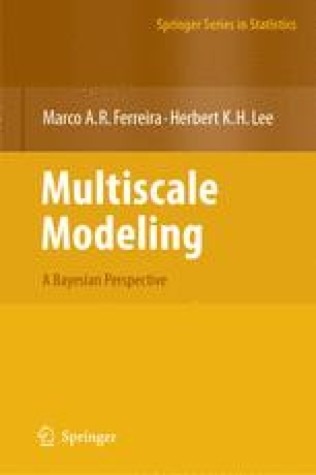
Multiscale Modeling : A Bayesian Perspective
The book is aimed at statisticians, applied mathematicians, and engineers working on problems dealing with multiscale processes in time and/or space, such as in engineering, finance, and environmetrics. The book will also be of interest to those working on multiscale computation research. The main prerequisites are knowledge of Bayesian statistics and basic Markov chain Monte Carlo methods. A number of real-world examples are thoroughly analyzed in order to demonstrate the methods and to assist the readers in applying these methods to their own work. To further assist readers, the authors are making source code (for R) available for many of the basic methods discussed herein.

Handbook of Data Visualization
This new volume in the series Springer Handbooks of Computational Statistics gives an overview of modern data visualization methods, both in theory and practice. There are definitive chapters on modern graphical tools such as mosaic plots, parallel coordinate plots and linked views. There are chapters dedicated to graphical methodology for particular areas of statistics, for example Bayesian analysis, genomic data and cluster analysis, as well as chapters on software for graphics.

Data visualization and analysis in second language research
This introduction to visualization techniques and statistical models for second language research focuses on three types of data (continuous, binary, and scalar), helping readers to understand regression models fully and to apply them in their work. Garcia offers advanced coverage of Bayesian analysis, simulated data, exercises, implementable script code, and practical guidance on the latest R software packages.

Le choix bayésien: Principes et pratique
Covers the so-called Bayesian approach to statistical inference and in particular its decision-making aspects. The bases of this axiomatics (choice of the a priori, optimal decisions, tests and regions of confidence) are discussed in detail, as well as more recent openings of Bayesian analysis such as the choice of models, the use of numerical methods. Stochastic approximation (MCMC), the theory of noninformative laws (Berger-Bernardo axioms) and the relation to the classical theory of admissibility. Each chapter is completed by an extensive series of exercises of increasing difficulty and by bibliographical notes on the themes addressed. This book can be used in a Master's program in Applied Mathematics, Biometrics, Econometrics or any other program that uses quantitative information processing techniques. It only requires a basic course in probability theory and mathematical statistics as a preliminary.
An Introduction to Bayesian Analysis : Theory and Methods
This book is a contemporary introduction to theory, methods and computation in Bayesian Analysis. It focuses on topics that have stood the test of time and on emerging areas. No other such book is available in the market.
