



الصفحة 1
الصفحة 1
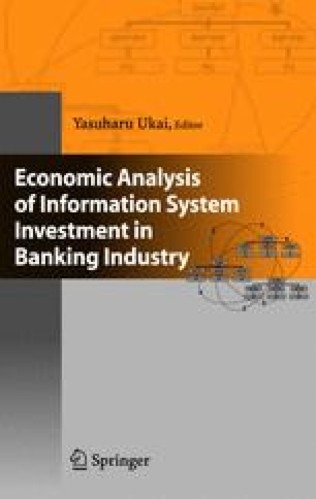
Economic Analysis of Information System Investment in Banking Industry
Explains in reahty, examines theoretically, and analyzes statistically information system investment in the banking industry with regard to the process of the information technology revolution. This kind of comprehensive research on the banking industry is the first in the world. It could be seen as an application study for Japanese financial deregulation after 1997. However, our project, the Workshop of Information System Investment, is a theoretical research venture, consisting originally, when it began in 1994, of economists and computer scientists. It aimed to measure the effect of com puter hardware and software on the modern economy, based on the microdata of each firm, and to extend the frontiers of economic science. It was, coin- dentally, the time when this project began full-scale operation, in July 1997, that the voluntary closure of Yamaichi Securities was decided. The failure of the Hokkaido Takushoku Bank was disclosed in November of the same year, and the breakdown, temporary nationalization, buying out, and mergers of several banks succeeded one another. Our research therefore suddenly got into the social spotlight on the application stage. Part I is the first history and strategic guidelines of information systems in the banking industry. Part II summarizes the economic analyses of informa tion system investment in the United States, Europe, and Japan. These parts are foundations for the statistical analyses in Part III.

Digital Entrepreneurship : Impact on Business and Society
Explores the global challenges and experiences related to digital entrepreneurial activities, using carefully selected examples from leading companies and economies that shape world business today and tomorrow. Digital entrepreneurship and the companies steering it have an enormous global impact; they promise to transform the business world and change the way we communicate with each other. These companies use digitalization and artificial intelligence to enhance the quality of decisions and augment their business and customer operations. This book demonstrates how cloud services are continuing to evolve; how cryptocurrencies are traded in the banking industry; how platforms are created to commercialize business, and how, taken together, these developments provide new opportunities in the digitalized era. Further, it discusses a wide range of digital factors changing the way businesses operate, including artificial intelligence, chatbots, voice search, augmented and virtual reality, as well as cyber threats and data privacy management.

Cyber-physical systems of systems : Foundations : A conceptual model and some derivations : The AMADEOS legacy
Technical Systems-of-Systems (SoS) – in the form of networked, independent constituent computing systems temporarily collaborating to achieve a well-defined objective – form the backbone of most of today’s infrastructure. The energy grid, most transportation systems, the global banking industry, the water-supply system, the military equipment, many embedded systems, and a great number more, strongly depend on systems-of-systems. The correct operation and continuous availability of these underlying systems-of-systems are fundamental for the functioning of our modern society.

Cooperative Sourcing : Simulation Studies and Empirical Data on Outsourcing Coalitions in the Banking Industry
Based on the integration of relevant economic and organizational theories, Daniel Beimborn develops a formal model of cooperative sourcing. The model captures the different drivers and inhibitors like economies of scale, scope and skill, transaction costs, strategic constraints etc. and forms the basis for both game-theoretical analyses and agent-based simulations. Simulations help to handle the numerical complexity and allow for compound analyses of the causes and effects of cooperative sourcing. Empirical data from two large-scale surveys and case studies in the German credit business are used in order to feed the simulation model and to validate the results.
Bio-inspired credit risk analysis : Computational intelligence with support vector machines
Credit risk analysis is one of the most important topics in the field of financial risk management. Due to recent financial crises and regulatory concern of Basel II, credit risk analysis has been the major focus of financial and banking industry. Especially for some credit-granting institutions such as commercial banks and credit companies, the ability to discriminate good customers from bad ones is crucial. The need for reliable quantitative models that predict defaults accurately is imperative so that the interested parties can take either preventive or corrective action. Hence credit risk analysis becomes very important for sustainability and profit of enterprises. In such backgrounds, this book tries to integrate recent emerging support vector machines and other computational intelligence techniques that replicate the principles of bio-inspired information processing to create some innovative methodologies for credit risk analysis and to provide decision support information for interested parties.
AI in banking : Practical applications and case studies
Delves into the application of AI from theory to practice, offering detailed insights into AI project design and code implementation across eleven business scenarios in four major sectors: retail banking, e-banking, bank credit, and tech operations. it provides hands-on examples of various technologies, including automatic machine learning, integrated learning, graph computation, recommendation systems, causal inference, generative adversarial networks, supervised learning, unsupervised learning, computer vision, reinforcement learning, fuzzy control, automatic control, speech recognition, semantic understanding, bayesian networks, edge computing, and more. this book stands as a rare and practical guide to AI projects in the banking industry.
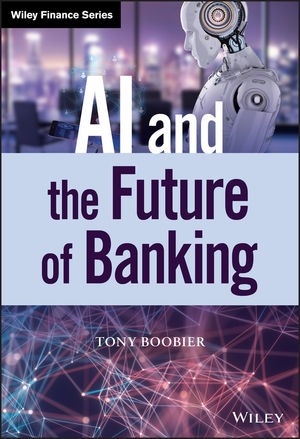
AI and the future of banking
Across its entire breadth and depth, the banking industry is at the forefront of investigating Advanced Analytics and AI technology for use in a broad range of applications, such as customer analytics and providing wealth advice for clients. AI and the Future of Banking provides new and established banking industry professionals with the essential information on the implications of data and analytics on their roles, responsibilities and personal career development.
