



الصفحة 1
الصفحة 1

High Noon in the Automotive Industry
The book provides valuable information in an understandable style and entertaining form, but also makes clear statements on the tough consequences of global competition for the automotive manufacturers and the supply industry. Recommended reading for everyone in risk and asset management in the financial industry.

Finite element analysis for design engineers
Finite Element Analysis (FEA) has been widely implemented by the automotive industry as a productivity tool for design engineers to reduce both development time and cost. This essential work serves as a guide for FEA as a design tool and addresses the specific needs of design engineers to improve productivity.

Evaluation of Cooperative Planning in Supply Chains : An Empirical Approach of the European Automotive Industry
Modern literature has heralded the "Era of Network Competition" in which cooperating networks and not individual firms seek to attain competitive advantages. Supply chains in the automotive industry provide a good example of such cooperative environments which are characterized by a division of labor and where almost no final product is produced and sold by just one company alone.

Europes Automotive Industry on the Move : Competitiveness in a Changing World
The automotive industry is a major pillar of the modern global economy and one of Europe’s key industries. There can hardly be any doubt about the important role of this sector as an engine for employment, growth and innovation in Europe, and there are crucial challenges and opportunities ahead. The authors shed light on a broad range of issues – globalisation and restructuring, trade and foreign direct investment, innovation, regulation, and industry policy – and put a special focus on the new member states. While change may be inevitable, progress is not. This book shall serve as a map to all stakeholders: business executives and policy makers, investors and scholars.

Disseminative Capabilities : A Case Study of Collaborative Product Development in the Automotive Industry
Nowadays, cooperating in Product Development seems to be a dominant strategy to lower costs and risks, to fully utilize capacities, and to gain access to lacking knowledge assets. Oppat analyzes cooperations in Product Development with a special focus on the automotive industry. He seeks answers to the question of how knowledge transfer between involved partners takes place. Although knowledge transfer and its success levers (e.g. absorptive capacity) are well-researched phenomena, equivalent investigations of the sender and her capabilities (DiC - Disseminative Capabilities) impacting inter-organizational transfer success are lacking. The in-depth case studies conducted concentrate on joint car development projects between Magna Steyr, an Austrian-based company, and German-based BMW, Mercedes Benz, and Audi. The research results clearly indicate that DiC have an impact on the knowledge transfer process and can explain why the analyzed projects differ in terms of transfer success. Based on the research findings, this work provides managerial implications for all eight dimensions of DiC and, by deploying insights from the empirical investigations, outlines ways to develop them successfully.

Computer Vision and Internet of Things : Technologies and Applications
Explores the utilization of Internet of Things (IoT) with computer vision and its underlying technologies in different applications areas. Using a series of present and future applications – including business insights, indoor-outdoor securities, smart grids, human detection and tracking, intelligent traffic monitoring, e-health departments, and medical imaging – this book focuses on providing a detailed description of the utilization of IoT with computer vision and its underlying technologies in critical application areas, such as smart grids, emergency departments, intelligent traffic cams, insurance, and the automotive industry.
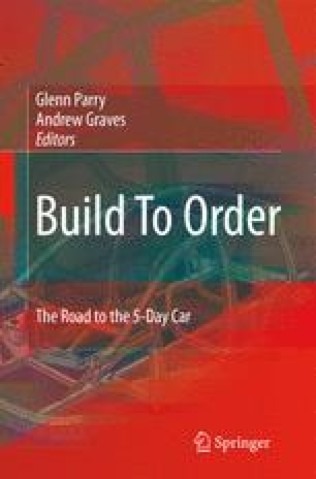
Build To Order: The Road to the 5-Day Car
Build To Order: The Road to the 5-Day Car addresses the conceptual and practical aspects for achieving the automotive industry’s next goal: the rapid delivery to the customer of a bespoke vehicle only days after placing an order.

Autonomous vehicles technological trends
The automotive industry has always been synonymous with research and innovation, but nowadays the industry is adding pressure and is establishing the agenda of the researchers from the field. Visions have been provided, and the hardware and the software exist; the only question remaining is: “who is going to deliver”? To answer this question, we encouraged scientists, researchers, industry specialists, and academics to share their vision of autonomous vehicles. What will the platform look like? What kind of hardware and software is most suitable? Who will make the connection between these two interdependent environments (and how), so that in the end the AI will define the process? These are the pressing issues of the current moment, and this Special Issue will help all those interested in the topic to promote their vision and ideas.
Automotive production systems and standardisation : From Ford to the case of Mercedes-Benz
The introduction of the Mercedes-Benz Production System (MPS) is exemplary of a trend within the automotive industry: the creation and introduction of company-specific standardised production systems. This book contributes to the debate about production systems by examining the social and economic implications of the role of standardisation in production systems. In this context it addresses three core issues: First, the driving forces behind the changing forms and functions of standardisation and the role of institutions therein. Second, the impact of standardisation on the evolution of automotive production systems. Third, based on the author's own empirical research conducted over a three year period at the Mercedes-Benz plant Stuttgart-Untertürkheim/Germany, the book examines the influence of standardisation on the work of actors on the shop floor in terms of organisational learning processes and the regulation of work.
Advanced Motion Control and Sensing for Intelligent Vehicles
Provides the latest information in intelligent vehicle control, sensing, and intelligent transportation. It addresses the growing need for safe, comfortable, time and energy-efficient modes of transportation with emphasis on the latest key findings, current trends, and likely future developments in this rapidly expanding field. Highlights : Discusses individual vehicle dynamics, sensory and multiple ground-vehicle interactions / Includes systematic review of past and current research achievements / Presents case studies in cutting-edge directions such as vehicle steering motion, vehicle vision systems, cooperative driving, intersection safety, and tire pressure monitoring / Assesses the likely future developments of this field. This book is useful for both practicing engineers and researchers in the automotive industry.
Advanced Microsystems for Automotive Applications 2008 ; 4th ed.
With the total number of vehicles steadily increasing and soon approaching one billion, the world is facing serious challenges in terms of both safety of road transport and sustainability. Consequently the two major persistent issues for the automotive industry are improved safety and reduced emissions. The book in hand is a showroom of activities, the International Forum on Advanced Microsystems for Automotive Applications (AMAA) has been known for during the last 12 years.
Advanced mathematical science for mobility society
The automotive industry has made steady progress in technological innovations under the names of Connected Autonomous-Shared-Electric (CASE) and Mobility as a Service (MaaS). Needless to say, mathematics and informatics are important to support such innovations. As the concept of cars and movement itself is diversifying, they are indispensable for grasping the essence of the future mobility society and building the foundation for the next generation. This book contains three main contents. 1. Mathematical models of flow 2. Mathematical methodsfor huge data and network analysis 3. Algorithm for mobility society The first one discusses mathematical models of pedestrian and traffic flow, as they are important for preventing accidents and achieving efficient transportation.
A Successful Transformation? : Restructuring of the Czech Automobile Industry
This book investigates the complex processes of the post-1990 transformation in the Czech automotive industry and its selective integration in the West European automobile manufacturing system. The post-1990 restructuring of the Czech automotive industry is analyzed in the context of its pre-1990 development and in the context of the Central and East European automobile industry as a whole. Specifically, the book examines the development and post-1990 restructuring of the Czech passenger car industry, the components industry and truck manufacturing. Major topics covered include the development of the Czech automotive industry before 1990, the detailed case study of Škoda Auto, the effects of the post-1990 privatization in the Czech automotive industry, the role and effects of foreign direct investment during the post-1990 restructuring, the restructuring of the Czech truck industry, and the rapid development of the automotive components manufacturing.
