



الصفحة 1
الصفحة 1
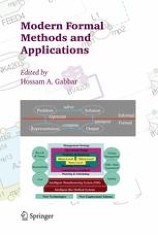
Modern Formal Methods and Applications
Formal methods are a robust approach for problem solving. It is based on logic and algebraic methods where problems can be formulated in a way that can help to find an appropriate solution. This book shows the basic concepts of formal methods and highlights modern modifications and enhancements to provide a more robust and efficient problem solving tool.Applications are presented from different disciplines such as engineering where the operation of chemical plants is synthesized using formal methods. Computational biology becomes easier and systematic using formal methods. Also, hardware compilation and systems can be managed using formal methods.

Modelling, State Observation and Diagnosis of Quantised Systems
The book concerns quantised systems which emerge from continuous-variable systems by quantising the values of all signals. It is shown how this leads to an abstract system description by means of a stochastic automaton. Based on stochastic automata, new methods for the solution to state observation and fault diagnostic problems are derived. The methods are extended to networks of stochastic automata, allowing component-oriented modelling and, thus, to deal with complex systems. The practical applicability and usefulness of the approach is shown at several examples.

Introduction to the theory of computation
Gain a solid understanding of the fundamental mathematical properties of computer hardware, software, and applications with a blend of practical and philosophical coverage and mathematical treatments, including advanced theorems and proofs.

Introduction to Discrete Event Systems
Introduction to Discrete Event Systems is a comprehensive introduction to the field of discrete event systems, offering a breadth of coverage that makes the material accessible to readers of varied backgrounds. The book emphasizes a unified modeling framework that transcends specific application areas, linking the following topics in a coherent manner: language and automata theory, supervisory control, Petri net theory, Markov chains and queueing theory, discrete-event simulation, and concurrent estimation techniques
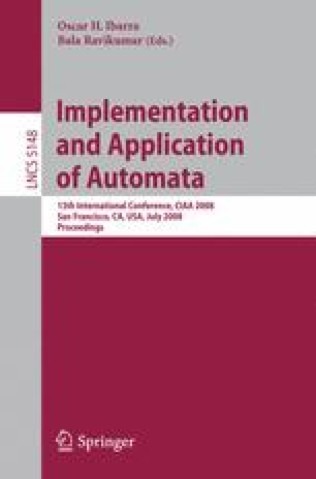
Implementation and Applications of Automata ; 13th International Conference, CIAA 2008, San Francisco, California, USA, July 21-24, 2008. Proceedings
This book constitutes the thoroughly refereed post-proceedings of the 13th International Conference on Implementation and Application of Automata, CIAA 2008, held in San Francisco, USA, in July 2008.The 26 revised full papers togehter with 4 invited papers were carefully reviewed and selected from 40 submissions and have gone through two rounds of reviewing and improvement. The papers cover various topics in the theory, implementation, and applications of automata and related structures.

Implementation and Application of Automata ; Vol. 4094 ; 11th International Conference, CIAA 2006, Taipei, Taiwan, August 21-23, 2006, Proceedings
This book constitutes the refereed proceedings of the 11th International Conference on Implementation and Application of Automata, CIAA 2006, held in Taipei, Taiwan, in August 2006.

Implementation and application of automata ; 12th International Conference, CIAA 2007, Prague, Czech Republic, July 16-18, 2007, Revised Selected Papers
The 12th International Conference on Implementation and Application of - tomata CIAA 2007 washeld at the Czech Technical Universityin Prague,Czech Republic on July 16–18, 2007. These proceedings contain the papers that were presented at CIAA 2007, as well as the abstracts of the poster papers that were displayed during the conference.

FSTTCS 2007 : Foundations of software technology and theoretical computer science; 27th International Conference, New Delhi, India, December 12-14, 2007, Proceedings
This book constitutes the refereed proceedings of the 27th International Conference on the Foundations of Software Technology and Theoretical Computer Science, FSTTCS 2007. The papers provide original research results in fundamental aspects of computer science as well as reports from the frontline of software technology and theoretical computer science.

FSTTCS 2006 : Foundations of software technology and theoretical computer science ; 26th International Conference, Kolkata, India, December 13-15, 2006, Proceed
This book constitutes the refereed proceedings of the 26th International Conference on the Foundations of Software Technology and Theoretical Computer Science, FSTTCS 2006, held in Kolkata, India, in December 2006. It contains 38 papers that cover a broad variety of current topics from the theory of computing, ranging from formal methods, discrete mathematics, complexity theory, and automata theory to theoretical computer science in general.

FSTTCS 2005 : Foundations of software technology and theoretical computer science ; 25th International conference, Hyderabad, India, December 15-18, 2005, Proceedings
This year marks a milestone in the history of FST&TCS, which ?rst took place in 1981. We would like to take this opportunity to express our appreciation of the foresight and commitment to excellence shown by the early organizersof the conference. The conference is now organized by IARCS (Indian Association for Researchin Computing Science), and the conference has been the foundation on which the IARCS community has been built. To commemorate the Silver Jubilee of FST&TCS.

FSTTCS 2004 : Foundations of software technology and theoretical computer science ; 24th International Conference, Chennai, India, December 16-18, 2004, Proceedings
The international conference on the Foundations of Software Technology and Theoretical Computer Science (FSTTCS) is the longest-running conference on computer science in India, and is organized under the aegis of the Indian As- ciation for Research in Computing Science, IARCS. Since its inception in 1981, the conference (held annually in the month of December) has helped in nurt- ing and creating an environment for the exchange of ideas amongst the research community in the country, by attracting top scientists around the world to the conference. This volume contains the proceedings of the 24th FSTTCS conf- ence held in December 2004. A strong point of the FSTTCS programmes has been excellent invited talks by eminent computer scientists of international renown.

From Data to Models and Back ; 9th International Symposium, DataMod 2020, Virtual Event, October 20, 2020, Revised Selected Papers
This book constitutes the refereed proceedings of the 9th International Symposium on From Data Models and Back, DataMod 2020, held virtually, in October 2020. The 11 full papers and 3 short papers presented in this book were selected from 19 submissions. The papers are grouped in these topical sections: machine learning; simulation-based approaches, and data mining and processing related approaches.
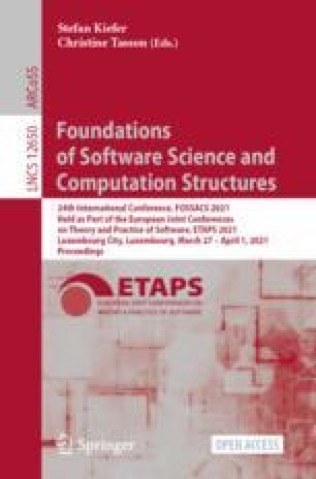
Foundations of software science and computation structures ; 24th International conference, FOSSACS 2021, Held as Part of the European joint conferences on theory and practice of software, ETAPS 2021, Luxembourg City, Luxembourg, March 27 – April 1, 2021, proceedings
This book constitutes the proceedings of the 24th International Conference on Foundations of Software Science and Computational Structures, FOSSACS 2021, which was held during March 27 until April 1, 2021, as part of the European Joint Conferences on Theory and Practice of Software, ETAPS 2021. The conference was planned to take place in Luxembourg and changed to an online format due to the COVID-19 pandemic.

Formal Models of Communicating Systems : Languages, Automata, and Monadic Second-Order Logic
This book studies the relationship between automata and monadic second-order logic, focusing on classes of automata that describe the concurrent behavior of distributed systems.

Evolvable systems : From biology to hardware ; 6th International Conference, ICES 2005, Sitges, Spain, September 12-14, 2005, Proceedings
The flying machines proposed by Leonardo da Vinci in the fifteenth century, the se- reproducing automata theory proposed by John von Neumann in the middle of the twentieth century and the current possibility of designing electronic and mechanical systems using evolutionary principles are all examples of the efforts made by humans to explore the mechanisms present in biological systems that permit them to tackle complex tasks. These initiatives have recently given rise to the emergent field of b- inspired systems and evolvable hardware. The inaugural workshop, Towards Evolvable Hardware, took place in Lausanne in October 1995, followed by the successive events of the International Conference on Evolvable Systems: From Biology to Hardware, held in Tsukuba (Japan) in October 1996, in Lausanne (Switzerland) in September 1998, in Edinburgh (UK) in April 2000, in Tokyo (Japan) in October 2001, and in Trondheim (Norway) in March 2003. Following the success of these past events the sixth international conference was aimed at presenting the latest developments in the field, bringing together researchers who use biologically inspired concepts to implement real systems in artificial intelligence, artificial life, robotics, VLSI design, and related domains. The sixth conference consolidated this biennial event as a reference meeting for the community involved in bio-inspired systems research. All the papers received were reviewed by at least three independent reviewers, thus guaranteeing a high-quality bundle for ICES 2005.

Emergent Computation : Emphasizing Bioinformatics
Emergent Computation is concerned with recent applications of Mathematical Linguistics or Automata Theory. This subject has a primary focus upon ""Bioinformatics"" (the Genome and arising interest in the Proteome), but the closing chapter also examines applications in Biology, Medicine, Anthropology, etc. The book is composed of an organized examination of DNA, RNA, and the assembly of amino acids into proteins. Rather than examine these areas from a purely mathematical viewpoint (that excludes much of the biochemical reality), the author uses scientific papers written mostly by biochemists based upon their laboratory observations. Thus while DNA may exist in its double stranded form, triple stranded forms are not excluded. Similarly, while bases exist in Watson-Crick complements, mismatched bases and abasic pairs are not excluded, nor are Hoogsteen bonds. Just as there are four bases naturally found in DNA, the existence of additional bases is not ignored, nor amino acids in addition to the usual complement of 20. Can there be more than ""64"" possible codons? RNA is examined from the point of view of Nussinov plots.
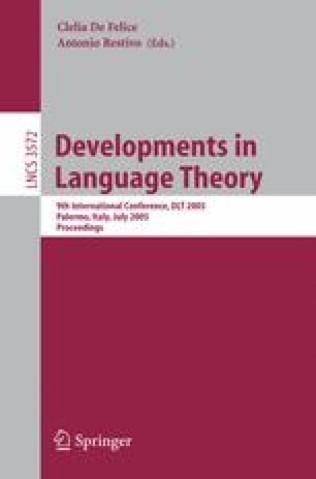
Developments in language theory ; Vol. 3572 ; 9th International Conference, DLT 2005, Palermo, Italy, July 4-8, 2005, Proceedings
Constitutes the refereed proceedings of the 9th International Conference on Developments in Language Theory, DLT 2005, held in Palermo, Italy in July 2005. Several issues in language theory are addressed including grammars, acceptors, and transducers for strings frees, graphs, and arrays; efficient text algorithms; and more.

Developments in language theory ; 8th International Conference, DLT 2004, Auckland, New Zealand, December 13-17, Proceedings
Basic Notions of Reaction Systems / A Kleene Theorem for a Class of Communicating Automata with Effective Algorithms / Algebraic and Topological Models for DNA Recombinant Processes / Contributed Papers : Regular Expressions for Two-Dimensional Languages Over One-Letter Alphabet / On Competence in CD Grammar Systems / The Dot-Depth and the Polynomial Hierarchy Correspond on the Delta Levels, and other

Computer Aided Verification ; 33rd International Conference, CAV 2021, Virtual Event, July 20–23, 2021, Proceedings, Part I
This two-volume set LNCS 12759 and 12760 constitutes the refereed proceedings of the 33rd International Conference on Computer Aided Verification, CAV 2021, held virtually in July 2021. The 63 full papers presented together with 16 tool papers and 5 invited papers were carefully reviewed and selected from 290 submissions. The papers were organized in the following topical sections: Part I: invited papers; AI verification; concurrency and blockchain; hybrid and cyber-physical systems; security; and synthesis. Part II: complexity and termination; decision procedures and solvers; hardware and model checking; logical foundations; and software verification.
Computer Aided Verification ; 32nd International Conference, CAV 2020, Los Angeles, CA, USA, July 21–24, 2020, Proceedings, Part II
The two-volume set LNCS 12224 and 12225 constitutes the refereed proceedings of the 32st International Conference on Computer Aided Verification, CAV 2020, held in Los Angeles, CA, USA, in July 2020.*
