



الصفحة 1
الصفحة 1

Handbook of molecular force spectroscopy
Modern materials science and biophysics are increasingly focused on studying and controlling intermolecular interactions on the single-molecule level. Molecular force spectroscopy was developed in the past decade as the result of several unprecedented advances in the capabilities of modern scientific instrumentation, and defines a number of techniques that use mechanical force measurements to study interactions between single molecules and molecular assemblies in chemical and biological systems. Examples of these techniques, which typically target a specific range of experimental systems and geometries, include atomic force microscopy, optical tweezers, surface forces apparatus, and magnetic tweezers.

Handbook of microscopy for nanotechnology
Handbook of Microscopy for Nanotechnology aims to provide an overview of the basics and applications of various microscopy techniques for nanotechnology. This handbook highlights various key microcopic techniques and their applications in this fast-growing field. Topics to be covered include the following: scanning near field optical microscopy, confocal optical microscopy, atomic force microscopy, magnetic force microscopy, scanning turning microscopy, high-resolution scanning electron microscopy, orientational imaging microscopy, high-resolution transmission electron microscopy, scanning transmission electron microscopy, environmental transmission electron microscopy, quantitative electron diffraction, Lorentz microscopy, electron holography, 3-D transmission electron microscopy, high-spatial resolution quantitative microanalysis, electron-energy-loss spectroscopy and spectral imaging, focused ion beam, secondary ion microscopy, and field ion microscopy.

Fundamentals of Friction and Wear on the Nanoscale
In the past twenty years, powerful tools such as atomic force microscopy have made it possible to accurately investigate the phenomena of friction and wear, down to the nanometer scale. Readers of this book will become familiar with the concepts and techniques of nanotribology, explained by an international team of scientists and engineers, actively involved and with long experience in this field. Edited by two pioneers in the field, 'Fundamentals of Frictions and Wear at the Nanoscale' is suitable both as first introduction to this fascinating subject, and also as a reference for researchers wishing to improve their knowledge of nanotribology and to keep up with the latest results in this field.
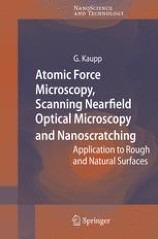
Atomic Force Microscopy, Scanning Nearfield Optical Microscopy and Nanoscratching : Application to Rough and Natural Surfaces
Making a clear distinction is made between nano- and micro-mechanical testing for physical reasons, this monograph describes the basics and applications of the supermicroscopies AFM and SNOM, and of the nanomechanical testing on rough and technical natural surfaces in the submicron range down to a lateral resolution of a few nm. New or improved instrumentation, new physical laws and unforeseen new applications in all branches of natural sciences (around physics, chemistry, mineralogy, materials science, biology and medicine) and nanotechnology are covered as well as the sources for pitfalls and errors.

Alzheimers disease : Cellular and molecular aspects of Amyloid beta
This book contains a survey of present-day research into the biomedical fundamentals of Alzheimer’s disease (AD). It contains 20 chapters dealing with widely ranging topics, all of which have a bearing upon the understanding and treatment of AD. Starting with a broad survey of the contribution that the various microscopical techniques (light microscopy, electron microscopy, atomic force microscopy)
