



الصفحة 1
الصفحة 1

Observing the Sun with Coronado™ Telescopes
At around the turn of the millennium, the introduction of the Coronado range of solar telescopes and filters heralded the ‘coming of age’ of amateur solar astronomy. Before then, solar astronomy was mostly white-light only. Hydrogen-alpha systems were expensive and difficult to use, but today even the budget-priced Coronado PST (Personal Solar Telescope) provides a band pass of one Angstrom and is thermally stable. That means that today’s amateur solar observers can see – and image – sunspots, flares, prominences, plage, filaments, and active regions of the Sun, all in amazing detail.

Ice, Rock, and Beauty : A Visual Tour of the New Solar System
Ice, Rock, and Beauty is a book for anybody who lives in the solar neighborhood, and takes an interest in its significance to us as residents.The book gathers images from a rich pool, many from national and international organizations such as NASA and ESA, some directly from academic astronomers, and a few from private individuals. Together they tell a story of the Solar System, and of its beauty, that has not been told before.
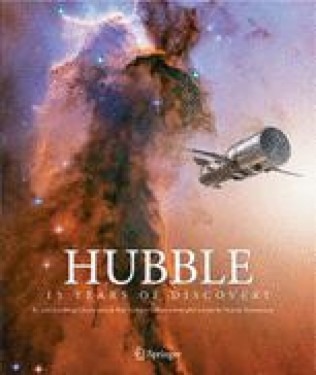
Hubble : 15 Years of Discovery
This book forms part of the European Space Agency’s 15th anniversary celebration activities for the 1990 launch of the NASA/ESA Hubble Space Telescope. As an observatory in space, Hubble is one of the most successful scientific projects of all time, both in terms of scientific output and its immediate public appeal.Hubble creates an enormous impact by exploiting a unique scientific niche where no other instruments can compete. It consistently delivers super-sharp images and clean, uncontaminated spectra over the entire near-infrared and ultraviolet regions of the electromagnetic spectrum. This has opened up new scientific territory and resulted in many paradigm-breaking discoveries.
High Time Resolution Astrophysics
High Time Resolution Astrophysics (HTRA) is an important new window to the universe and a vital tool in understanding a range of phenomena from diverse objects and radiative processes. This importance is demonstrated in this volume with the description of a number of topics in astrophysics, including quantum optics, cataclysmic variables, pulsars, X-ray binaries and stellar pulsations to name a few. Underlining this science foundation, technological developments in both instrumentation and detectors are described. These instruments and detectors combined cover a wide range of timescales and can measure fluxes, spectra and polarisation. These advances make it possible for HTRA to make a big contribution to our understanding of the Universe in the next decade.

Galaxies in Turmoil : The Active and Starburst Galaxies and the Black Holes That Drive Them
Active galaxies involve some of the most extreme conditions and some of the most intriguing phenomena found anywhere in the universe. Research students - and even established research astronomers - will also find this book invaluable as a quick reference to the properties of, and phenomena within, those types of active galaxies that may be outside their specialisms.
Making Beautiful Deep-Sky Images : Astrophotography with Affordable Equipment and Software
Professor Greg Parker's astronomical photographs are widely known for their excellence, and a selection of them has recently been shown as a public exhibition in the UK. In Making Beautiful Deep-Sky Images, he provides a detailed account of how spectacular deep-sky images can be taken by amateur astronomers using CCD cameras, and how they can subsequently be processed and enhanced in the "electronic darkroom" for maximum beauty and impact. Quite simply, this is a "how to do it" book for people who want to make stunning astronomical pictures.
CCD Astrophotography : High-Quality Imaging from the Suburbs
This is a reference book for amateur astronomers who have become interested in CCD imaging. Those glorious astronomical images found in astronomy magazines might seem out of reach to newcomers to CCD imaging, but this is not the case. Great pictures are attainable with modest equipment. Adam Stuart’s many beautiful images, reproduced in this book, attest to the quality of – initially – a beginner’s efforts. Chilled-chip astronomical CCD-cameras and software are also wonderful tools for cutting through seemingly impenetrable light-pollution. CCD Astrophotography from the Suburbs describes one man’s successful approach to the problem of getting high-quality astronomical images under some of the most light-polluted conditions.
Astrophysics is easy! : An introduction for the amateur astronomer
With some justification, many amateur astronomers believe astrophysics is a very difficult subject, requiring at least degree-level mathematics to understand it properly. This isn’t necessarily the case. Mike Inglis' quantitative approach to the subject explains all aspects of astrophysics in simple terms and cuts through the incomprehensible mathematics with which this fascinating subject is all too often associated. Astrophysics is Easy! begins by looking at the H-R diagram and other basic tools of astrophysics, then ranges across the universe, from a first look at the interstellar medium and nebulae, through the birth, evolution and death of stars, to the physics of galaxies and clusters of galaxies.
Astronomical sketching : A step-by-step introduction
At some time we have all gazed through the telescope eyepiece at the magnificent rings and banded globe of Saturn, or seen long shadows reaching across crater floors at the Moon’s terminator – and wondered at the sheer beauty of the sight. It seems almost anachronistic to think of sketching when CCD imaging is available, but astronomical sketching provides an entirely different and deeply personal experience. It means spending time at the eyepiece to really look at what you can see, training your eye to perceive ever greater detail to take the fullest advantage of your telescope's light grasp and resolution.
