



الصفحة 1
الصفحة 1

Il cielo sopra Roma : I luoghi dell’astronomia = The sky above Rome : The places of astronomy
Astronomy in Rome has always been there, but a little hidden: it was in the palaces, in the churches or, better, above the churches, speculas scattered along a path that few know by now. Intrigued and frightened, the Romans witnessed the burning of Giordano Bruno in a familiar corner of Campo de 'Fiori, but they probably didn't quite understand what guilt he was accused of. They certainly did not think that he was a philosopher and a scientist who had tried to imagine what the world was like.

Highlights of Spanish Astrophysics IV ; Proceedings of the Seventh Scientific Meeting of the Spanish Astronomical Society (SEA) held in Barcelona, Spain, September 12-15, 2006
This volume documents the contributions presented at the Seventh Scientific Meeting of the Spanish Astronomical Society (Sociedad Española de Astronomía, SEA). Two plenary sessions of the meeting were devoted to the approved entrance of Spain as a full member of the European Southern Observatory (ESO) and to the imminent first light of the greatest telescope in the world, the GTC (Gran Telescopio de Canarias), milestones that will certainly lead the Spanish Astronomy in the next future.

Fare astronomia con piccoli telescopi = Are astronomy with small telescopes
Giant tools are not necessarily required to produce scientifically valid results in the field of astronomy. Even the amateur with a small telescope, with a diameter of only 8-9 cm, can contribute to the science of the sky by making useful observations of the Sun, the Moon, planets, comets, asteroids, double or variable stars, nebulae and star clusters. The manual of M.K. Gainer explains what the minimum equipment is (a small telescope, a computer, a simple digital camera), how to use it, and what are the appropriate techniques to be adopted in the observations. It also offers schemes for interpreting and reducing the collected data, as well as forms to be filled in and sent to international collection centers.
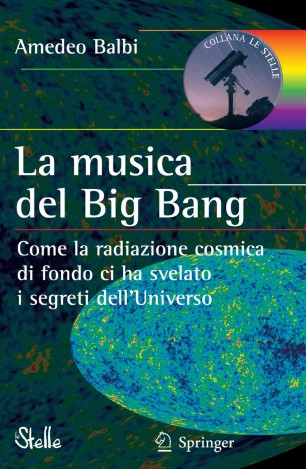
La musica del Big Bang : Come la radiazione cosmica di fondo ci ha svelato i segreti dell’Universo = The music of the Big Bang : How the cosmic background radiation revealed the secrets of the Universe to us
Cosmic microwave background radiation is the residue of the great heat following the Big Bang. A tenuous sign, over 13 billion years old, in which the answers to many of the questions about the nature of our Universe are hidden. Discovered by chance in 1964, in the last forty years this fossil trace of the origins of the Cosmos has been explored with every available means. Two Nobel Prizes in physics have already been awarded for research involving it, the last in 2006 for the results of the COBE satellite. Much of the information encoded in the cosmic background radiation was impressed by the superimposition of acoustic waves present in the early Universe: a "music" of the Big Bang, which cosmologists have tried for years to reconstruct, using techniques similar to those that allow to distinguish the sound of different musical instruments. Only recently have the first notes of this extraordinary cosmic symphony finally been revealed, but the investigation is not over yet. This book illustrates, with a language suitable even for non-specialists, the theories, observations and discoveries that have brought cosmology into a new era.
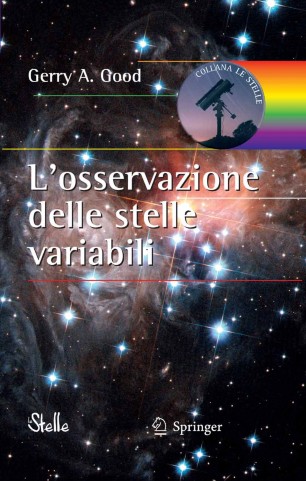
L’osservazione delle stelle variabili = The observation of variable stars
The observation of variable stars is one of the main contributions that amateur astronomers can offer to science and this book provides all the information necessary to pursue it profitably. In the first part the different classes of variables are presented in detail, with examples, light curves and physical descriptions. The second section, on the other hand, covers all the practical aspects of observation: from preparation and planning, to observation techniques, up to the management and processing of data.
