



الصفحة 1
الصفحة 1

Numerical Methods in Finance
The use of mathematical models and numerical techniques in finance is a growing practice, and an increasing number of applied mathematicians are working on applications in finance and business. This book presents some exciting developments arising from the combination of mathematics, numerical analysis, and finance. It covers a wide range of topics, from portfolio management and asset pricing, to performance, risk, debt and real option evaluation. It also presents applications of a variety of cutting edge approaches and techniques, including robust control, min-max optimisation, Bessel processes, stochastic viability, variational inequalities, and Monte-Carlo test techniques. The book also presents surveys of models and approaches in specific areas in finance, such as corporate debt valuation and portfolio selection

Investment valuation and asset pricing : Models and methods
Offers an overview of original works on foundational asset pricing studies that follows their historical publication chronologically throughout the text. Each chapter stays close to the original works of these major authors, including quotations, examples, graphical exhibits, and empirical results. Additionally, it includes statistical concepts and methods as applied to finance. These statistical materials are crucial to learning asset pricing, which often applies statistical tests to evaluate different asset pricing models.

Dynamic Asset Allocation with Forwards and Futures
DYNAMIC ASSET ALLOCATION WITH FORWARD AND FUTURES is an advanced text on the theory of forward and futures markets which aims at providing readers with a comprehensive knowledge of how prices are established and evolve over time, what optimal strategies one can expect from the participants, what characterizes such markets, and what major theoretical and practical differences distinguish futures from forward contracts. The book proposes an approach of these markets from the perspective of dynamic asset allocation and asset pricing theory within an inter-temporal framework. The main ingredients that are used are the assumed absence of frictions and arbitrage opportunities in financial and real markets, the uniqueness of the economic general equilibrium, when such an equilibrium is required and the tools of continuous time finance, namely martingale theory and stochastic dynamic programming. The scope of DYNAMIC ASSET ALLOCATION WITH FORWARD AND FUTURES is essentially theoretical, with emphasis on economic meaning and financial interpretation. Regarding investment and/or hedging, focus is on optimal strategies rather than on actual practice. Simulations, however, are performed when important insights can be delivered as to the practical relevance of some theoretical results. Also, optimal strategies using futures are shown to differ markedly from those using forwards. The following issues are examined: pure hedging, investment and hedging in complete or incomplete markets, currency risk, optimal spreading, presence of stochastic dividend or convenience yields, pricing of non-redundant futures or forwards by means of general equilibrium analysis, and revisiting of existing Capital Asset Pricing Models.
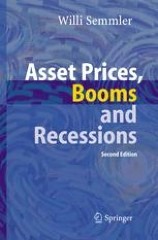
Asset prices, booms and recessions : Financial economics from a dynamic perspective
Studies the interaction of the financial market, economic activity and the macroeconomy from a dynamic perspective. The financial market to be studied here encompasses the money and bond market, credit market, stock market and foreign exchange market. Economic activity is described by the activity of firms, banks, households, governments and countries. The book shows how economic activity affects asset prices and the financial market and how asset prices and financial market volatility feed back to economic activity. The focus in this book is on theories, dynamic models and empirical evidence.

A Course in Derivative Securities : Introduction to Theory and Computation
Aims at a middle ground between the introductory books on derivative securities and those that provide advanced mathematical treatments. It is written for mathematically capable students who have not necessarily had prior exposure to probability theory, stochastic calculus, or computer programming. It provides derivations of pricing and hedging formulas (using the probabilistic change of numeraire technique) for standard options, exchange options, options on forwards and futures, quanto options, exotic options, caps, floors and swaptions, as well as VBA code implementing the formulas. It also contains an introduction to Monte Carlo, binomial models, and finite-difference methods.
