



الصفحة 1
الصفحة 1

New Carbon Based Materials for Electrochemical Energy Storage Systems : Batteries, Supercapacitors and Fuel Cells
This NATO-ARW volume contains a diverse collection of papers addressing the role of carbon in some key electrochemical systems, both conventional and emerging. These papers discuss the latest issues associated with development, synthesis, characterization and use of new advanced carbonaceous materials for electrochemical energy storage. Such systems include: metal-air primary and rechargeable batteries, fuel cells, supercapacitors, cathodes and anodes of lithium-ion and lithium polymer rechargeable batteries, as well as nanocarbon materials of the future.
Nanotechnology and nanoelectronics : Materials, devices, measurement techniques
This book provides a concise and didactically structured presentation of nanotechnology as matters stand.nanotechnology. Based on known facts, an evaluation of nanotechnology, its further development, and its future prospects are attempted.

Nanostructures : Fabrication and Analysis
The main theme of this book is the exploration the underlying physical laws that permit the fabrication of nanometer-scale structures. As researchers attempt to fabricate nanometer-scale structures which do not exist per se, they must still employ the natural laws to fabricate them through processes such as self-assembly. So it turns out that our techniques for fabrication of nanometer-scale structures are not artificial but actually rely on the natural laws. We even find that nanometer-scale structures, e.g. fullerenes, are fabricated in nature beneath the surface of the Earth. This fact may be called the ubiquity of the nanometer-scale structures. The topics presented in the book include: scanning probe-related and near-field techniques, nanolithography, self assembling and design of novel nanostructures, as well as new nanodevices and their application.

Nanoscaled Semiconductor-on-Insulator Structures and Devices
This proceedings volume constitutes an archive of the contributions of the key-speakers who attended the NATO Advanced Research Workshop on “Nanoscaled Semiconductor-On-Insulator Structures and devices” held in the Tourist and Recreation Centre “Sudak” (Crimea, Ukraine) from 15 to 19 October 2006. The semiconductor industry has sustained a very rapid growth during the last three decades through impressive technological developments which have resulted in products with higher performance and lower cost per function. After many years of development it is now confidently predicted that semiconductor-on-insulator materials will enter and increasingly be used by manufacturing industry. The wider use of semiconductor (es- cially silicon) on insulator materials will not only enable the benefits of these materials to be demonstrated but, also, will drive down the cost of substrates which, in turn, will stimulate the development of other novel devices and applications.

Nanomaterials for Application in Medicine and Biology
This volume contains research reports presented during the NATO Advanced Research Workshop (ARW) “Materials for Application in Medicine and Biology” held in Bonn, Germany, from October 4 to 6, 2006 at the center of advanced european studies and research (caesar). The application of nanomaterials in medicine and biology can be understood as the gathering and use of our current knowledge on nanoscale features of b- logical systems in order to learn how to design nanodevices for biomedical uses.
Nanomaterials and Nanosystems for Biomedical Applications
The book includes expert reviews on the advances and current problems associated with the implants and nanodevices along with their applications in medicine, pharmaceutics, cancer therapy, gene transfer and drug delivery. The editor, M. R. Mozafari (PhD), has been working in the field of nanobiotechnology for the past 14 years and has produced more than 60 publications.
Modern Aspects of Electrochemistry ; Vol. 42
MODERN ASPECTS OF ELECTROCHEMISTRY No. 42 Edited by Constantinos Vayenas University of Patras, Greece Topics in Number 42 include: The electrochemistry and electrocatalysis of Ruthenium in regards to the development of electrodes for Polymer Electrolyte Membrane (PEM) fuel cells Breakthroughs in Solid Oxide Fuel Cell (SOFC) anodes and cathodes leading to improved electrocatalysis Electrocatalysis of the electrochemical reduction of CO2 on numerous metals The interfacial phenomena of electrodeposition and codeposition, and the need for new theoretical analyses of the electrode-electrolyte interface Advantages of scanning tunneling microscopy (STM) in understanding the basics of catalysis, electrocatalysis and electrodeposition The role of electrochemistry in emerging technologies including electrodeposition and electroforming at the micro and nano levels, semiconductor and information storage, including magnetic storage devices.

Conducting Polymers with Micro or Nanometer Structure
Conducting Polymers with Micro or Nanometer Structure describes a topic discovered by three winners of the Nobel Prize in Chemistry in 2000: Alan J. Heeger, University of California at Santa Barbara, Alan G. MacDiarmid at the University of Pennsylvania, and Hideki Shirakawa at the University of Tsukuba. Since then, the unique properties of conducting polymers have led to promising applications in functional materials and technologies. The book first briefly summarizes the main concepts of conducting polymers before introducing micro/nanostructured conducting polymers dealing with their synthesis, structural characterizations, formation mechanisms, physical and chemical properties, and potential applications in nanomaterials and nanotechnology. The book is intended for researchers in the related fields of chemistry, physics, materials, nanomaterials and nanodevices.

Materials for Tomorrow : Theory, Experiments and Modelling
This book contains six chapters on central topics in materials science. Each is written by specialists in the field, and gives a state-of-the-art presentation of the subject for graduate students and scientists not necessarily working in that field. Computer simulations of new materials, theory and experimental work are all extensively discussed. As nanomaterials are of great current interest, most of the topics discussed have a bearing on nanomaterials and nanodevices. In addition to inorganic nanotubes, metallic nanocrystals, electronic nanodevices, spintronics and interfaces on an atomic scale, the text also presents computer simulations on one of the less well understood fields in solid-state physics and materials science: glasses and undercooled fluids.
Light, Water, Hydrogen : The Solar Generation of Hydrogen by Water Photoelectrolysis
The development of a direct, inexpensive, and efficient method for converting solar energy into a portable, clean fuel would allow elimination of the growing problems associated with the ever increasing use of fossil fuels and the reality of their rapid depletion. As the title suggests, Light, Water, Hydrogen: The Solar Generation of Hydrogen by Water Photoelectrolysis, considers the combination of water and light with a suitable semiconductor to achieve a safe, renewable and therefore inexhaustable means for hydrogen generation via the splitting of the water molecule, or photoelectrolysis.
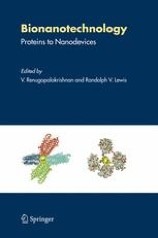
Bionanotechnology : Proteins to Nanodevices
Bionanotechnology is the key integrative technology of the 21st century and aims to use the knowledge, gathered from the natural construction of cellular systems, for the advancement of science and engineering. Investigating the topology and communication processes of cell parts can lead to invention of novel biological devices with exciting applications. Though microscale to nanoscale research offers an excellent space for the development of futuristic technologies, a number of challenges must be overcome. Due to paucity of a dedicated literature on the protein based nanodevices we bring you this monograph that combines collective research works of scientists probing into this fascinating universe of bionanotechnology. The monograph has been written with an aim of surveying engineering design principles of biomolecular nanodevices, prototype nanodevices based on redox proteins, bacteriorhodopsins and natural fibers, and touching upon the future developments in the field.

Advances in dental implantology using nanomaterials and allied technology applications
Discusses how nanotechnology has influenced the provision of implant treatment from surgery to prosthetic reconstruction and post treatment biological complications. It aims to present both the nanotechnology and allied research along with the clinical concepts of almost every different aspect of implantology in one volume.
