



الصفحة 1
الصفحة 1

Moral Psychology Today : Essays on Values, Rational Choice, and the Will
This book brings together in one volume some of the very latest developments in moral psychology that were presented at a major American conference in 2004. Moral psychology is a broad area at the intersection of moral philosophy and philosophy of mind and action. Essays in this collection deal with most of the central issues in moral psychology that are of interest to a large number of philosophers today, including important questions in normative ethical theory, meta-ethics, and applied ethics.

Fundamentals in Nuclear Physics : From Nuclear Structure to Cosmology
Explores nuclear physics and its applications ranging from the structure of nuclei and their reactions, to astrophysics and cosmology. The physics is introduced with arguments based on simple ideas such as the empirical structure of nuclear forces and its interplay with the Pauli principle and Coulomb repulsion. The book then develops elementary nuclear models and illustrates nuclear systematics with experimental data. Reactions and decays are discussed both phenomenologically and from the point of view of fundamental electro-weak interaction theory. The discussions of fission and fusion emphasize nuclear energy production. This leads directly into nuclear astrophysics and nucleosynthesis. The book ends with a presentation of the latest ideas about cosmology. As a primer this course will lay the foundations for more specialized subjects within the vast domain of nuclear physics as a whole. This book emerged from a series of topical courses the authors delivered at the Ecole Polytechnique and will be useful for advanced undergraduates and for scientists in a variety of fields.

Engineering Optics
Engineering Optics is a book for students who want to apply their knowledge of optics to engineering problems, as well as for engineering students who want to acquire the basic principles of optics. It covers such important topics as optical signal processing, holography, tomography, holographic radars, fiber optical communication, electro- and acousto-optic devices, and integrated optics (including optical bistability). As a basis for understanding these topics, the first few chapters give easy-to-follow explanations of diffraction theory, Fourier transforms, and geometrical optics. Practical examples, such as the video disk, the Fresnel zone plate, and many more, appear throughout the text, together with numerous solved exercises. There is an entirely new section in this updated edition on 3-D imaging.

Electromagnetic Theory for Microwaves and Optoelectronics
This book is a first year graduate text on electromagnetic fields and waves. At the same time it serves as a useful reference for researchers and engineers in the areas of microwaves and optoelectronics. Following the presentation of the physical and mathematical foundations of electromagnetic theory, the book discusses the field analysis of electromagnetic waves confined in material boundaries, or so-called guided waves, electromagnetic waves in the dispersive media and anisotropic media, Gaussian beams and scalar diffraction theory. The theories and methods presented in the book are foundations of wireless engineering, microwave and millimeter wave techniques, optoelectronics and optical fiber communication.

Collective Action in the Formation of Pre-Modern States
This book explores a collective action perspective on the formation of pre-modern states, but does not only promote a new mode of theoretical understanding. Rather, it subjects collective action theory to a methodologically rigorous evaluation using a systematic cross-cultural analysis of historical, ethnographic, and archaeological data drawn from a world-wide sample of societies. These data provide strong support for the theory while pointing the way to a more complex and nuanced approach to collective action, uniting theories of pre-modern and modern states.

Knowledge and Action
Explores interdependencies between knowledge, action, and space from different interdisciplinary perspectives. Some of the contributors discuss knowledge as a social construct based on collective action, while others look at knowledge as an individual capacity for action. The chapters contain theoretical frameworks as well as experimental outcomes.
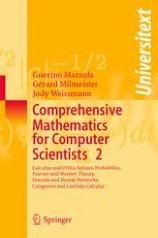
Comprehensive mathematics for computer scientists 2 : Calculus and ODEs, splines, probability, fourier and wavelet theory, fractals and neural networks, categories and lambda calculus
This second volume of a comprehensive tour through mathematical core subjects for computer scientists completes the first volume in two - gards: Part III first adds topology, di?erential, and integral calculus to the t- ics of sets, graphs, algebra, formal logic, machines, and linear geometry, of volume 1. With this spectrum of fundamentals in mathematical e- cation, young professionals should be able to successfully attack more involved subjects, which may be relevant to the computational sciences. In a second regard, the end of part III and part IV add a selection of more advanced topics. In view of the overwhelming variety of mathematical approaches in the computational sciences, any selection, even the most empirical, requires a methodological justi?cation. Our primary criterion has been the search for harmonization and optimization of thematic - versity and logical coherence. This is why we have, for instance, bundled such seemingly distant subjects as recursive constructions, ordinary d- ferential equations, and fractals under the unifying perspective of c- traction theory.
