



الصفحة 1
الصفحة 1

Nanotribology and nanomechanics : An introduction ; 1st ed.
This volume serves as a timely, practical introduction to the principles of nanotribology and nanomechanics and applications to magnetic storage systems and MEMS/NEMS. Assuming some familiarity with macrotribology/mechanics, the book comprises chapters by internationally recognized experts, who integrate knowledge of the field from the mechanics and materials-science perspectives. They cover key measurement techniques, their applications, and theoretical modelling of interfaces, each beginning their contributions with macro- and progressing to microconcepts.

Nanophytomedicine : An emerging platform for drug delivery
Covers recent advances in experimental and theoretical studies on various properties of nanoparticles derived from plant sources. This book assesses the recent advancements and applications of plant-based nanoparticles and also highlights emerging concepts of biomimetics. Contains 24 chapters encompassing various therapeutic applications of phytochemicals derived from plants, ferns, seaweeds, and so on, mediated through nanotechnology and its allied approaches. A fervent attempt has been made to compile every significant advancement in the field of phytonanomedicine so as to accelerate its momentum in the pharmaceutical sector.

Nanobiotechnology of Biomimetic Membranes
Nanobiotechnology of Biomimetic Membranes focuses on biomimetic membranes. The application of nanotechnology principles and methodology to problems in biotechnology provides an exciting new discipline that will generate a revolution of novel applications, across many disciplines. This valuable new title offers an international perspective on the development of biotechnology applications.

N4-Macrocyclic Metal Complexes
The study of nanoparticles is anchored in Colloid Science. Colloid Science as we consider it today was nucleated by Wolfgang Ostwald and initiated by his biological studies. The strong connection between biology and Colloid Science lost attractiveness in the last decades. The revival of this interdisciplinary science is now noted and we hope that a signal will start from the Potsdam conference. "This is an excellent and detailed book of 14 chapters that is timely in its reviews of the electrochemical and electrocatalytic properties of the porphyrinoids and is written by a range of experts in the different fields covered.

Multiscale Dissipative Mechanisms and Hierarchical Surfaces : Friction, Superhydrophobicity, and Biomimetics
Multiscale Dissipative Mechanisms and Hierarchical Surfaces covers the rapidly developing topics of hierarchical surfaces, roughness-induced superhydrophobicity and biomimetic surfaces. The research in these topics has been progressing rapidly in the recent years due to the advances in the nanosciences and surfaces science and due to potential applications in nanotechnology. The first in its field, this monograph provides a comprehensive review of these subject and presents the background introduction as well as recent and new results in the area.

Iridescences : The Physical Colors of Insects
Biologists will find a clear and in-depth study of the different physical phenomena generating colors. It will constitute a boundless "biomimetical" inspiration for physicists and engineers, for if physics is simple, the combinations of effects and the structures involved are extremely complex and original.

Fuel Cell Technology : Reaching Towards Commercialization
The Engineering Materials and Processes series focuses on all forms of materials and the processes used to synthesise and formulate them as they relate to the various engineering disciplines.The series deals with a diverse range of materials: ceramics, metals (ferrous and non-ferrous), semiconductors, composites, polymers biomimetics, etc. Each monograph in the series is written by a specialist and demonstrates how enhancements in materials and the processes associated with them can improve performance in the field of engineering in which they are used.

Efficiency in Natural Product Total Synthesis
Uniting the key organic topics of total synthesis and efficient synthetic methodologies, this book clearly overviews synthetic strategies and tactics applied in total synthesis, demonstrating how the total synthesis of natural products enables scientific and drug discovery. • Focuses on efficiency, a fundamental and important issue in natural products synthesis that makes natural product synthesis a powerful tool in biological and pharmaceutical science • Describes new methods like organocatalysis, multicomponent and cascade reactions, and biomimetic synthesis

Computational Mechanics of Composite Materials : Sensitivity, Randomness and Multiscale Behaviour
The Engineering Materials and Processes series focuses on all forms of materials and the processes used to synthesise and formulate them as they relate to the various engineering disciplines. The series deals with a diverse range of materials: ceramics; metals (ferrous and non-ferrous); semiconductors; composites, polymers biomimetics etc. Each monograph in the series will be written by a specialist and will demonstrate how enhancements in materials and the processes associated with them can improve performance in the field of engineering in which they are used.

Color science and shade selection in operative dentistry : Essential elements for clinical success
Presents all the theory and clinical guidance required in order to achieve consistent clinical success. The book opens by reviewing color and its dimensions and discussing color perception, drawing attention to the various phenomena that impact upon it. Shade selection in Operative Dentistry is then explained in detail with the aid of copious illustrations. The coverage encompasses shade selection methods for resin-based composite restorations and for bleaching procedures, with presentation of the latest evidence on their accuracy and reliability.

Collagen: Structure and Mechanics
Collagen: Structure and Mechanics provides a cohesive introduction to collagen-rich tissues, such as tendon, bone, cornea or arterials walls. Written in a clear and didactic manner, this volume reviews current knowledge on hierarchical structure, mechanical properties, deformation and strengthening mechanisms, and discusses many applications in biomaterials and tissue engineering.
Materials Chemistry
"Written to fill the need for a textbook that addresses inorganic-, organic-, and nano-based materials from a structure vs. property treatment, Materials Chemistry aims to provide a suitable breadth and depth coverage of the rapidly evolving materials field - in a concise format. This modern treatment offers innovative coverage and practical perspective throughout.

Learning from nature how to design new implantable biomaterialsis : From biomineralization fundamentals to biomimetic materials and processing routes ; Proceedings of the NATO Advanced Study Institute, held in Alvor, Algarve, Portugal, 13-24 October 2003
The demands upon the material properties largely depend on the site of application and the function it has to restore. Ideally, a replacement material should mimic the living tissue from a mechanical, chemical, biological and functional point of view.

Click chemistry
In chemical synthesis, click chemistry is a class of simple atomic economy reactions commonly used to join two selected molecular entities. Click chemistry is not one specific reaction, but describes a method for generating products that follow examples in nature, which also generates substances by joining small modular units. In many applications, click interactions that join a biomolecule and a reporter molecule. Click chemistry is not limited to biological conditions: the concept of a 'click' reaction has been used in protein chemistry, pharmacokinetics, and many biomimetic applications. However, they have been made remarkably useful in the discovery, localization and qualification of biomolecules.
Biomineralization II : Mineralization Using Synthetic Polymers and Templates
In nature, biological organisms produce mineralized tissues such as bone, teeth, diatoms, and shells. Biomineralization is the sophisticated process of production of these inorganic minerals by living organisms. Construction of organic–inorganic hybrid materials with controlled mineralization analogous to those produced by nature has recently received much attention because it can aid in understanding the mechanisms of the biomineralization process and development of biomimetic materials processing. The biomineralization processes use aqueous solutions at temperatures below 100 ◦C and no toxic intermediates are produced in these systems. This series presents critical reviews of the present position and future trends in modern chemical research. The short and concise reports on chemistry are each written by world renowned experts. This series is still valid and useful after 5 or 10 years.
Biomineralization I : Crystallization and Self-Organization Process
The five chapters of Biomineralization, volume 1, provide a bridge between the mineralogy and the organic substrates that enable the mineral formation by organisms in nature and under laboratory conditions. The book is a most useful reference for all concerned with biomineralization and biogenic minerals.In nature, biological organisms produce mineralized tissues such as bone, teeth, diatoms, and shells. Biomineralization is the sophisticated process of production of these inorganic minerals by living organisms. Construction of organic–inorganic hybrid materials with controlled mineralization analogous to those produced by nature has recently received much attention because it can aid in understanding the mechanisms of the biomineralization process and development of biomimetic materials processing.
Biomimetics for architecture & design : Nature - analogies - technology
Provides the readers with a timely guide to the application of biomimetic principles in architecture and engineering design. As a result of a combined effort by two internationally recognized authorities, the biologist Werner Nachtigall and the architect Göran Pohl, the book describes the principles which can be used to compare nature and technology, and at the same time it presents detailed explanations and examples showing how biology can be used as a source of inspiration and “translated” in building and architectural solutions (biomimicry). Even though nature cannot be directly copied, the living world can provide architects and engineers with a wealth of analogues and inspirations for their own creative designs. But how can analysis of natural entities give rise to advanced and sustainable design? By reporting on the latest bionic design methods and using extensive artwork, the book guides readers through the field of nature-inspired architecture, offering an extraordinary resource for professional architects, engineers, designers and urban planners, as well as for university teachers, researchers and students.
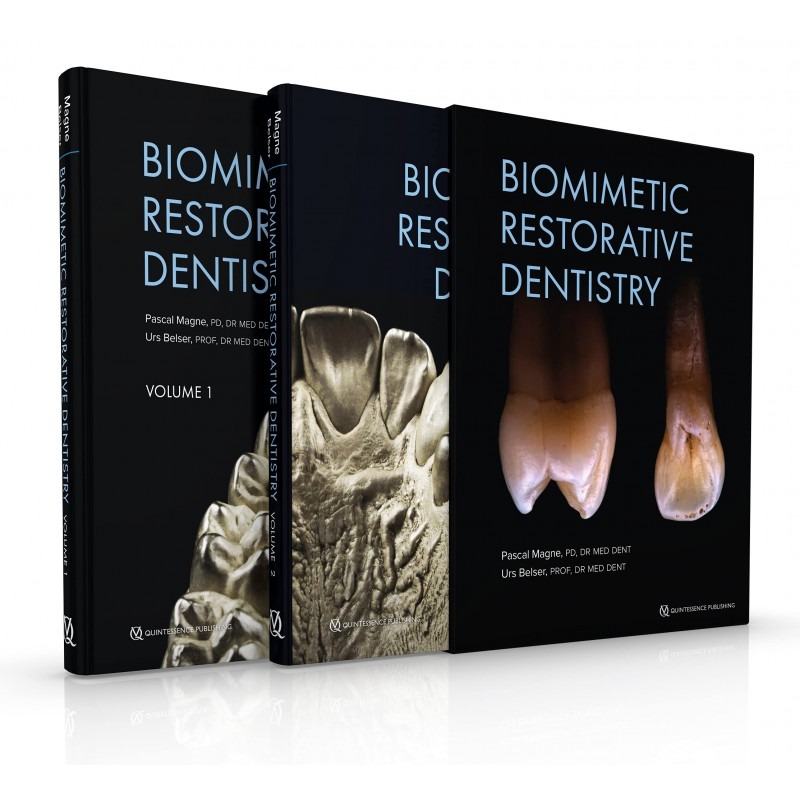
Biomimetic restorative dentistry ; Vol.1 : Fundamentals and basic clinical procedures
Takes the science of esthetic dental reconstruction to a new level both clinically and academically, and it offers all that a clinician could wish for in terms of indications and the classic clinical steps for tooth preparation, laboratory and CAD/CAM procedures, adhesive luting procedures, and maintenance. But above all, what makes this book so unique is the biomimetic principle—as such, restoring or mimicking the biomechanical, structural, and esthetic integrity of teeth is paramount. The core of this book centers on the application of the biomimetic principle in the form of bonded restorations using composite resins and ceramics, covering indications, treatment planning, diagnosis, tooth preparation and impression, laboratory and CAD/CAM procedures, final delivery, follow-up, maintenance, and repair. Written by a true master and artist, this book will undoubtedly inspire excellence in anyone who picks it up.

Biomimetic restorative dentistry
Biomimetic dentistry represents a significant advancement in restorative practices, emphasizing the preservation of natural tooth structure and the use of innovative materials that closely mimic biological tissues. This article explores the potential impact of biomimetic approaches on patient outcomes, highlighting key findings that demonstrate improved longevity of dental restorations and reduced incidence of secondary caries.
Biomimetic neural learning for intelligent robots : Intelligent systems, cognitive robotics, and neuroscience
This book presents research performed as part of the EU project on biomimeticmultimodal learning in a mirror neuron-based robot (MirrorBot) and contribu-tions presented at the International AI-Workshop on NeuroBotics. The over-all aim of the book is to present a broad spectrum of current research intobiomimetic neural learning for intelligent autonomous robots. In this book we show the development of newtechniques using cell assemblies, associative neural networks, and Hebbian-typelearning in order to associate vision, language and motor concepts. We havedeveloped biomimetic multimodal learning and language instruction in a robotto investigate the task of searching for objects. As well as the research performedin this area for the MirrorBot project, the second part of this book incorporatessignificant contributions from other research in the field of biomimetic robotics.This second part of the book concentrates on the progress made in neuroscienceinspired robotic learning approaches (in short: NeuroBotics). We hope that this book stimulates and encourages new research in this in-teresting and dynamic area.
