



الصفحة 1
الصفحة 1

Ontologies for Software Engineering and Software Technology
The editors structured the contributions into three parts: first, a detailed introduction into the use of ontologies in software engineering and software technology in general; second, the use of ontologies to conceptualize different process-related domains such as software maintenance, software measurement, or SWEBOK, initiated by IEEE; third, the use of ontologies as artifacts in several software processes, like, for example, in OMG’s MOF or MDA.

Objects, Components, Models and Patterns ; 46th International Conference, TOOLS EUROPE 2008, Zurich, Switzerland, June 30 - July 4, 2008. Proceedings
This book constitutes the thoroughly refereed proceedings of the 46th International Conference on Objects, Components, Models and Patterns, TOOLS EUROPE 2008, held in Zurich, Switzerland, in June/July 2008.TOOLS played a major role in the spread of object-oriented and component technologies. It has now broadened its scope beyond the original topics of object technology and component-based development to encompass all modern, practical approaches to software development.
Object-Oriented Programming and Java
Object-Oriented Programming and Java presents two important topics in contemporary software development: object-oriented programming and Java. This book takes a different teaching approach from most available literature, it begins with the description of real-world object interaction scenarios and explains how they can be translated, represented and executed using object-oriented programming paradigm.
Object-oriented metrics in practice : Using software metrics to characterize, Evaluate, and Improve the design of object-oriented systems
The combination of theoretically sound results and practically tested procedures and solution paths makes this book an ideal companion for professional software architects, developers and quality engineers. The pattern-oriented description of disharmonies offers easy access to detecting shortcomings and applying solution strategies. "This well-written book is an important piece of work that takes the seemingly forgotten art of object-oriented metrics to the next level in terms of relevance and usefulness."
New challenges in software engineering ; Vol 1
Explores the key challenges shaping the future of software development, including automation, AI-driven development, security-focused engineering, resilient and autonomous architectures, business process optimization, cloud computing, microservices, high-performance distributed systems, and sustainable technologies. Software engineering is undergoing a constant transformation, driven by rapid technological advances and evolving market demands. additionally, it delves into the ethical considerations of AI, the evolution of intuitive user interfaces, and the importance of multidisciplinary collaboration.
Multimedia Introduction to Programming Using Java
Although vital to modern software development, Java and object-oriented programming can pose significant challenges to newcomers. This text, unique in both scope and approach and accompanied by interactive content that you may find on extras.springer.com, addresses that learning curve by providing a careful, classroom-tested presentation of Java -- from the fundamentals of variables, types, and expressions to procedural concepts like loops and sophisticated object-oriented ideas. Additional key features of this work Introduces objects and classes early in the exposition, rendering object-oriented programming intuitive and natural. Develops programs, rather than simply showcasing them. Supports all concepts through complementary lectures on the zip-file featured on extras.springer.com. Contains numerous self-help exercises that encourage readers to practice programming. With its comprehensive appendices and bibliography, systematic approach, and helpful interactive programs on extras.springer.com, this exciting work provides the key tools they needed for successful object-oriented programming. It is ideal for use at the undergraduate and graduate beginning level, whether in the classroom or for distance learning; furthermore, the text will also be a valuable self-study resource or reference volume in any programmer’s library.

Multibody Dynamics : Computational Methods and Applications
This book contains the revised and extended versions of selected conference communications, representing the state-of-the-art in the advances on computational multibody models, from the most abstract mathematical developments to practical engineering applications. This book will be highly valuable for experienced researchers that want to keep updated on the details of the latest driving ideas in this field. It will also be of interest to researchers approaching the field for the first time, since it provides a useful overview of the most active areas and the efforts devoted by many prominent research groups worldwide.

Multi-access Edge Computing : Software Development at the Network Edge
The book aims not only at providing a comprehensive technology and standard reference overview for students, but also useful research insights and practical exercises for edge software developers and investigators in the area (and for students looking to apply their skills). A particular emphasis is given Multi-access Edge Computing (MEC) as defined in European Telecommunications Standards Institute (ETSI), in relationship with other standard organizations like 3GPP, thus in alignment with the recent industry efforts to produce harmonized standards for edge computing leveraging both ETSI ISG MEC and 3GPP specifications.

Models in Software Engineering ; Workshops and Symposia at MoDELS 2006, Genoa, Italy, October 1-6, 2006, Reports and Revised Selected Papers
This book constitutes the thoroughly refereed post-proceedings of 11 international workshops held as satellite events of the 9th International Conference on Model Driven Engineering Languages and Systems, MoDELS 2006, in Genoa, Italy, in October 2006 (see LNCS 4199). The 32 revised full papers were carefully selected for inclusion in the book.

Modeling, Simulation and Optimization of Complex Processes HPSC 2018 ; Proceedings of the 7th International Conference on High Performance Scientific Computing, Hanoi, Vietnam, March 19-23, 2018
The contributions cover a broad, interdisciplinary spectrum of scientific computing and showcase recent advances in theory, methods, and practical applications. Subjects covered include numerical simulation, methods for optimization and control, machine learning, parallel computing and software development, as well as the applications of scientific computing in mechanical engineering, airspace engineering, environmental physics, decision making, hydrogeology, material science and electric circuits.

Modeling, Simulation and Optimization of Complex Processes ; Proceedings of the Third International Conference on High Performance Scientific Computing, March 6–10, 2006, Hanoi, Vietnam
This proceedings volume contains a selection of papers presented at the Third International Conference on High Performance Scientific Computing held at the Hanoi Institute of Mathematics, Vietnamese Academy of Science and Technology (VAST), March 6-10, 2006. The conference has been organized by the Hanoi Institute of Mathematics, Interdisciplinary Center for Scientific Computing (IWR), Heidelberg, and its International PhD Program ``Complex Processes: Modeling, Simulation and Optimization'', and Ho Chi Minh City University of Technology. The contributions cover the broad interdisciplinary spectrum of scientific computing and present recent advances in theory, development of methods, and applications in practice. Subjects covered are mathematical modelling, numerical simulation, methods for optimization and control, parallel computing, software development, applications of scientific computing in physics, chemistry, biology and mechanics, environmental and hydrology problems, transport, logistics and site location, communication networks, production scheduling, industrial and commercial problems.

Modeling, Simulation and Optimization of Complex Processes ; Proceedings of the International Conference on High Performance Scientific Computing, March 10-14, 2003, Hanoi, Vietnam
This proceedings volume contains a selection of papers presented at the symposium "International Conference on High Performance Scientific Computing'' held at the Hanoi Institute of Mathematics of the Vietnam National Center for Natural Science and Technology (NCST). The contributions cover the broad interdisciplinary spectrum of scientific computing and present recent advances in theory, development of methods, and applications in practice. Subjects covered are mathematical modelling, numerical simulation, methods for optimization and optimal control, parallel computing, symbolic computing, software development, applications of scientific computing in physics, chemistry, biology and mechanics, environmental and hydrology problems, transport, logistics and site location, communication networks, production scheduling, industrial and commercial problems.
Model-Driven Testing : Using the UML Testing Profile
Written by the original members of this standardization group, this book shows you how to use UML to test complex software systems. The authors introduce UTP step-by-step, using a case study that illustrates how UTP can be used for test modeling and test specification. You’ll learn how UTP concepts can be used for functional and non-functional testing, with example applications and best practices for user-interfaces and service oriented architectures. In addition, the authors demonstrate how to apply UTP using frameworks like TTCN-3 and the JUnit test framework for Java.
Model-Driven Software Development
Abstraction is the most basic principle of software engineering. Abstractions are provided by models. Modeling and model transformation constitute the core of model-driven development. Models can be refined and finally be transformed into a technical implementation, i.e., a software system. The aim of this book is to give an overview of the state of the art in model-driven software development. Achievements are considered from a conceptual point of view in the first part, while the second part describes technical advances and infrastructures. Finally, the third part summarizes experiences gained in actual projects employing model-driven development. Beydeda, Book and Gruhn put together the results from leading researchers in this area, both from industry and academia. The result is a collection of papers which gives both researchers and graduate students a comprehensive overview of current research issues and industrial forefront practice, as promoted by OMG’s MDA initiative.
Model-driven architecture in practice ; A Software Production Environment Based on Conceptual Modeling
This book introduces all the relevant information required to understand and put Model Driven Architecture (MDA) into industrial practice. The book combines a sound theoretical approach based on more than 10 years' research.
Model-Based Engineering of Collaborative Embedded Systems : Extensions of the SPES Methodology
This book presents the results of the "Collaborative Embedded Systems" (CrESt) project, aimed at adapting and complementing the methodology underlying modeling techniques developed to cope with the challenges of the dynamic structures of collaborative embedded systems (CESs) based on the SPES development methodology.
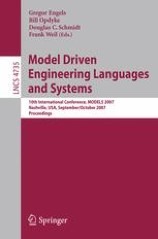
Model driven Engineering Languages and Systems; 10th International Conference, MoDELS 2007, Nashville, USA, September 30 - October 5, 2007, Proceedings
This book constitutes the refereed proceedings of the 10th International Conference on Model Driven Engineering Languages and Systems (formerly the UML series of conferences), MODELS 2007, held in Nashville, USA, September 30 - October 5, 2007. The 45 revised full papers were carefully reviewed and selected from 158 initial submissions.

Model Driven Engineering Languages and Systems ; Vol. 4199 ; 9th International Conference, MoDELS 2006, Genova, Italy, October 1-6, 2006, Proceedings
This book constitutes the refereed proceedings of the 9th International Conference on Model Driven Engineering Languages and Systems (formerly the UML series of conferences), MoDELS 2006, held in Genova, Italy, in October 2006. The 51 revised full papers and 2 invited papers presented were carefully reviewed and selected from 178 initial submissions. The papers are organized in topical sections on evaluating UML, MDA in software development, concrete syntax, applying UML to interaction and coordination, aspects, model integration, formal semantics of UML, security, model transformation tools and implementation, analyzing dynamic models, specifying transformations, MOF, bridging models, risk, trust and dependability, tool environments, OCL, roundtrip engineering, real time and embedded systems, as well as workshops, tutorials and panels.
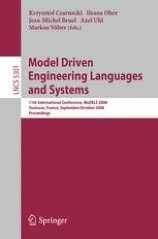
Model Driven Engineering Languages and Systems ; 11th International Conference, MoDELS 2008, Toulouse, France, September 28 - October 3, 2008. Proceedings
The book also contains three keynote speeches and contributions to workshops, symposia, tutorials and panels at the conference. The papers are organized in topical sections on Model Transformation: Foundations; Requirements Modeling; Domain-Specific Modeling; Model Transformation: Techniques, Composition and Analysis of Behavioral Models; Model Comprehension; Model Management; Behavioral Conformance and Refinement; Metamodeling and Modularity; Constraints; Model Analysis; Service-Oriented Architectures; Adaptive and Autonomic Systems; Empirical Studies; Evolution and Reverse Engineering; Modeling Language Semantics; Dependability Analysis and Testing; Aspect-Oriented Modeling; Structural Modeling;and Embedded Systems.
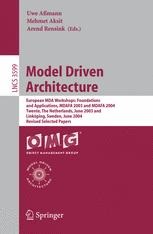
Model Driven Architecture ; European MDA Workshops : Foundations and Applications, MDAFA 2003 and MDAFA 2004, Twente, The Netherlands, June 26-27, 2003, and Linköping, Sweden, June 10-11, 2004, Revised Selected Papers
Model-Driven Architecture (MDA) is an initiative proposedby the Object M- agement Group (OMG) for platform-generic software development. MDA s- arates the specification of system functionality from the implementation on a specific platform. It is aimed at making software assets more resilient to changes caused by emerging technologies. While stressing the importance of modeling, the MDA initiative covers a wide spectrum of research areas. Further efforts are required to bring them into a coherent approach based on open standards and supported by matured tools and techniques. This volume contains the selected papers of two workshops on “Model-Driven Architecture – Foundations and Applications” (MDAFA): MDAFA 2003 held at the University of Twente, Twente, The Netherlands, June 26–27, 2003, and MDAFA 2004 held at Linko ¨ping University, Link¨ oping, Sweden, June 10–11, 2004. The goal of the workshops was to understand the foundations of MDA, to share experience in applying MDA techniques and tools, and to outline future research directions. The workshops organizers encouraged authors of accepted papers to re-submit their papers to a post-workshop reviewing process; 15 of these papers were accepted to appear in this volume on MDA.
