



الصفحة 1
الصفحة 1

Essays in Constructive Mathematics
This book aims to promote constructive mathematics, not by defining it or formalizing it, but by practicing it, by basing all definitions and proofs on finite algorithms. The topics covered derive from classic works of nineteenth century mathematics---among them Galois' theory of algebraic equations, Gauss's theory of binary quadratic forms and Abel's theorem about integrals of rational differentials on algebraic curves. It is not surprising that the first two topics can be treated constructively---although the constructive treatments shed a surprising amount of light on them---but the last topic, involving integrals and differentials as it does, might seem to call for infinite processes. In this case too, however, finite algorithms suffice to define the genus of an algebraic curve, to prove that birationally equivalent curves have the same genus, and to prove the Riemann-Roch theorem. The main algorithm in this case is Newton's polygon, which is given a full treatment. Other topics covered include the fundamental theorem of algebra, the factorization of polynomials over an algebraic number field, and the spectral theorem for symmetric matrices.
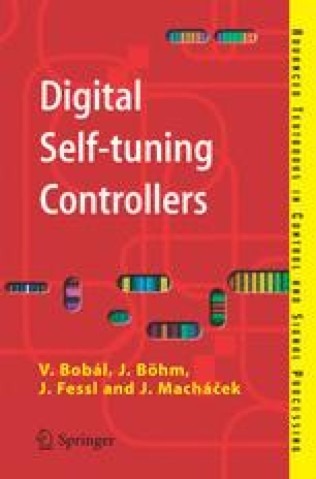
Digital self-tuning controllers : Algorithms, implementation and applications
Digital Self-tuning Controllers presents you with a complete course in self-tuning control, beginning with a survey of adaptive control and the formulation of adaptive control problems. Modelling and identification are dealt with before passing on to algebraic design methods and particular PID and linear-quadratic forms of self-tuning control. Finally, laboratory verification and experimentation will show you how to ground your theoretical knowledge in real plant control.
Binary Quadratic Forms: An Algorithmic Approach
This book deals with algorithmic problems concerning binary quadratic forms 2 2 f(X,Y)= aX +bXY +cY with integer coe?cients a, b, c, the mathem- ical theories that permit the solution of these problems, and applications to cryptography.
Automorphic forms and even unimodular lattices : Kneser neighbors of niemeier lattices
This book includes a self-contained approach of the general theory of quadratic forms and integral Euclidean lattices.It explains how the new advances in the Langlands program mentioned above pave the way for a solution. This study proves to be very rich, leading us to classical themes such as theta series, Siegel modular forms, the triality principle, L-functions and congruences between Galois representations.
Algèbre, Chapitre 9 = Algebra, Chapter 9
Sesquilinear and quadratic forms : The Mathematics Elements of Nicolas BOURBAKI aim to provide a rigorous, systematic presentation without prerequisites of mathematics from their foundations. This ninth chapter of the Book of Algebra, the second Book of the treatise, is devoted to quadratic, symplectic or Hermitian forms and to associated groups.
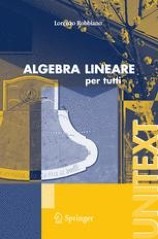
Algebra lineare = Linear Algebra : per tutti
Provides the first mathematical tools related to a chapter of science called Linear Algebra. The notes were written by a mathematician who tried to get out of his character to meet a wide audience. The challenge is to make accessible to all the first rudiments of a fundamental knowledge for science and technology.

Algebra ; Vol. I : Fields and Galois Theory
The present textbook is a lively, problem-oriented and carefully written introduction to classical modern algebra. The first volume focuses on field extensions. Galois theory and its applications are treated more thoroughly than in most texts. It also covers basic applications to number theory, ring extensions and algebraic geometry.The main focus of the second volume is on additional structure of fields and related topics. Much material not usually covered in textbooks appears here, including real fields and quadratic forms, diophantine dimensions of a field, the calculus of Witt vectors, the Schur group of a field, and local class field theory.
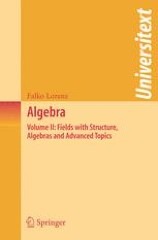
Algebra : Fields with structure, algebras and advanced topics
The present textbook is a lively, problem-oriented and carefully written introduction to classical modern algebra. The author leads the reader through interesting subject matter, while assuming only the background provided by a first course in linear algebra. The first volume focuses on field extensions. Galois theory and its applications are treated more thoroughly than in most texts. It also covers basic applications to number theory, ring extensions and algebraic geometry. The main focus of the second volume is on additional structure of fields and related topics. Much material not usually covered in textbooks appears here, including real fields and quadratic forms, the Tsen rank of a field, the calculus of Witt vectors, the Schur group of a field, and local class field theory.
