



الصفحة 1
الصفحة 1

Numerical Treatment of Partial Differential Equations
In 1988 we started work on the frst German edition of our book, which appeared in 1992. Our aim was to give students a textbook that contained the basic concepts and ideas behind most numerical methods for partial di?er- tial equations. The success of this frst edition and the second edition in 1994 encouraged us, ten years later, to write an almost completely new version, taking into account comments from colleagues and students and drawing on the enormous progress made in the numerical analysis of partial di?erential equations in recent times. The present English version slightly improves the third German edition of 2005: we have corrected some minor errors and added additional material and references.
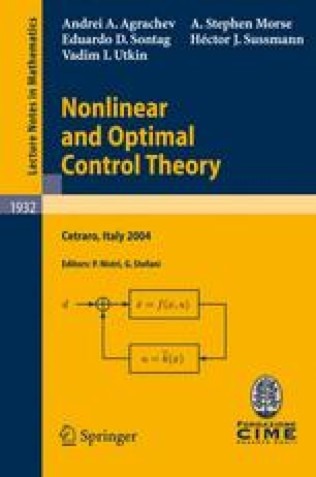
Nonlinear and Optimal Control Theory : Lectures given at the C.I.M.E. Summer School held in Cetraro, Italy June 19–29, 2004
The lectures gathered in this volume present some of the different aspects of Mathematical Control Theory. Adopting the point of view of Geometric Control Theory and of Nonlinear Control Theory, the lectures focus on some aspects of the Optimization and Control of nonlinear, not necessarily smooth, dynamical systems. Specifically, three of the five lectures discuss respectively: logic-based switching control, sliding mode control and the input to the state stability paradigm for the control and stability of nonlinear systems. The remaining two lectures are devoted to Optimal Control: one investigates the connections between Optimal Control Theory, Dynamical Systems and Differential Geometry, while the second presents a very general version, in a non-smooth context, of the Pontryagin Maximum Principle.

Introduction to Partial Differential Equations: A Computational Approach
Mathematics is playing an ever more important role in the physical and biological sciences, provoking a blurring of boundaries between scientific disciplines and a resurgence of interest in the modern as well as the cl- sical techniques of applied mathematics. This renewal of interest, both in research and teaching, has led to the establishment of the series: Texts in Applied Mathematics (TAM). The development of new courses is a natural consequence of a high level of excitement on the research frontier as newer techniques, such as numerical and symbolic computer systems, dynamical systems, and chaos mix with and reinforce the traditional methods of applied mathematics. Thus, the purpose of this textbook series is to meet the current and future needs of these advances and encourage the teaching of new courses.

Elliptic and Parabolic Problems : A Special Tribute to the Work of Haim Brezis
This volume contains contributions by former students and collaborators of Haim Brezis given in honor of his 60th anniversary at a conference in Gaeta. H. Brezis has made significant contributions in the fields of partial differential equations and functional analysis. He is an inspiring teacher and counselor of many mathematicians in the front ranks. The collection of papers presented here grew out from his deep insight of analysis. In addition it reflects Brezis's elegant way of creative thinking
Compatible Spatial Discretizations
Compatible spatial discretizations are those that inherit or mimic fundamental properties of the PDE such as topology, conservation, symmetries, and positivity structures and maximum principles. It offer a snapshot of the current trends and developments in compatible spatial discretizations. The reader will find valuable insights on spatial compatibility from several different perspectives and important examples of applications compatible discretizations in computational electromagnetics, geosciences, linear elasticity, eigenvalue approximations and MHD. The contributions collected in this volume will help to elucidate relations between different methods and concepts and to generally advance our understanding of compatible spatial discretizations for PDEs.
Applied Stochastic Control of Jump Diffusions
The main purpose of the book is to give a rigorous, yet mostly nontechnical, introduction to the most important and useful solution methods of various types of stochastic control problems for jump diffusionsThe types of control problems covered include classical stochastic control, optimal stopping, impulse control and singular control. Both the dynamic programming method and the maximum principle method are discussed, as well as the relation between them. Corresponding verification theorems involving the Hamilton-Jacobi Bellman equation and/or (quasi-)variational inequalities are formulated. There are also chapters on the viscosity solution formulation and numerical methods.The text emphasises applications, mostly to finance. All the main results are illustrated by examples and exercises appear at the end of each chapter with complete solutions. This will help the reader understand the theory and see how to apply it.The book assumes some basic knowledge of stochastic analysis, measure theory and partial differential equations.
