



الصفحة 1
الصفحة 1

Nature-Based Flood Risk Management on Private Land : Disciplinary Perspectives on a Multidisciplinary Challenge
This book addresses the various disciplinary aspects of nature-based solutions in flood risk management on private land. In recent decades, water management has been moving towards nature-based solutions. These are assumed to be much more multi-purpose than traditional “grey infrastructures” and seem to be regarded as a panacea for many environmental issues. At the same time, such measures require more – and mostly privately owned – land and more diverse stakeholder involvement than traditional (grey) engineering approaches. They also present challenges related to different disciplines. Nature-based solutions for flood risk management not only require technical expertise, but also call for interdisciplinary insights from land-use planning, economics, property rights, sociology, landscape planning, ecology, hydrology, agriculture and other disciplines to address the challenges of implementing them. Ultimately, nature-based flood risk management is a multi-disciplinary endeavor.

Nature Conservation : Concepts and Practice
This book provides a multi-disciplinary coverage of the broad fields of species, community and landscape conservation.
Modelling Environmental Dynamics : Advances in Geomatic Solutions
Modelling environmental dynamics is critical to understanding and predicting the evolution of the environment in response to the large number of influences including urbanisation, climate change and deforestation. Simulation and modelling provide support for decision making in environmental management.
Mine Wastes : Characterization, Treatment and Environmental Impacts
Provides an overview of the accumulation of wastes at mine, including sulfidic mine wastes, mine water, tailings, cyanidation wastes of gold-silver ores, radioactive wastes of uranium ores, and wastes of phosphate and potash ores. This work presents crucial aspects of mine wastes as scientific issues.

Microplastic in the Environment : Pattern and Process
This book examines global plastic pollution, an issue that has become a critical societal challenge with implications for environmental and public health. This volume provides a comprehensive, holistic analysis on the plastic cycle and its subsequent effects on biota, food security, and human exposure. Importantly, global environmental change and its associated, systems-level processes, including atmospheric deposition, ecosystem complexity, UV exposure, wind patterns, water stratification, ocean circulation, etc., are all important direct and indirect factors governing the fate, transport and biotic and abiotic processing of plastic particles across ecosystem types.
Methods for measuring greenhouse Gas balances and evaluating mitigation options in smallholder agriculture
This book provides standards and guidelines for quantifying greenhouse gas emissions and removals in smallholder agricultural systems and comparing options for climate change mitigation based on emission reductions and livelihood trade-offs. Globally, agriculture is directly responsible for about 11% of annual greenhouse gas (GHG) emissions and induces an additional 17% through land use change, mostly in developing countries. Farms in the developing countries of sub-Saharan Africa and Asia are predominately managed by smallholders, with 80% of land holdings smaller than ten hectares. However, little to no information exists on greenhouse gas emissions and mitigation potentials in smallholder agriculture.
Methods and Techniques for Cleaning-up Contaminated Sites
This publication is meant to foster links between groups facing challenges cleaning up contaminated sites through presentations that explore the problems currently being addressed and solutions that are emerging in the field.

Interlocal Adaptations to Climate Change in East and Southeast Asia : Sharing Lessons of Agriculture, Disaster Risk Reduction, and Resource Management
This Obook’s main focus is agriculture and natural resource management, disaster risk reduction, and human resource development in the countries of East and Southeast Asia and Japan.

Integration of Information for Environmental Security : Environmental Security - Information Security - Disaster Forecast and Prevention - Water Resources Management
Currently the necessary information exists in a multitude of forms and formats geographically and physically scattered over different countries, institutes and organisations, and are subject to widely different data policies and management schemes. Moreover, there is no complete and updated overview of the existing information, e.g. in the form of a metadata catalogue. As a result, integration of this information in case of emergencies has proven to be extremely difficult, if not impossible. Although in some cases, interesting and impressive "demonstrations" have been shown of the possibilities of the integration of information, for a number of reasons these have reached the "operational" stage.

Integrated Water Management : Practical Experiences and Case Studies
This book introduced a whole range of specific definitions, objectives and constraints regarding the various aspects of water management, including water quality management, policies, economic aspects, ecology, price, and sustainable development. These issues all require the formulation of common, integrated, sustainable approaches for managing the water system from a multidisciplinary perspective, and the definition of new professional skills, requirements which become even more evident where transboundary areas are concerned.

Institutional Dynamics in Environmental Governance
This book presents fresh analyses of a number of well-known cases, but does so from one comprehensive view, the so-called policy arrangement approach. Cases discussed range over organic farming, integrated water management, nature policy, cultural heritage policy, integrated region-oriented policy, corporate environmental management and target group policy, always in search of the commonality of experience and conclusions to be drawn in understanding the past and in formulating future perspectives.
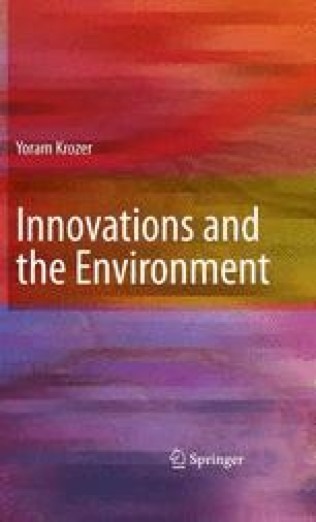
Innovations and the Environment
The book to provide a systematic review of the forces that drive technologies towards sustainable development, Innovations and the Environment discusses the possibilities for fostering renewable energy and environmental quality oriented innovations from the perspective of decision makers in policy and business.

Information Technologies in Environmental Engineering ; ITEE 2007 - 3rd International ICSC Symposium
Potentially dangerous environmental changes are happening in the atm- phere, oceans, animal habitats and places where hazardous materials are used, or have been discarded without adequate environmental protections. These increasing problems that also affect human health demand for int- disciplinary approaches where engineers, natural scientists, economists and computer scientists work together. This book publishes the results of the ITEE 2007 conference where information about the topics above has been presented and discussed among environmental engineers, computer scientists and economists.

Information and communication technologies in tourism 2021 ; Proceedings of the ENTER 2021 eTourism Conference, January 19–22, 2021
This book is the proceedings of the International Federation for IT and Travel & Tourism (IFITT)’s 28th Annual International eTourism Conference, which assembles the latest research presented at the ENTER21@yourplace virtual conference January 19–22, 2021.

Implementing Environmental Management Accounting : Status and Challenges
The focus of the conference and the papers presented was on implementation of Environmental Management Accounting. That is to say what challenges there are in getting EMAto work in companies, how governments are promoting EMAand how EMA can be supported by for instance IT. From the papers in this volume it can be seen that EMAis becoming more established as a ?eld of practice as well as an a- demic endeavour. EMA is no longer the sole interest of large multinational c- panies but is being adopted by SMEs as well as being promoted by various gove- ment agencies.

Human-Nature Interactions : Exploring Nature’s Values Across Landscapes
Highlights how humans value nature, the opportunities and challenges in changing socio-ecological systems / Provides insights into concepts and methods to study human-nature relationships, designed for a broad audience / Focus on integrative approaches exploring interactions across different scales, intensity levels and landscapes

Habitats and Biota of the Gulf of Mexico : Before the deepwater horizon oil spill ; Vol.2 : Fish resources, fisheries, sea turtles, avian resources, marine mammals, diseases and mortalities
The Gulf of Mexico is an open and dynamic marine ecosystem rich in natural resources but heavily impacted by human activities, including agricultural, industrial, commercial and coastal development. Nutrients and pollutants from coastal communities and dozens of rivers flow into the Gulf, including material from the Mississippi River watershed, which drains over one third of continental United States. The Gulf of Mexico has been continuously exposed to petroleum hydrocarbons for millions of years from natural oil and gas seeps on the sea floor, and more recently from oil drilling and production activities located in the water near and far from shore. Major accidental oil spills in the Gulf are infrequent; two of the most significant include the Ixtoc I blowout in the Bay of Campeche in 1979 and the Deepwater Horizon Oil Spill in 2010.

Habitats and Biota of the Gulf of Mexico : Before the deepwater horizon oil spill ; Vol.1 : Water quality, sediments, sediment contaminants, oil and gas Seeps, coastal habitats, offshore plankton and benthos, and shellfish
The Gulf of Mexico is an open and dynamic marine ecosystem rich in natural resources but heavily impacted by human activities, including agricultural, industrial, commercial and coastal development. Nutrients and pollutants from coastal communities and dozens of rivers flow into the Gulf, including material from the Mississippi River watershed, which drains over one third of continental United States. The Gulf of Mexico has been continuously exposed to petroleum hydrocarbons for millions of years from natural oil and gas seeps on the sea floor, and more recently from oil drilling and production activities located in the water near and far from shore. Major accidental oil spills in the Gulf are infrequent; two of the most significant include the Ixtoc I blowout in the Bay of Campeche in 1979 and the Deepwater Horizon Oil Spill in 2010.

Greening the Supply Chain
Since the Rio summit in 1992, the paradigm of corporate environmental responsibility has gradually and consistently extended beyond complying with increasingly stringent environmental regulation and taking up the proactive initiatives of a few world-class companies. Research indicates that the business and financial performance of companies may depend directly on socially and environmentally responsible business practices. Many world-class companies now realize that customers and other stakeholders do not distinguish between a company and its suppliers. As a result, greening the supply chain is an innovative idea which is fast gaining attention in the industry.

Greening the Industrial Facility : Perspectives, Approaches, and Tools
This book fills a critical gap as a textbook and reference book on the comprehensive environmental impacts of industrial organizations. It is intended for both upper-level undergraduate and beginning graduate students in environmental studies or engineering, and, more broadly, for practicing managers and engineers seeking to improve industrial processes. Nineteen chapters, each focusing on an industrial sector, from resource extraction through fabrication and manufacturing to recycling, evaluate the sector’s inherent "potential to pollute" by providing an overview of typical sector operations and their environmental implications. Beyond outlining and providing frameworks for assessing industrial facilities’ contemporary interactions with the environment (energy and water use, material throughput and hazard, and pollution potential), the book provides forward-looking analyses concerning how new technologies and practices can transform environmentally degrading effects of industry. It also addresses how managers can navigate these changes and move their industrial organizations towards environmental sustainability over the long term.
