



الصفحة 1
الصفحة 1

Univariate Stable Distributions : Models for Heavy Tailed Data
Highlights the many practical uses of stable distributions, exploring the theory, numerical algorithms, and statistical methods used to work with stable laws. Because of the author’s accessible and comprehensive approach, readers will be able to understand and use these methods. Both mathematicians and non-mathematicians will find this a valuable resource for more accurately modelling and predicting large values in a number of real-world scenarios.The following chapters present the theory of stable distributions, a wide range of applications, and statistical methods, with the final chapters focusing on regression, signal processing, and related distributions. Each chapter ends with a number of carefully chosen exercises. Links to free software are included as well, where readers can put these methods into practice.

Uncertainty in Engineering : Introduction to Methods and Applications
Provides an introduction to uncertainty quantification in engineering. Starting with preliminaries on Bayesian statistics and Monte Carlo methods, followed by material on imprecise probabilities, it then focuses on reliability theory and simulation methods for complex systems. The final two chapters discuss various aspects of aerospace engineering, considering stochastic model updating from an imprecise Bayesian perspective, and uncertainty quantification for aerospace flight modelling.

The Bayesian Choice : From Decision-Theoretic Foundations to Computational Implementation
This book covers both the basic ideas of statistical theory, and also some of the more modern and advanced topics of Bayesian statistics such as complete class theorems, the Stein effect, Bayesian model choice, hierarchical and empirical Bayes modeling, Monte Carlo integration including Gibbs sampling, and other MCMC techniques.

The Analysis of Cross-Classified Categorical Data
This book presents some of the recent work on the statistical analysis of cross-classified data using longlinear models, especially in the multidimensional situation.

Testing Statistical Hypotheses
The third edition of Testing Statistical Hypotheses updates and expands upon the classic graduate text, emphasizing optimality theory for hypothesis testing and confidence sets. The principal additions include a rigorous treatment of large sample optimality, together with the requisite tools. In addition, an introduction to the theory of resampling methods such as the bootstrap is developed. The sections on multiple testing and goodness of fit testing are expanded. The text is suitable for Ph.D. students in statistics and includes over 300 new problems out of a total of more than 760.

Statistical Methods in Molecular Evolution
This book provides an overview of the statistical theory and methods used in studies of molecular evolution. It includes an introductory section suitable for readers that are new to the field, a section discussing practical methods for data analysis, and more specialized sections discussing specific models and addressing statistical issues relating to estimation and model choice. The chapters are written by the leaders in the field and they will take the reader from basic introductory material to the state-of the-art statistical methods.
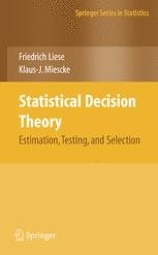
Statistical Decision Theory : Estimation, Testing, and Selection
This monograph is written for advanced graduate students, Ph.D. students, and researchers in mathematical statistics and decision theory. All major topics are introduced on a fairly elementary level and then developed gradually to higher levels. The book is self-contained as it provides full proofs, worked-out examples, and problems. It can be used as a basis for graduate courses, seminars, Ph.D. programs, self-studies, and as a reference book.

Régression : Théorie et applications = Regression : Theory and Applications
This book explains in detail, with supporting examples, one of the most common statistical methods: regression. The first chapters are devoted to simple and multiple linear regression. They explain the fundamentals of the method, both in terms of the choices made as well as the hypotheses and their usefulness. Then the tools are developed to verify the basic assumptions implemented by the regression. A simple presentation of the analysis of covariance and variance models is performed. Finally, the last chapters are devoted to the choice of models as well as to certain extensions of the regression.

Quantum Statistics of Nonideal Plasmas
This book deals with the statistical theory of strongly coupled Coulomb systems. After an elementary introduction to the physics of nonideal plasmas, a presentation of the method of (nonequilibrium) Green's functions is given. On this basis, the dielectric, thermodynamic, transport, and relaxation properties are discussed systematically. Especially, the behavior of bound states in the surrounding plasma (lowering of the ionization energy), the ionization kinetics, and the equation of state of dense partially ionized hydrogen are each carefully investigated. Furthermore, generalized kinetic equations are derived which are also valid for short time scales. They are applied to ultra-fast processes and to plasmas in laser fields.

Premiers pas en statistique = First steps in statistics
This book introduces the fundamental concepts of statistical theory and describes the methods most often used in practice. It is intended for students of economics and social sciences whose study program includes a broad knowledge of statistical methods. It is also aimed at researchers in various fields of applied sciences as well as students who plan to pursue a more in-depth study of statistical theory and its applications at a later stage. The work has three parts: descriptive statistics, probabilities and inferential statistics.

Premiers pas en simulation = First steps in simulation
Why simulation techniques? Simulation methods, designed for use in statistics and operations research, have experienced and continue to develop rapidly due to the extraordinary evolution of computers. Applications are found in industry and in economics, or even social sciences, in particle physics, in astronomy and in many other fields. In many situations, whether in everyday life or in scientific research, the researcher is faced with problems which he seeks solutions on the basis of certain initial assumptions and constraints. To solve this type of problem, there exist analytical methods applicable to situations where the model makes it possible to treat the di? Erent variables by mathematically manageable equations, and numerical methods where the complexity of the model imposes a fragmentation of the problem, in particular by the identification of the various variables which come into play and the study of their interactions. This last approach is often accompanied by a large mass of calculations. Simulation techniques are numerical techniques: to simulate a phenomenon essentially means to carefully reconstruct its evolution.

Pandemics : Insurance and Social Protection
Starting by considering the impulse given by COVID-19 to the insurance industry and to actuarial research, the text covers compartment models, mortality changes during a pandemic, risk-sharing in the presence of low probability events, group testing, compositional data analysis for detecting data inconsistencies, behaviouristic aspects in fighting a pandemic, and insurers’ legal problems, amongst others.

Multirate Statistical Signal Processing
This book introduces a statistical theory for extracting information from signals that have di?erent sampling rates. This new theory generalizes the conventional (deterministic) theory of multirate systems beyond many of its constraints.Furthermore,itallowsfortheformulationofseveralnewproblems such as spectrum estimation, time-delay estimation and sensor fusion in the realm of multirate signal processing. I have arrived at the theory presented here by integrating concepts from diverse areas such as information theory, inverse problems and theory of - equalities. The process of merging a variety of concepts of di?erent origin results in both merits and shortcomings. The former include the fresh and - di?erentiated view of an amateur, providing scope of application. The latter include a lack of in-depth experience in each of the original ?elds. Granted, this may lead to gaps in continuity, however it goes without saying that a complete theory can seldom be achieved by one person and in a short time.

Modern Mathematical Statistics with Applications
This book tries to strike a balance between mathematical foundations and statistical practice. The book provides a clear and current exposition of statistical concepts and methodology, including many examples and exercises based on real data gleaned from publicly available sources. The main focus of the book is on presenting and illustrating methods of inferential statistics used by investigators in a wide variety of disciplines, from actuarial science all the way to zoology. It begins with a chapter on descriptive statistics that immediately exposes the reader to the analysis of real data. The next six chapters develop the probability material that facilitates the transition from simply describing data to drawing formal conclusions based on inferential methodology. Point estimation, the use of statistical intervals, and hypothesis testing are the topics of the first three inferential chapters. The remainder of the book explores the use of these methods in a variety of more complex settings.

Modélisation et statistique spatiales = Spatial modeling and statistics
Spatial statistics are undergoing significant development due to their use in many fields: earth sciences, environment and climatology, epidemiology, econometrics, image analysis, etc. This book presents the main spatial models used as well as their statistics for the three types of data: geostatistics (observation on a continuous domain), data on a discrete network, point data. The objective is to present in a concise but mathematically complete way the most classical models (second order and variogram; software model and Gibbs-Markov field; point processes) as well as their simulation by MCMC algorithm. Then comes the presentation of statistical tools useful for their study.

Matrix Algebra : Theory, Computations, and Applications in Statistics
Matrix algebra is one of the most important areas of mathematics for data analysis and for statistical theory. The first part of this book presents the relevant aspects of the theory of matrix algebra for applications in statistics. This part begins with the fundamental concepts of vectors and vector spaces, next covers the basic algebraic properties of matrices, then describes the analytic properties of vectors and matrices in the multivariate calculus, and finally discusses operations on matrices in solutions of linear systems and in eigenanalysis. This part is essentially self-contained.

Mathematical Statistics : Exercises and Solutions
This book consists of four hundred exercises in mathematical statistics and their solutions,this solutions to train students for their research ability in mathematical statistics and presents many additional results and examples that complement any text in mathematical statistics. To develop problem-solving skills, two solutions and/or notes of brief discussions accompany a few exercises.The exercises are grouped into seven chapters with titles matching those in the author's Mathematical Statistics.

Inference in Hidden Markov Models
This book is a comprehensive treatment of inference for hidden Markov models, including both algorithms and statistical theory. Topics range from filtering and smoothing of the hidden Markov chain to parameter estimation, Bayesian methods and estimation of the number of states.In a unified way the book covers both models with finite state spaces, which allow for exact algorithms for filtering, estimation etc. and models with continuous state spaces (also called state-space models) requiring approximate simulation-based algorithms that are also described in detail. Simulation in hidden Markov models is addressed in five different chapters that cover both Markov chain Monte Carlo and sequential Monte Carlo approaches. Many examples illustrate the algorithms and theory. The book also carefully treats Gaussian linear state-space models and their extensions and it contains a chapter on general Markov chain theory and probabilistic aspects of hidden Markov models.

How Data Quality Affects our Understanding of the Earnings Distribution
This book demonstrates how data quality issues affect all surveys and proposes methods that can be utilised to deal with the observable components of survey error in a statistically sound manner. This book begins by profiling the post-Apartheid period in South Africa's history when the sampling frame and survey methodology for household surveys was undergoing periodic changes due to the changing geopolitical landscape in the country. This book profiles how different components of error had disproportionate magnitudes in different survey years, including coverage error, sampling error, nonresponse error, measurement error, processing error and adjustment error.

Heavy-Tailed Time Series
This book aims to present a comprehensive, self-contained, and concise overview of extreme value theory for time series, incorporating the latest research trends alongside classical methodology.Additionally, the book incorporates complete proofs and exercises with solutions as well as substantive reference lists and appendices, featuring a novel commentary on the theory of vague convergence.
