



الصفحة 9
الصفحة 9

Neurobiology of Human Values
Man has been pondering for centuries over the basis of his own ethical and aesthetic values. Until recent times, such issues were primarily fed by the thinking of philosophers, moralists and theologists, or by the findings of historians or sociologists relating to universality or variations in these values within various populations. Science has avoided this field of investigation within the confines of philosophy. Beyond the temptation to stay away from the field of knowledge science may also have felt itself unconcerned by the study of human values for a simple heuristic reason, namely the lack of tools allowing objective study. For the same reason, researchers tended to avoid the study of feelings or consciousness until, over the past two decades, this became a focus of interest for many neuroscientists

Neurobiology of Exceptionality
Nurture or nature? Biology or environment? Why are some people intelligent, or personable, or creative and others obtuse, or shy, or unimaginative? Although each human being is a unique mixture of positive and negative traits and behaviors, the question remains: What is the neurobiological basis for each individual’s makeup? For example, why does one person suffer from a disorder (e.g., ADHD, autism, mental retardation) and another lives free of maladies?

Neuroanatomy for the Neuroscientist
Neurology, more than any other system of medicine, is rooted in the firm knowledge of basic science material (i.e., the anatomy, physiology, and pathology of the nervous system). This material enables students to readily arrive at diagnoses and to apply their knowledge at solving problems in clinical situations. Neuroanatomy for the Neuroscientist gives neuroscientists the tools to teach this material at levels appropriate for students at several levels of study, including undergraduate, graduate, dental, and medical school. The text also provides an updated approach to lesion localization in neurology, utilizing the techniques of computerized axial tomography (CT scanning), magnetic resonance imaging (MRI), and magnetic resonance angiography (MRA). Multiple illustrations demonstrating the value of these techniques in clinical neurology and neuroanatomical localization has been provided.

Neuroanatomical Tract-Tracing : Molecules, Neurons, and Systems
"The content of the book also serves to emphasize that neuroanatomy is, perhaps more than ever, a thriving and important part of the neurosciences...Most contributions have in common the combination of modern tract-tracing methods with other means of characterizing neural tissue, and thus the book also serves to highlight the gradual disappearance of borders between traditional neuroanatomy and other approaches to the study of the nervous system...this book should continue to be a useful source of information, and deserves to be available in all laboratories applying or considering to apply neuroanatomical methods."

Neural networks and deep learning
Covers both classical and modern models in deep learning. The primary focus is on the theory and algorithms of deep learning. The theory and algorithms of neural networks are particularly important for understanding important concepts, so that one can understand the important design concepts of neural architectures in different applications. Why do neural networks work? When do they work better than off-the-shelf machine-learning models? When is depth useful? Why is training neural networks so hard? What are the pitfalls? The book is also rich in discussing different applications in order to give the practitioner a flavor of how neural architectures are designed for different types of problems.

Neural Information Processing ; 14th International Conference, ICONIP 2007, Kitakyushu, Japan, November 13-16, 2007, Revised Selected Papers, Part II
The 228 revised full papers presented were carefully reviewed and selected from numerous ordinary paper submissions and 15 special organized sessions. The 116 papers of the first volume are organized in topical sections on computational neuroscience, learning and memory, neural network models ,supervised /unsupervised/reinforcement learning, statistical learning algorithms, optimization algorithms, novel algorithms, as well as motor control and vision. The second volume contains 112 contributions related to statistical and pattern recognition algorithms, neuromorphic hardware and implementations, robotics, data mining and knowledge discovery, real world applications, cognitive and hybrid intelligent systems, bioinformatics, neuroinformatics, brain-conputer interfaces, and novel approaches.

Neural Information Processing ; 14th International Conference, ICONIP 2007, Kitakyushu, Japan, November 13-16, 2007, Revised Selected Papers, Part I
The 228 revised full papers presented were carefully reviewed and selected from numerous ordinary paper submissions and 15 special organized sessions. The 116 papers of the first volume are organized in topical sections on computational neuroscience, learning and memory, neural network models, supervised/unsupervised/reinforcement learning, statistical learning algorithms, optimization algorithms, novel algorithms, as well as motor control and vision. The second volume contains 112 contributions related to statistical and pattern recognition algorithms, neuromorphic hardware and implementations, robotics, data mining and knowledge discovery, real world applications, cognitive and hybrid intelligent systems, bioinformatics, neuroinformatics, brain-conputer interfaces, and novel approaches.

Neural Engineering
Neural Engineering, Bioelectric Engineering Volume 2, contains reviews and discussions of contemporary and relevant topics by leading investigators in the field.

Networks : From Biology to Theory
The concept of a network emerges as a powerful and stimulating research paradigm in mathematics, physics and computer science, and demonstrates a very lively interaction between experimental findings, simulation studies, and theoretical investigations that then in turn lead to new experimental questions. This volume explores this concept in full and features contributions from a truly global set of contributors.

Network Performance Analysis : Using the J Programming Language
This useful volume introduces concepts and principles of network performance analysis by example, using the J programming language. J is rich in mathematical functionality, which makes it an ideal tool for analytical methods. The book favours a practical approach and develops functions in J to demonstrate mathematical concepts, thereby enabling readers to explore the underlying principles behind network performance analysis. In addition, this allows the subject to become more accessible to those who, although have a mathematical background, are not pure mathematicians.

Network Models and Optimization : Multiobjective Genetic Algorithm Approach
Network Models and Optimization: Multiobjective Genetic Algorithm Approach extensively covers algorithms and applications, including shortest path problems, minimum cost flow problems, maximum flow problems, minimum spanning tree problems, travelling salesman and postman problems, location-allocation problems, project scheduling problems, multistage-based scheduling problems, logistics network problems, communication network problem, and network models in assembly line balancing problems, and airline fleet assignment problems.

Network Classification For Traffic Management : Anomaly detection, feature selection, clustering and classification
Investigates network traffic classification solutions by proposing transport-layer methods to achieve better run and operated enterprise-scale networks. With the massive increase of data and traffic on the Internet within the 5G, IoT and smart cities frameworks, current network classification and analysis techniques are falling short. Novel approaches using machine learning algorithms are needed to cope with and manage real-world network traffic, including supervised, semi-supervised, and unsupervised classification techniques. Accurate and effective classification of network traffic will lead to better quality of service and more secure and manageable networks. Investigates network traffic classification solutions by proposing transport-layer methods to achieve better run and operated enterprise-scale networks. The authors explore novel methods for enhancing network statistics at the transport layer, helping to identify optimal feature selection through a global optimization approach and providing automatic labelling for raw traffic through a SemTra framework to maintain provable privacy on information disclosure properties.

Network and Parallel Computing ; IFIP International Conference, NPC 2005, Beijing, China, November 30 - December 3, 2005, Proceedings
These proceedings contain the papers presented at the 2005 IFIP International Conference on Network and Parallel Computing (NPC 2005), held in Beijing, China, between November 30 and December 3, 2005. The goal of the conference was to establish an international forum for engineers and scientists to present their ideas and experiences in network and parallel computing. A total of 320 submissions were received in response to our Call for Papers. These papers were from the following countries or regions: Australia, Canada, China, France, Germany, Hong Kong, India, Iran, Italy, Japan, Korea, Lux- burg, Nepal, Netherlands, Taiwan, United Arab Emirates, and United States.

Network Analysis : Methodological Foundations
‘Network’ is a heavily overloaded term, so that ‘network analysis’ means different things to different people. Specific forms of network analysis are used in the study of diverse structures such as the Internet, interlocking directorates, transportation systems, epidemic spreading, metabolic pathways, the Web graph, electrical circuits, project plans, and so on. There is, however, a broad methodological foundation which is quickly becoming a prerequisite for researchers and practitioners working with network models. From a computer science perspective, network analysis is applied graph theory. Unlike standard graph theory books, the content of this book is organized according to methods for specific levels of analysis (element, group, network) rather than abstract concepts like paths, matchings, or spanning subgraphs. Its topics therefore range from vertex centrality to graph clustering and the evolution of scale-free networks. In 15 coherent chapters, this monograph-like tutorial book introduces and surveys the concepts and methods that drive network analysis, and is thus the first book to do so from a methodological perspective independent of specific application areas.
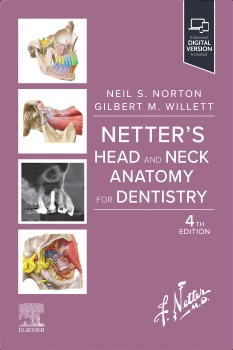
Netter's head and neck anatomy for dentistry
A concise and highly visual guide to clinically relevant anatomy for dentistry, as well as a valuable resource for any healthcare professional interested in head and neck anatomy, Netter's Head and Neck Anatomy for Dentistry, 4th Edition, is an ideal text/atlas for class and exam preparation, as well as a quick review in professional practice.

Netter's essential histology with correlated histopathology
Concise and easy to use, it integrates gross anatomy and embryology with classic histology slides and state-of-the-art scanning electron microscopy, offering a clear, visual understanding of this complex subject. Additional histopathology images, more clinical boxes, and new histopathology content ensure that this textbook-atlas clearly presents the most indispensable histologic concepts and their clinical relevance. Helps you recognize both normal and diseased structures at the microscopic level with the aid of succinct explanatory text as well as numerous clinical boxes. Features more histopathology content and additional clinical boxes to increase your knowledge of pathophysiology and clinical relevance. Includes high-quality light and electron micrographs, including enhanced and colorized electron micrographs that show ultra-structures in 3D, side by side with classic Netter illustrations that link your knowledge of anatomy and cell biology to what is seen in the micrographs.

Nearrings and Nearfields ; Proceedings of the Conference on Nearrings and Nearfields, Hamburg, Germany July 27 - August 3, 2003
This present volume is the Proceedings of the 18th International Conference on Nearrings and Nearfields held at the Helmut-Schmidt-Universitat, Universitat der Bundeswehr Hamburg, from July 27-August 3, 2003. It contains the written versions of the lectures by the five invited speakers. These concern recent developments of planar nearrings, nearrings of mappings, group nearrings and loop-nearrings. One of them is a long and very substantial research paper "The Z-Constrained Conjecture". These are followed by 13 contributions reflecting the diversity of the subject of nearrings and related structures. Besides the purely algebriac structure theory, these papers show many connections of nearring theory with group theory, combinatorics, geometries, and topology, and all contain original research.

Nearest Neighbor Search : A Database Perspective
Modern applications are both data and computationally intensive and require the storage and manipulation of voluminous traditional (alphanumeric) and nontraditional data sets (images, text, geometric objects, time-series). Examples of such emerging application domains are: Geographical Information Systems (GIS), Multimedia Information Systems, CAD/CAM, Time-Series Analysis, Medical Information Sstems, On-Line Analytical Processing (OLAP), and Data Mining. These applications pose diverse requirements with respect to the information and the operations that need to be supported. From the database perspective, new techniques and tools therefore need to be developed towards increased processing efficiency. This monograph explores the way spatial database management systems aim at supporting queries that involve the space characteristics of the underlying data, and discusses query processing techniques for nearest neighbor queries. It provides both basic concepts and state-of-the-art results in spatial databases and parallel processing research, and studies numerous applications of nearest neighbor queries.

Neanderthals Revisited : New Approaches and Perspectives
This volume presents cutting-edge research by leading scientists re-examining the major debates in Neanderthal research with the use of innovative state-of-the art methods and exciting new theoretical approaches.Topics addressed include the re-evaluation of Neanderthal anatomy, inferred adaptations and habitual activities, developmental patterns, phylogenetic relationships, and the Neanderthal extinction; new methods include computer tomography, 3D geometric morphometrics, ancient DNA and bioenergetics. The diverse contributions offer fresh insights and advances in Neanderthal and modern human origins research.

Nature-Based Flood Risk Management on Private Land : Disciplinary Perspectives on a Multidisciplinary Challenge
This book addresses the various disciplinary aspects of nature-based solutions in flood risk management on private land. In recent decades, water management has been moving towards nature-based solutions. These are assumed to be much more multi-purpose than traditional “grey infrastructures” and seem to be regarded as a panacea for many environmental issues. At the same time, such measures require more – and mostly privately owned – land and more diverse stakeholder involvement than traditional (grey) engineering approaches. They also present challenges related to different disciplines. Nature-based solutions for flood risk management not only require technical expertise, but also call for interdisciplinary insights from land-use planning, economics, property rights, sociology, landscape planning, ecology, hydrology, agriculture and other disciplines to address the challenges of implementing them. Ultimately, nature-based flood risk management is a multi-disciplinary endeavor.
