



الصفحة 9
الصفحة 9

Handbook of High -Temperature Superconductivity : Theory and Experiment
Handbook of High-Temperature Superconductvity is a comprehensive and in-depth treatment of both experimental and theoretical methodologies. It's a unified, coherent work providing a global view of high-temperature superconductivity covering the materials, the relationships with heavy-fermion and organic systems, and the many formidable challenges that remain.

Handbook of brain connectivity
The Handbook provides an account of the current knowledge on the measurement, analysis and theory of the anatomical and functional connectivity of the brain. All contributors are leading experts in various fields concerning structural and functional brain connectivity.
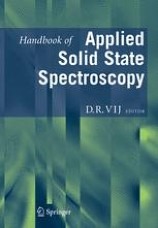
Handbook of Applied Solid State Spectroscopy
Solid-State spectroscopy is a burgeoning field with applications in many branches of science, including physics, chemistry, biosciences, surface science, and materials science. Handbook of Applied Solid-State Spectroscopy brings together in one volume information about various spectroscopic techniques that is currently scattered in the literature of these disciplines. This concise yet comprehensive volume covers theory and applications of a broad range of spectroscopies, including NMR, NQR, EPR/ESR, ENDOR, scanning tunneling, acoustic resonance, FTIR, auger electron emission, x-ray photoelectron emission, luminescence, and optical polarization, and more. Emphasis is placed on fundamentals and current methods and procedures, together with the latest applications and developments in the field.

Handbook of advanced magnetic materials : Vol 1 : Nanostructural effects ; Vol 2 : Characterization and simulation ; Vol 3 : Fabrication and processing ; Vol 4 : Properties and applications
The objective of Handbook of Advanced Magnetic Materials is to provide a timely, comprehensive review of recent progress in magnetic materials research. This broad yet detailed reference consists of four volumes: 1.) Nanostructured advanced magnetic materials, 2.) Characterization and simulation of advanced magnetic materials, 3.) Processing of advanced magnetic materials, and 4.) Properties and applications of advanced magnetic materials Emphasis is on the processing, experimental investigation, theoretical understanding, and application of nanostructured magnetic materials. The chapters, authored by worldwide known specialists, provide an introduction into the topics and review the latest advances in magnetic nanostructures and materials. This includes emerging new materials, scientific methods, and experimental techniques. The coverage is very broad and includes nanostructural effects, characterization and simulation, fabrication and processing, and properties and applications of advanced magnetic materials.

Hamiltonian Methods in the Theory of Solitons
The main characteristic of this now classic exposition of the inverse scattering method and its applications to soliton theory is its consistent Hamiltonian approach to the theory. The nonlinear Schrödinger equation, rather than the (more usual) KdV equation, is considered as a main example.

Half-metallic Alloys : Fundamentals and Applications
Half-metals are particular ferromagnetic materials which can be considered as hybrids between metals and semiconductors. A particular feature of these materials is that electrons at the Fermi level show complete spin polarization making them prime targets for research into suitable divices for spin electronics. This book is both an introduction and state-of-art survey of the latest advances in the understanding and applications of Heusler alloys and related compounds.

Hadron Collider Physics 2005 ; Proceedings of the 1st Hadron Collider Physics Symposium, Les Diablerets, Switzerland, July 4-9, 2005
The Hadron Collider Physics Symposia (HCP) are a new series of conferences that follow the merger of the Hadron Collider Conferences with the LHC Symposia series, with the goal of maximizing the shared experience of the Tevatron and LHC communities. This book gathers the proceedings of the first symposium, HCP2005 and reviews the state-of-the-art in the key physics directions of experimental hadron collider research: - QCD physics - precision electroweak physics - c-, b-, and t-quark physics - physics beyond the Standard Model - heavy ion physics

Guide to Observing Deep-Sky Objects : A Complete Global Resource for Astronomers
Guide to Observing Deep-Sky Objects is an invaluable reference for all amateur astronomers. The book contains, for each constellation, (1) a star chart showing the Bayer labels, (2) a table for many of the stars in the constellation, along with their positions and magnitudes, and (3) a table of the major deep-sky objects in the constellation, with relevant observational data. Facing pages provide unique year-long graphs that show when the constellation is visible in the sky, which allows the user to quickly determine whether a given constellation can be seen, and when the best time to see it will be.

Growing Black Holes: Accretion in a Cosmological Context ; Proceedings of the MPA/ESO/MPE/USM Joint Astronomy Conference Held at Garching, Germany, 21-25 June 2004
Supermassive black holes are now believed to play an important role in the evolution of the Universe. Every respectable galaxy hosts in its center a black hole that appears to regulate the growth of the galaxy itself. In this book, leading experts in the field review the most recent theoretical and observational results on the following topics: * formation and growth of the first black holes in the Universe and their role in the formation and evolution of galaxies * the physics of black-hole accretion and the production of relativistic jets * binary black-hole mergers and gravitational radiation. Theoretical work is supplemented by the most recent exciting results from space and ground based observatories. This volume is useful research and reference tool for the entire astrophysical community.

Groups of Galaxies in the Nearby Universe ; Proceedings of the ESO Workshop held at Santiago de Chile, December 5 - 9, 2005
In the cosmological context, groups trace large-scale structures better than clusters, and the evolution of groups and clusters appears to be related. All these aspects of research on groups of galaxies are summarized in this book.

Group theory : Application to the physics of condensed matter
Every process in physics is governed by selection rules that are the consequence of symmetry requirements. The beauty and strength of group theory resides in the transformation of many complex symmetry operations into a very simple linear algebra. This concise and class-tested book has been pedagogically tailored over 30 years MIT and 2 years at the University Federal of Minas Gerais (UFMG) in Brazil. The approach centers on the conviction that teaching group theory in close connection with applications helps students to learn, understand and use it for their own needs. For this reason, the theoretical background is confined to the first 4 introductory chapters (6-8 classroom hours). From there, each chapter develops new theory while introducing applications so that the students can best retain new concepts, build on concepts learned the previous week, and see interrelations between topics as presented.

Greens Functions in Quantum Physics
The main part of this book is devoted to the simplest kind of Green's functions, namely the solutions of linear differential equations with a -function source. It is shown that these familiar Green's functions are a powerful tool for obtaining relatively simple and general solutions of basic problems such as scattering and bound-level information. The bound-level treatment gives a clear physical understanding of "difficult" questions such as superconductivity, the Kondo effect, and, to a lesser degree, disorder-induced localization. The more advanced subject of many-body Green's functions is presented in the last part of the book.

Gravity, Black Holes, and the Very Early Universe : An Introduction to General Relativity and Cosmology
In the early 1900s, Albert Einstein formulated two theories that would forever change the landscape of physics: the Special Theory of Relativity and the General Theory of Relativity. By 1925, quantum mechanics had been born out of the dissection of these two theories, and shortly after that, relativistic quantum field theory. We now had in place some important ties between the laws of physics and the types of particle interactions the new physics was uncovering. Gravity is one of the four types of forces that are found throughout the universe. In fact, although it is a relatively weak force, it operates at huge distances, and so must be accounted for in any cosmological system. Unfortunately, gravity continues to defy our neat categorization of how all the forces in nature work together.

Gravitational Lensing : Strong, Weak and Micro : Saas-Fee Advanced Course 33
The up-to-date contributions in this book are based on the lecture notes of the 33rd Saas–Fee Advanced Course of the Swiss Society of Astronomy and Astrophysics, entitled Gravitational Lensing: Strong, Weak, and Micro. The book comprises four complementary parts, written by leading experts in the field, constituting a genuine textbook about gravitational lensing: • Peter Schneider – Part 1: Introduction to Gravitational Lensing and Cosmology • Christopher Kochanek – Part 2: Strong Gravitational Lensing • Peter Schneider – Part 3: Weak Gravitational Lensing • Joachim Wambsganss – Part 4: Gravitational Microlensing

Gravitation and Experiment : Poincaré Seminar 2006
This book is the sixth in a series of lectures of the S´ eminaire Poincar´ e,whichis directed towards a large audience of physicists and of mathematicians. The goal of this seminar is to provide up-to-date information about general topics of great interest in physics. Both the theoretical and experimental aspects are covered, with some historical background.

Glucose Sensing
This volume incorporates authoritative analytical fluorescence-based glucose sensing reviews specialized enough to be attractive to professional researchers, yet also appealing to the wider audience of scientists in related disciplines of fluorescence. Glucose Sensing is an essential reference for any lab working in the analytical fluorescence glucose sensing field. All academics, bench scientists, and industry professionals wishing to take advantage of the latest and greatest in the continuously emerging field of glucose sensing, and diabetes care & management, will find this volume an invaluable resource.

Geospace Electromagnetic Waves and Radiation
The contributions gathered in this volume provide introductions to current problems in geospace electromagnetic radiation, guides to the associated literature and tutorial reviews of the relevant space physics. Students and scientists working on various aspects of the terrestrial aurora or magnetospheric and near-Earth heliospheric high-frequency waves will find this volume an indispensable companion for their studies.

Geometry of Quantum Theory ; 2nd ed.
This book a classic on the foundations of quantum theory. This view, which is essentially geometric and relies on the concept of symmetry. The mathematical treatment of symmetry in quantum theory is based on the theory of group representations, and this book includes a self-contained treatment of the parts of this theory that are most useful in quantum physics.

Geometric numerical integration : Structure-preserving algorithms for ordinary differential equations
Numerical methods that preserve properties of Hamiltonian systems, reversible systems, differential equations on manifolds and problems with highly oscillatory solutions are the subject of this book. A complete self-contained theory of symplectic and symmetric methods, which include Runge-Kutta, composition, splitting, multistep and various specially designed integrators, is presented and their construction and practical merits are discussed. The long-time behaviour of the numerical solutions is studied using a backward error analysis (modified equations) combined with KAM theory. The book is illustrated by many figures, it treats applications from physics and astronomy and contains many numerical experiments and comparisons of different approaches.

Geometric and Topological Methods for Quantum Field Theory
This volume offers an introduction, in the form of four extensive lectures, to some recent developments in several active topics at the interface between geometry, topology and quantum field theory. The first lecture is by Christine Lescop on knot invariants and configuration spaces, in which a universal finite-type invariant for knots is constructed as a series of integrals over configuration spaces. This is followed by the contribution of Raimar Wulkenhaar on Euclidean quantum field theory from a statistical point of view. The author also discusses possible renormalization techniques on noncommutative spaces. The third lecture is by Anamaria Font and Stefan Theisen on string compactification with unbroken supersymmetry. The authors show that this requirement leads to internal spaces of special holonomy and describe Calabi-Yau manifolds in detail. The last lecture, by Thierry Fack, is devoted to a K-theory proof of the Atiyah-Singer index theorem and discusses some applications of K-theory to noncommutative geometry. These lectures notes, which are aimed in particular at graduate students in physics and mathematics, start with introductory material before presenting more advanced results. Each chapter is self-contained and can be read independently.
