



الصفحة 9
الصفحة 9

Handbook Of Operations Research In Natural Resources
Handbook of Operations Research in Natural Resources will be the first systematic handbook treatment of quantitative modeling natural resource problems, their allocated efficient use, and societal and economic impact. Andrés Weintraub is the very top person in Natural Resource research. Moreover, he has an international reputation in OR and a former president of the International Federation of Operational Research Societies (IFORS). He has selected co-editors who are at the top of the sub-fields in natural resources: agriculture, fisheries, forestry, and mining. The book will cover these areas in terms with contributions from researchers on modeling natural research problems, quantifying data, developing algorithms, and discussing the benefits of research implementations. The handbook will include tutorial contributions when necessary.

Handbook of nutrition and pregnancy
This book discusses relevant topics in the scientific community such as determining to what extent prenatal and perinatal environmental factors are linked to childhood and adult obesity and chronic diseases. This book also examines issues that are common to both the developed and the developing worlds and includes chapters that are specific to nutritional and reproductive factors seen mainly in developing countries. These chapters discuss contemporary issues that impact both the woman and the developing infant. Also covered in several chapters is a review of nutritional as well as physiological factors that either increase or decrease the potential for high risk pregnancies such as gestational diabetes mellitus, Type I and Type II diabetes mellitus, preeclampsia, anemia, and so forth.

Handbook of Combinatorial Optimization : Supplement ; Vol. B
It presents chapters dealing with various aspects of the subject, including optimization problems and algorithmic approaches for discrete problems.

Handbook of big data analytics ; Vol.2 : Applications in ICT, security and business analytics
Big Data analytics is the complex process of examining big data to uncover information such as correlations, hidden patterns, trends and user and customer preferences, to allow organizations and businesses to make more informed decisions. These methods and technologies have become ubiquitous in all fields of science, engineering, business and management due to the rise of data-driven models as well as data engineering developments using parallel and distributed computational analytics frameworks, data and algorithm parallelization, and GPGPU programming. However, there remain potential issues that need to be addressed to enable big data processing and analytics in real time.

Handbook of big data analytics ; Vol.1 : Methodologies
Big Data analytics is the complex process of examining big data to uncover information such as correlations, hidden patterns, trends and user and customer preferences, to allow organizations and businesses to make more informed decisions. These methods and technologies have become ubiquitous in all fields of science, engineering, business and management due to the rise of data-driven models as well as data engineering developments using parallel and distributed computational analytics frameworks, data and algorithm parallelization, and GPGPU programming. However, there remain potential issues that need to be addressed to enable big data processing and analytics in real time. This volume presents several methodologies to support Big Data analytics including database management, processing frameworks and architectures, data lakes, query optimization strategies, towards real-time data processing, data stream analytics, Fog and Edge computing, and Artificial Intelligence and Big Data.

Guide to software systems development : Connecting novel theory and current practice
This book argues that the key problems of software systems development (SSD) are socio-technical rather than purely technical in nature. Software systems are unique. They are the only human artefacts that are both intangible and determinant. This presents unprecedented problems for the development process both in determining what is required and how it is developed. Primarily this is a problem of communications between stakeholders and developers, and of communications within the development team. Current solutions are not only inadequate in expressing the technical problem, they also evade the communications problems almost entirely.
Groupware : Design, Implementation, and Use ; 14th International Workshop, CRIWG 2008, Omaha, NE, USA, September 14-18, 2008, Revised Selected Papers
This book constitutes the refereed post-conference proceedings of the 14th International Workshop on Groupware: Design, Implementation, and Use, held in Omaha, Nebraska, USA, during September 14-18, 2008.The 30 papers presented were carefully reviewed and selected from numerous submission. The topics covered are groupware solutions, co-located groups, groupware for health care, collaborative systems development, collaborative emergency response, groupware approaches, patterns of collaboration.

Grouping Multidimensional Data : Recent Advances in Clustering
Clustering is one of the most fundamental and essential data analysis techniques. Clustering can be used as an independent data mining task to discern intrinsic characteristics of data, or as a preprocessing step with the clustering results then used for classification, correlation analysis, or anomaly detection.

Group Coordination and Cooperative Control
Group coordination and cooperative control are topics currently receiving a lot of interest. Coordinating the motion of a group of relatively simple and inexpensive agents can cover a larger operational area and achieve complex tasks exceeding the abilities of a single agent. This enables applications such as teams of robots for de-mining operations, aerospace formation flying for survey, fleets of AUVs for oceanographic mapping, and ships doing coordinated towing operations. This volume contains the contributions of the workshop. The book covers a wide range of subjects within the area of group coordination and cooperative control, and forms a valuable and up-to-date text on the newer trends in group coordination and cooperative control.
Graphics Recognition. Recent Advances and New Opportunities ; 7th International Workshop, GREC 2007, Curitiba, Brazil, September 20-21, 2007. Selected Papers
This book constitutes the thoroughly refereed post-proceedings of the 7th International Workshop on Graphics Recognition, GREC 2007, held in Curitiba, Brazil in September 2007.The 30 revised full papers presented together with a panel discussion report were carefully selected and improved during two rounds of reviewing and revision. The papers are organized in topical sections on technical documents, maps and diagrams understanding; symbol and shape description and recognition; information retrieval, indexing and spotting; sketching interfaces and on-line processing; feature and primitive analysis and segmentation; performance evaluation and ground truthing.

Graphics of Large Datasets : Visualizing a Million
Graphics are great for exploring data, but how can they be used for looking at the large datasets that are commonplace to-day? This book shows how to look at ways of visualizing large datasets, whether large in numbers of cases or large in numbers of variables or large in both. Data visualization is useful for data cleaning, exploring data, identifying trends and clusters, spotting local patterns, evaluating modeling output, and presenting results. It is essential for exploratory data analysis and data mining. New approaches to graphics are needed to visualize the information in large datasets and most of the innovations described in this book are developments of standard graphics. There are considerable advantages in extending displays which are well-known and well-tried, both in understanding how best to make use of them in your work and in presenting results to others. It should also make the book readily accessible for readers who already have a little experience of drawing statistical graphics. All ideas are illustrated with displays from analyses of real datasets and the authors emphasize the importance of interpreting displays effectively. Graphics should be drawn to convey information and the book includes many insightful examples.

Graph-based Knowledge Representation : Computational Foundations of Conceptual Graphs
This book studies a graph-based knowledge representation and reasoning formalism stemming from conceptual graphs, with a substantial focus on the computational properties.Knowledge can be symbolically represented in many ways, and the authors have chosen labeled graphs for their modeling and computational qualities. the authors have attempted to answer, the following question:`how far is it possible to go in knowledge representation and reasoning by representing knowledge with graphs and reasoning with graph operations?''

Graph structures for knowledge representation and reasoning ; 6th International Workshop, GKR 2020, virtual event, September 5, 2020, revised selected papers
This book constitutes the thoroughly refereed post-conference proceedings of the 6th International Workshop on Graph Structures for Knowledge Representation and Reasoning, GKR 2020, held virtually in September 2020, associated with ECAI 2020, the 24th European Conference on Artificial Intelligence.
Granular computing : At the junction of rough sets and fuzzy sets
This volume is a compilation of the best papers presented at the First International Symposium on Fuzzy and Rough Sets (ISFUROS 2006) held in Santa Clara, Cuba. You will therefore find valuable contributions both in the theoretical field as in several application domains.

Geosynthetics and their applications
Geosynthetics are being used extensively throughout the world as they offer the most efficient and cost-effective solutions of a myriad of civil engineering problems.If properly protected, geosynthetics have the potential of functioning for hundreds of years.Rational design methods - based on sound concepts and standardized text techniques for detemining the technical properties of geosynthetics - are now available, placing the use of geosynthetics on a firm base.

Geostatistics for environmental applications ; Proceedings of the Fifth European Conference on geostatistics for environmental applications
Once applied only to problems of mining-reserves assessment or petroleum-reservoir characterization, geostatistics is now being used in an increasingly large number of disciplines in environmental sciences. On the one hand, it enables the analysis and handling, in a rigorous probabilistic framework of the issues of spatial and temporal interpolation of continuous or categorical environmental variables. On the other hand, the methodology is also used to design and optimize sampling campaigns. "Geostatistics for Environmental Applications" contains forty selected contributions covering the latest progress in a broad spectrum of fields including air quality, climatology, ecology, groundwater hydrology, surface hydrology, oceanography, soil contamination, epidemiology and health, natural hazards, and remote sensing.

Geostatistics Banff 2004
The five major sections are: theory, mining, petroleum, environmental and other applications. The first section showcases new and innovative ideas in the theoretical development of geostatistics as a whole; these ideas will have large impact on (1) the directions of future geostatistical research, and (2) the conventional approaches to heterogeneity modelling in a wide range of natural resource industries. The next four sections are focused on applications and innovations relating to the use of geostatistics in specific industries. Historically, mining, petroleum and environmental industries have embraced the use of geostatistics for uncertainty characterization, so these three industries are identified as major application areas. The last section is open for innovative geostatistical application to address the issues and impact of uncertainty in other industries.

Geospatial Services and Applications for the Internet
This book covers a wide spectrum of techniques, algorithms and modeling methodologies that address the challenges in service-oriented architectural design for GIS, and intelligent processing for spatial queries. This book presents in-depth studies on performance improvement, data integration, service personalization and interoperation between geospatial services. These studies provide the reader with a wide spectrum of examples and case studies on the development of GIS for hydrological applications, electrical power supply applications, land usage and urban planning, and NASA’s Earth image datasets dissemination.
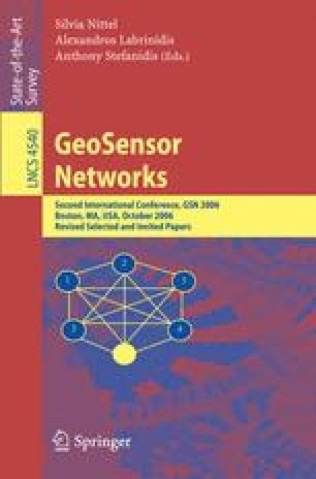
GeoSensor Networks : 2nd International Conference, GSN 2006, Boston, MA, USA, October 1-3, 2006, Revised Selected and Invited Papers
This book constitutes the thoroughly refereed proceedings of the Second GeoSensor Networks Conference, held in Boston, Massachusetts, USA, in October 2006. The conference addressed issues related to the collection, management, processing, analysis, and delivery of real-time geospatial data using distributed geosensor networks. This represents an evolution of the traditional static and centralized geocomputational paradigm.

Geology and Ecosystems
This book includes an analysis of the relationship between the different geological, hydrochemical, hydrogeological and engineering-geological processes and the processes within surface ecosystems. The analysis of specific interactions between the lithosphere and biosphere provides an integrated concept of the role of the geological environment in the evolution of the biosphere. The practical significance of the book is reflected by the analysis of modern engineering activity associated with the mining of minerals, excessive groundwater withdrawal, disposal of industrial and domestic wastes (including radioactive wastes) and their impacts on all components of the environment. Geology and Ecosystems includes a scientific approach to the complex monitoring of the environment under different natural and anthropogenic conditions, including the monitoring of permafrost regions. An important part of the book is the analysis of the "water factor" impact on ecosystems and sustainable development. Influences of intensive groundwater extraction on river flow, vegetation and land subsidence are also considered.
