



الصفحة 9
الصفحة 9

Matrix Algebra From a Statistician`s Perspective
This book presents matrix algebra in a way that is well-suited for those with an interest in statistics or a related discipline. It provides thorough and unified coverage of the fundamental concepts along with the specialized topics encountered in areas of statistics such as linear statistical models and multivariate analysis. It includes a number of very useful results that have only been available from relatively obscure sources. Detailed proofs are provided for all results. The style and level of presentation are designed to make the contents accessible to a broad audience. The book is essentially self-contained, though it is best-suited for a reader who has had some previous exposure to matrices (of the kind that might be acquired in a beginning course on linear or matrix algebra).

Matrix Algebra : Theory, Computations, and Applications in Statistics
Matrix algebra is one of the most important areas of mathematics for data analysis and for statistical theory. The first part of this book presents the relevant aspects of the theory of matrix algebra for applications in statistics. This part begins with the fundamental concepts of vectors and vector spaces, next covers the basic algebraic properties of matrices, then describes the analytic properties of vectors and matrices in the multivariate calculus, and finally discusses operations on matrices in solutions of linear systems and in eigenanalysis. This part is essentially self-contained.

Mathématiques, informatique, physique. Au fil des TIPE = Mathematics, computer science, physics : Throughout the TIPE projects
Presents nine cases in mathematics, physics, or computer science used in the competition. Each case study is accompanied by general remarks, commentary, a suggested outline, questions a jury might ask, and an explanation placing the case study's theme within its scientific context. The authors hope not only to assist CPGE students in their preparation but also to provide valuable support to teachers who have embraced this new pedagogical approach. Laurent Decreusefond and Alain Maruani, the pedagogical coordinators for the mathematics, computer science, and physics component of the TIPE, have made significant contributions to its design and implementation.

Mathématiques de base pour économistes = Basic Mathematics for Economists
This book contains fundamental elements of mathematics and includes the following elements: notion of logic, propositions, theorems, sets, relations and functions; graphical representations of functions, economic applications of lines and functions, sequences, limits and first derivative, differential economic applications of derivatives; integrals: undefined and defined with economic applications; mathematical series; functions of several variables, partial derivatives, Lagrange multiplier with economic applications; linear algebra: matrix calculus, system of linear equations, vectors, differential calculus in matrix form.

Mathematics of Large Eddy Simulation of Turbulent Flows
Large eddy simulation (LES) is a method of scientific computation seeking to predict the dynamics of organized structures in turbulent flows by approximating local, spatial averages of the flow. This book focuses on the mathematical foundations of LES and its models and provides a connection between the powerful tools of applied mathematics, partial differential equations and LES. Thus, it is concerned with fundamental aspects not treated so deeply in the other books in the field, aspects such as well-posedness of the models, their energy balance and the connection to the Leray theory of weak solutions of the Navier-Stokes equations.

Mathematics of Financial Markets
This book presents the mathematics that underpins pricing models for derivative securities, such as options, futures and swaps, in modern financial markets. The idealized continuous-time models built upon the famous Black-Scholes theory require sophisticated mathematical tools drawn from modern stochastic calculus. However, many of the underlying ideas can be explained more simply within a discrete-time framework. This is developed extensively in this substantially revised second edition to motivate the technically more demanding continuous-time theory, which includes a detailed analysis of the Black-Scholes model and its generalizations, American put options, term structure models and consumption-investment problems. The mathematics of martingales and stochastic calculus is developed where it is needed.

Mathematics Is Not a Spectator Sport
Mathematics Is Not a Spectator Sport challenges the reader to become an active mathematician. Beginning at a gentle pace, the author encourages the reader to get involved, with discussions of an exciting variety of topics, each placed in its historical context, The chapters are largely self-contained and each topic can be understood independently. However, the author draws many connections between the various topics to demonstrate their interplay and role within the context of mathematics as a whole. Lots of carefully chosen problems are included at the end of each section to stimulate the reader's development as a mathematician.

Mathematics for Life Science and Medicine
Dynamical systems theory in mathematical biology has attracted much attention from many scientific directions. The purpose of this volume is to present and discuss the many rich properties of the dynamical systems that appear in life science and medicine. The main topics include cancer treatment, dynamics of paroxysmal tachycardia, vector disease models, epidemic diseases and metapopulations, immune systems, pathogen competition and coexistence and the evolution of virulence and the rapid evolution of viruses within a host. Each chapter will serve to introduce students and scholars to the state-of-the-art in an exciting area, to present new results, and to inspire future contributions to mathematical modeling in life science and medicine.

Mathematics for Ecology and Environmental Sciences
Dynamical systems theory in mathematical biology has attracted much attention from many scientific directions. The purpose of this volume is to discuss the many rich and interesting properties of dynamical systems that appear in ecology and environmental sciences. The main topics include population dynamics with dispersal, nonlinear discrete population dynamics, structured population models, mathematical models in evolutionary ecology, stochastic spatial models in ecology, game dynamics and the chemostat model. Each chapter will serve to introduce students and scholars to the state-of-the-art in an exciting area, to present important new results, and to inspire future contributions to mathematical modeling in ecology and environmental sciences.

Mathematics and the Historians Craft : The Kenneth O. May Lectures
Mathematical practitioners, for pedagogical reasons or to contextualize the work, tend to focus on finding the antecedents for current mathematical theories in a search for how particular subdisciplines and results came to be as they are today. On the other hand, historians of mathematics bypass the current state of affairs, and are more interested in questions that bear on the changing nature of the discipline itself.

Mathematics and the Aesthetic : New Approaches to an Ancient Affinity
The essays in this book explore the ancient affinity between the mathematical and the aesthetic, focusing on the fundamental connections between these two modes of reasoning and communicating. From historical, philosophical and psychological perspectives, with particular attention to certain mathematical areas such as geometry and analysis, the authors examine the ways in which the aesthetic is ever present in mathematical thinking and contributes to the growth and value of mathematical knowledge.

Mathematics and Technology
Mathematics and Technology presents technological applications of mathematics making use of elegant mathematical concepts. The selected subjects consist of: public key cryptography, error correcting codes, the global positioning system (GPS) and cartography, image compression using fractals and the JPEG format, digital recording, robot movement, DNA computing, Google's PageRank algorithm, savings and loans, gamma ray surgery and random number generators. The authors highlight how mathematical modeling, together with the power of mathematical tools, have been crucial for innovation in technology. The exposition is clear, straightforward, motivated by excellent examples, and user-friendly. Numerous exercises at the end of every chapter reinforce the material. An engaging quality is the various historical notes accompanying the mathematical development.

Mathematics and Politics : Strategy, Voting, Power and Proof
Mathematics and Politics requires no prerequisites in either subject. The underlying philosophy involves minimizing algebraic computations while focusing on the conceptual aspects of mathematics in the context of real-world questions in political science. This new addition has an added co-author, Allison Pacelli, and covers six major topics: social choice, yes-no voting systems, political power, game-theoretic models of international conflict, fairness, and escalation. In addition to having two new chapters (treating apportionment and conflict resolution), the text has been extensively reorganized and the number of exercises increased to over 300.

Mathematics and Culture II : Visual Perfection: Mathematics and Creativity
This book presents the mathematical foundations of systems theory in a self-contained, comprehensive, detailed and mathematically rigorous way. This volume is devoted to the analysis of dynamical systems with emphasis on problems of uncertainty, whereas the second volume will be devoted to control. It combines features of a detailed introductory textbook with that of a reference source. The book contains many examples and figures illustrating the text which help to bring out the intuitive ideas behind the mathematical constructions.

Mathematics and Computation, a Contemporary View ; The Abel Symposium 2006
The 2006 Abel symposium is focusing on contemporary research involving interaction between computer science, computational science and mathematics. In recent years, computation has been affecting pure mathematics in fundamental ways. Conversely, ideas and methods of pure mathematics are becoming increasingly important within computational and applied mathematics. At the core of computer science is the study of computability and complexity for discrete mathematical structures. Studying the foundations of computational mathematics raises similar questions concerning continuous mathematical structures. There are several reasons for these developments. The exponential growth of computing power is bringing computational methods into ever new application areas.
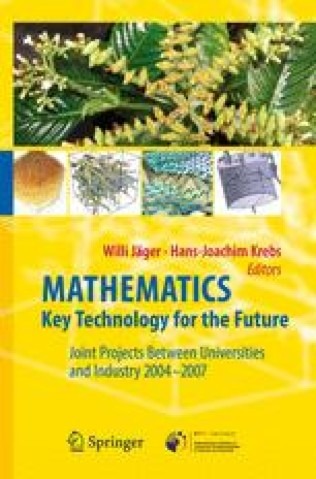
Mathematics - Key Technology for the Future : Joint Projects Between Universities and Industry 2004–2007
This book is about the results of a number of projects funded by the BMBF in the initiative "Mathematics for Innovations in Industry and Services". It shows that a broad spectrum of analytical and numerical mathematical methods and programming techniques are used to solve a lot of different specific industrial or services problems. The main focus is on the fact that the mathematics used is not usually standard mathematics or black box mathematics but is specifically developed for specific industrial or services problems. Mathematics is more than a tool box or an ancilarry science for other scientific disciplines or users. Through this book the reader will gain insight into the details of mathematical modeling and numerical simulation for a lot of industrial applications.

Mathematical Theory of Feynman Path Integrals : An Introduction
Feynman path integrals, suggested heuristically by Feynman in the 40s, have become the basis of much of contemporary physics, from non-relativistic quantum mechanics to quantum fields, including gauge fields, gravitation, cosmology. Recently ideas based on Feynman path integrals have also played an important role in areas of mathematics like low-dimensional topology and differential geometry, algebraic geometry, infinite-dimensional analysis and geometry, and number theory.

Mathematical Systems Theory I : Modelling, State Space Analysis, Stability and Robustness
This book presents the mathematical foundations of systems theory in a self-contained, comprehensive, detailed and mathematically rigorous way. This volume is devoted to the analysis of dynamical systems with emphasis on problems of uncertainty, whereas the second volume will be devoted to control. It combines features of a detailed introductory textbook with that of a reference source. The book contains many examples and figures illustrating the text which help to bring out the intuitive ideas behind the mathematical constructions.

Mathematical Survey Lectures 1943-2004
This collection traces the career of Beno Eckmann, whose work ranges across a broad spectrum of mathematical concepts from topology and differential geometry through homological algebra to group theory. One of our most influential living mathematicians, Eckmann has been associated for nearly his entire professional life with the Swiss Federal Institute of Technology Zurich (ETH), as student, lecturer, professor, and professor emeritus.

Mathematical Statistics : Exercises and Solutions
This book consists of four hundred exercises in mathematical statistics and their solutions,this solutions to train students for their research ability in mathematical statistics and presents many additional results and examples that complement any text in mathematical statistics. To develop problem-solving skills, two solutions and/or notes of brief discussions accompany a few exercises.The exercises are grouped into seven chapters with titles matching those in the author's Mathematical Statistics.
