



الصفحة 9
الصفحة 9

Free Convection Film Flows and Heat Transfer
This book presents recent developments in systematic studies of hydrodynamics and heat and mass transfer in laminar free convection, accelerating film boiling and condensation of Newtonian fluids, as well as accelerating film flow of non-Newtonian power-law fluids (FFNF). A novel system of analysis models is provided with a developed velocity component method, instead of traditional Falkner-Skan type transformation, and a system of models for treatment of variable thermophysical properties is presented with an innovative temperature parameter method that makes it easier to similarly treat related governing differential equations for consideration of fluid variable thermophysical properties. A pseudo-similarity method is applied for dealing with thermal boundary layer of FFNF, furthermore, with an induced local Prandtl number, which greatly simplifies the heat-transfer analysis and numerical calculation.

Free Boundary Problems : Theory and Applications
This book gathersa collection of refereed articles containing original result srepo- ing the recent originalcontributions of the lectures and communications presented at the Free Boundary Problems (FBP2005) Conference that took place at the University of Coimbra, Portugal, from 7 to 12 of June 2005. They deal with the Mathematics of a broad class of models and problems involving nonlinear partial diferentialequationsarising inPhysics, Engineering, Biology and Finance. Among the main topics, the talks considered free boundary problems in biomedicine, in porous media, in thermodynamic modeling.

Fractional-in-time semilinear parabolic equations and applications
This book provides a unified analysis and scheme for the existence and uniqueness of strong and mild solutions to certain fractional kinetic equations. This class of equations is characterized by the presence of a nonlinear time-dependent source, generally of arbitrary growth in the unknown function, a time derivative in the sense of Caputo and the presence of a large class of diffusion operators. The global regularity problem is then treated separately and the analysis is extended to some systems of fractional kinetic equations, including prey-predator models of Volterra–Lotka type and chemical reactions models, all of them possibly containing some fractional kinetics.

Fractional calculus—theory and applications
Fractional calculus has led to tremendous progress in various areas of science and mathematics. New definitions of fractional derivatives and integrals have been uncovered, extending their classical definitions in various ways. Moreover, rigorous analysis of the functional properties of these new definitions has been an active area of research in mathematical analysis. Systems considering differential equations with fractional-order operators have been investigated thoroughly from analytical and numerical points of view, and potential applications have been proposed for use in sciences and in technology. The purpose of this Special Issue is to serve as a specialized forum for the dissemination of recent progress in the theory of fractional calculus and its potential applications.
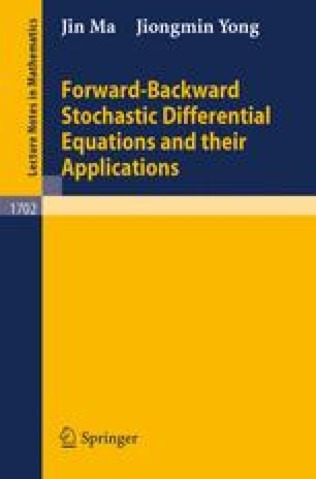
Forward-backward stochastic differential equations and their applications
This volume is a survey/monograph on the recently developed theory of forward-backward stochastic differential equations (FBSDEs). Basic techniques such as the method of optimal control, the "Four Step Scheme", and the method of continuation are presented in full. Related topics such as backward stochastic PDEs and many applications of FBSDEs are also discussed in detail. The volume is suitable for readers with basic knowledge of stochastic differential equations, and some exposure to the stochastic control theory and PDEs. It can be used for researchers and/or senior graduate students in the areas of probability, control theory, mathematical finance, and other related fields.

Fluid Mechanics : An Introduction to the Theory of Fluid Flows
Advancements of fluid flow measuring techniques and of computational methods have led to new ways to treat laminar and turbulent flows. These methods are extensively used these days in research and engineering practise. This also requires new ways to teach the subject to students at higher educational institutions in an introductory manner. The book provides the knowledge to students in engineering and natural science needed to enter fluid mechanics applications in various fields. Analytical treatments are provided, based on the Navier-Stokes equations. Introductions are also given into numerical and experimental methods applied to flows. The main benefit the reader will derive from the book is a sound introduction into all aspects of fluid mechanics covering all relevant subfields.

Fluid and thermodynamics ; Vol.1 : Basic fluid mechanics
Simple, yet precise solutions to special flows are also constructed, namely Blasius boundary layer flows, matched asymptotics of the Navier-Stokes equations, global laws of steady and unsteady boundary layer flows and laminar and turbulent pipe flows

Fluctuations, Information, Gravity and the Quantum Potential
A main theme of the book outlines the role of the quantum potential in quantum mechanics and general relativity and one of its origins via fluctuations formulated in terms of Fisher information. Another theme is the description of various approaches to Bohmian mechanics and their role in quantum mechanics and general relativity. Along the way various approaches to, for instance, the Dirac equation, the Einstein equations, the Klein-Gordon equation, the Maxwell equations and the Schr?dinger equations are described. Statistics and geometry are intertwined in various ways and, among other matters, the aether, cosmology, entropy, fractals, quantum Kaehler geometry, the vacuum and the zero point field are discussed. There is also some speculative material and some original work along with material extracted from over 1000 references and the work is current up to April 2005.

Finite Zeros in discrete time control systems
The book starts with definition of invariant zeros and goes as far as a general characterization of output-zeroing inputs and the corresponding solutions, explicit formulas for maximal output-nulling invariant subspaces and for the zero dynamics. The objective of this book is to render the reader familiar with a certain method of analysis of multivariable zeros (which goes beyond the classical approach) and related problems. The minimal mathematical background that is required from the reader is a working knowledge of linear algebra and difference equations.

Finite Elements III : First-Order and Time-Dependent PDEs
Volume III is divided into 28 chapters. The first eight chapters focus on the symmetric positive systems of first-order PDEs called Friedrichs' systems. This part of the book presents a comprehensive and unified treatment of various stabilization techniques from the existing literature. It discusses applications to advection and advection-diffusion equations and various PDEs written in mixed form such as Darcy and Stokes flows and Maxwell's equations. The remainder of Volume III addresses time-dependent problems: parabolic equations (such as the heat equation), evolution equations without coercivity (Stokes flows, Friedrichs' systems), and nonlinear hyperbolic equations (scalar conservation equations, hyperbolic systems). It offers a fresh perspective on the analysis of well-known time-stepping methods. The last five chapters discuss the approximation of hyperbolic equations with finite elements. Here again a new perspective is proposed.

Finite Element Methods for Engineering Sciences : Theoretical Approach and Problem Solving Techniques
This self-tutorial offers a concise yet thorough grounding in the mathematics necessary for successfully applying FEMs to practical problems in science and engineering. The enlarged English-language edition, based on the original French, also contains a chapter on the approximation steps derived from the description of nature with differential equations and then applied to the specific model to be used.

Finite element methods and their applications
This book serves as a text for one- or two-semester courses for upper-level undergraduates and beginning graduate students and as a professional reference for people who want to solve partial differential equations (PDEs) using finite element methods. The author has attempted to introduce every concept in the simplest possible setting and maintain a level of treatment that is as rigorous as possible without being unnecessarily abstract. Quite a lot of attention is given to discontinuous finite elements, characteristic finite elements, and to the applications in fluid and solid mechanics including applications to porous media flow, and applications to semiconductor modeling. An extensive set of exercises and references in each chapter are provided.

Finite Difference Computing with PDEs : A Modern Software Approach
This easy-to-read book introduces the basics of solving partial differential equations by means of finite difference methods. Unlike many of the traditional academic works on the topic, this book was written for practitioners. Accordingly, it especially addresses: the construction of finite difference schemes, formulation and implementation of algorithms, verification of implementations, analyses of physical behavior as implied by the numerical solutions, and how to apply the methods and software to solve problems in the fields of physics and biology.

Finite Difference Computing with Exponential Decay Models
This text provides a very simple, initial introduction to the complete scientific computing pipeline: models, discretization, algorithms, programming, verification, and visualization. The pedagogical strategy is to use one case study – an ordinary differential equation describing exponential decay processes – to illustrate fundamental concepts in mathematics and computer science. The book is easy to read and only requires a command of one-variable calculus and some very basic knowledge about computer programming. Contrary to similar texts on numerical methods and programming, this text has a much stronger focus on implementation and teaches testing and software engineering in particular.

Fields and Galois Theory
The pioneering work of Abel and Galois in the early nineteenth century demonstrated that the long-standing quest for a solution of quintic equations by radicals was fruitless: no formula can be found. The techniques they used were, in the end, more important than the resolution of a somewhat esoteric problem, for they were the genesis of modern abstract algebra. This book provides a gentle introduction to Galois theory suitable for third- and fourth-year undergraduates and beginning graduates. The approach is unashamedly unhistorical: it uses the language and techniques of abstract algebra to express complex arguments in contemporary terms. Thus the insolubility of the quintic by radicals is linked to the fact that the alternating group of degree 5 is simple - which is assuredly not the way Galois would have expressed the connection.

Field Models in Electricity and Magnetism
Covering the development of field computation in the past forty years, Field Models in Electricity and Magnetism intends to be a concise, comprehensive and up-to-date introduction to field models in electricity and magnetism, ranging from basic theory to numerical applications. The approach assumed throughout the whole book is to solve field problems directly from partial differential equations in terms of vector quantities. Theoretical issues are illustrated by practical examples. In particular, a single example is solved by different methods so that, by comparison of results, limitations and advantages of the various methods are made clear.

Fault-Diagnosis Systems : An Introduction from Fault Detection to Fault Tolerance
This book gives an introduction into the field of fault detection, fault diagnosis and fault-tolerant systems with methods which have proven their performance in practical applications. It guides the reader in a structured tutorial style: supervision methods, reliability, safety, system integrity and related terminology; fault detection with signal-based methods for periodic and stochastic signals; fault detection with process model-based methods like parameter estimation, state estimation, parity equations and principal component analysis; fault diagnosis with classification and inference methods; fault-tolerant systems with hardware and analytical redundancy; many practical simulation examples and experimental results for processes like electrical motors, pumps, actuators, sensors and automotive components; end-of-chapter exercises for self testing or for practice.

Factorization of Matrix and Operator Functions : The State Space Method
The present book deals with factorization problems for matrix and operator functions. The problems originate from, or are motivated by, the theory of non-selfadjoint operators, the theory of matrix polynomials, mathematical systems and control theory, the theory of Riccati equations, inversion of convolution operators, theory of job scheduling in operations research. The book systematically employs a geometric principle of factorization which has its origins in the state space theory of linear input-output systems and in the theory of characteristic operator functions. This principle allows one to deal with different factorizations from one point of view. Covered are canonical factorization, minimal and non-minimal factorizations, pseudo-canonical factorization, and various types of degree one factorization.

Exponentially Dichotomous Operators and Applications
In this monograph the natural evolution operators of autonomous first-order differential equations with exponential dichotomy on an arbitrary Banach space are studied in detail. Characterizations of these so-called exponentially dichotomous operators in terms of their resolvents and additive and multiplicative perturbation results are given. The general theory of the first three chapters is then followed by applications to Wiener-Hopf factorization and Riccati equations, transport equations, diffusion equations of indefinite Sturm-Liouville type, noncausal infinite-dimensional linear continuous-time systems, and functional differential equations of mixed type.

Explicit Stability Conditions for Continuous Systems : A Functional Analytic Approach
Explicit Stability Conditions for Continuous Systems deals with non-autonomous linear and nonlinear continuous finite dimensional systems. Explicit conditions for the asymptotic, absolute, input-to-state and orbital stabilities are discussed. This monograph provides new tools for specialists in control system theory and stability theory of ordinary differential equations, with a special emphasis on the Aizerman problem. A systematic exposition of the approach to stability analysis based on estimates for matrix-valued functions is suggested and various classes of systems are investigated from a unified viewpoint.
