



الصفحة 9
الصفحة 9

From Melancholia to Depression : Disordered Mood in Nineteenth-Century Psychiatry
This book maps a crucial but neglected chapter in the history of psychiatry: how was melancholia transformed in the nineteenth century from traditional melancholy madness into a modern biomedical mood disorder

From Bilateral Arbitral Tribunals and Investment Courts to a Multilateral Investment Court : Options Regarding the Institutionalization of Investor-State Dispute Settlement
This book considers the potential setup for a future Multilateral Investment Court (MIC). The option of an MIC was first discussed by the EU Commission in 2016 and has since been made an official element of the EU Common Commercial Policy. In 2017, UNCITRAL also decided to discuss the possibility of an MIC, and on 20 March 2018, the Council of the EU gave the EU Commission the mandate to negotiate the creation of an MIC. The “feasibility study” presented here is intended to contribute to a broader discussion on the options for a new international court specialized in investment protection.

Fractals in Biology and Medicine : Beyond Planting Trees
This volume it highlights the potential that fractal geometry offers for elucidating and explaining the complex make-up of cells, tissues and biological organisms either in normal or in pathological conditions, including the structural changes that occur in tumours. It helps develop the concepts, questions and methods required in research on fractal biology and natural phenomena and to evidence the pitfalls of a too simplistic application of these principles in investigating topical subjects of biology and medicine. It discusses present and future applications of fractal geometry, bringing together cellular and molecular biology, engineering, mathematics, physics, medicine and other disciplines and allowing an interdisciplinary vision.

Foundations of Intelligent Systems ; Vol. 3488 ; 15th International Symposium ISMIS 2005, Saratoga Springs, NY, USA, May 25-28, 2005, Proceedings
This volume contains the papers selected for presentation at the 15th International S- posiumonMethodologiesforIntelligentSystems, ISMIS2005, heldinSaratogaSprings, NewYork,25-28May,2005. ThesymposiumwasorganizedbySUNYatAlbany. Itwas sponsored by the Army Research Of?ce and by several units of the University at Albany including its Division for Research, College of Arts and Sciences, Department of C- puter Science, and Institute for Informatics, Logics, and Security Studies (formerly the Institute for Programming and Logics). The Program Committee selected the following major areas for ISMIS 2005: intelligent information systems, knowledge discovery and data mining, knowledge - formation and integration, knowledge representation, logic for arti?cial intelligence, soft computing, Web intelligence, Web services, and papers dealing with applications of intelligent systems in complex/novel domains. The contributed papers were selected from almost 200 full draft papers by the Program Committee members.

Foundations of Intelligent Systems ; 13th International Symposium, ISMIS 2002, Lyon, France, June 27-29, 2002. Proceedings
This volume contains the papers selected for presentation at the 13th International Symposium on Methodologies for Intelligent Systems ISMIS 2002, held in Lyon, France, 27-29 June, 2002. The symposium was organized by the UniversitØ ClaudThe program committee selected the following major areas for ISMIS 2002: Intelligent Multimedia, Intelligent Information Retrieval, Intelligent Information Systems, Knowledge Representation and Integration, Learning and Knowledge Discovery, Logic for Artificial Intelligence, Methodologies (modeling, design, validation, performance evaluation), and Soft Computing.

Forest Trees
Genome Mapping and Molecular Breeding in Plants presents the current status of the elucidation and improvement of plant genomes of economic interest. The focus is on genetic and physical mapping, positioning, cloning, monitoring of desirable genes by molecular breeding and the most recent advances in genomics. The series comprises seven volumes: Cereals and Millets; Oilseeds; Pulses, Sugar and Tuber Crops; Fruits and Nuts; Vegetables; Technical Crops; and Forest Trees. Forest trees cover one third of the global land surface, constitute many ecosystems and play a pivotal role in the world economy. Despite their importance in the economy, ecology and environment, genetic analysis and breeding efforts have lagged behind. Presented here are chapters on Populus trees, pines, Fagaceae trees, eucalypts, spruces, Douglas fir and black walnut, and a first-ever detailed review of Cryptomeria japonica. Innovative strategies to address the inherent problems of genome analysis of tree species are thoroughly discussed.

Forest Radioecology in Fukushima : Radiocesium Dynamics, Impact, and Future
This book provides holistic information on the radioactive contamination of forests. Topics are highly interdisciplinary, ranging from the dynamics of radioactive cesium in forest ecosystems to the radiation protection or the socio-economic aspects of radiation effects. It is designed to help people understand the radioactive contamination in forests and provide hints of how to cope with it and restore their livelihoods. The book is characterized by its well-balanced structure that allows the reader to understand the whole picture without going into too much scientific content. After explaining the basics of radioactive materials and radiation, the book illustrates the radioactive contamination of forests, it also describes the impacts on the forestry and life of local people and the measures taken by. Few books address the concerns about how to deal with radioactive contamination of forests and the future perspectives. In this book, people can learn all about the Fukushima nuclear accident of forests, forest products, and people with abundant reference materials.

Forensic Psychiatry : Influences of Evil
In Forensic Psychiatry: Influences of Evil, Tom Mason brings together an international panel of experts from diverse specialties to examine the idea of "evil" in a medical context, specifically a mental health setting, to consider how the concept can be usefully interpreted, and to elucidate its relationship to forensic psychiatry. The authors challenge the belief that the concept of "evil" plays no role in "scientific" psychiatry and is not helpful to our understanding of aberrant human thinking and behavior.

Forensic Pathology Reviews ; Vol. 4
Building on the excellent foundation laid in earlier volumes of the series, leading forensic pathologists from the United States and around the world again provide in Forensic Pathology Reviews, Volume 4 evidence-based accounts of special topics of current interest from various fields of forensic pathology and death-scene investigation. The authors offer cutting-edge insights into death from environmental conditions (lightning and elder abuse), homicide by sharp force, death from natural causes (asthma, Marfan syndrome, and peliosis of the liver and spleen), and pathology of human endothelium in septic organ failure.

Forensic pathology reviews ; Vol. 3
Maintaining the high quality achieved in earlier volumes, leading national and international forensic pathologists provide in Forensic Pathology Reviews, Volume 3 evidence-based accounts of special topics of current interest from various fields of forensic pathology and death-scene investigation. The authors offer cutting-edge insights into the medicolegal investigation of bodies found in water, the forensic aspects of the human immunodeficiency virus (HIV)-1 infection of the central nervous system, deaths in a head-down position, and forensic bitemark analysis. Additional chapters address taphonomic changes in human bodies during the early postmortem interval, arrhythmogenic ventricular dysplasia that produces sudden death in young people, the postmortem diagnosis of death in anaphylaxis, and iatrogenic deaths. The forensic aspects of suicide, murder-suicide, and suicide trends in the United States are also discussed, along with the evaluation of fatal pulmonary thromboembolism and the use of radiology in medicolegal investigations. A comprehensive, up-to-date review of the international literature is given for each chapter. Evidence-based and state-of-the-art, Forensic Pathology Reviews, Volume 3 synthesizes the practical advances made in a variety of important subspecialties of forensic pathology, demonstrating how the latest medical and scientific advances are being applied to solve current problems of high interest to forensic pathologists today.
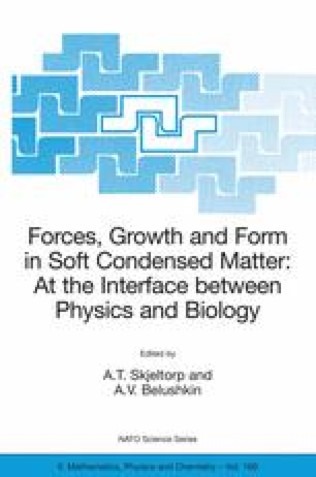
Forces, Growth and Form in Soft Condensed Matter : At the Interface between Physics and Biology
This volume comprises the proceedings of a NATO Advanced Study Institute held at Geilo, Norway, 24 March - 3 April 2003, the seventeenth ASI in a series held every two years since 1971. The objective of this ASI was to identify and discuss areas where synergism between modern physics, soft condensed matter and biology might be most fruitful. The main pedagogical approach was to have lecturers focussing on basic understanding of important aspects of the relative role of the various interaction- electrostatic, hydrophobic, steric, conformational, van der Waals etc. Soft condensed matter and the connection between physics and biology have been the themes of several earlier Geilo Schools. A return to these subjects thus allowed a fresh look and a possibility for defining new directions for research. Examples of soft materials, which were discussed at this ASI, included colloidal dispersions, gels, biopolymers and charged polymer solutions, polyelectrolytes, protein/membrane complexes, nucleic acids and their complexes. Indeed, most forms of condensed matter are soft and these substances are composed of aggregates and macromolecules, with interactions that are too weak and complex to form crystals spontaneously. A characteristic feature is that small external forces, slight perturbations in temperature, pressure or concentration, can all be enough to induce significant structural changes. Thermal fluctuations are almost by definition strong in soft materials and entropy is a predominant determinant of structure, so that disorder, slow dynamics and plastic deformation are the rule. Hence the phrase ‘soft condensed matter’ has been coined.

Forced migration and mental health : Rethinking the care of refugees and displaced persons
In the last half century, the steadily increasing incidence of armed conflict (both within and between nations) has created mounting numbers of asylum seekers, refugees, and displaced persons. The provision of appropriate mental health services for these individuals has become a major focus of concern, but considerable controversy remains as to what kind of care is necessary. The initial assumptions and models that informed the field have recently come under attack, and alternative approaches have arisen. Forced Migration and Mental Health: Rethinking the Care of Refugees and Displaced Persons provides an up-to-date view of the controversies and future directions for the mental health care of those displaced by war or other extreme conditions.

Food Safety and Ways to Prevent Life-Threatening Pollutants
The fears regarding food safety started long time ago, and till this very moment of ours, the international organizations and INGOs pay lots of hard work to minimize and achieve reduction in the effects and the suffering caused to people around the world by contaminated foods each year. This research talks about the main patterns of food contaminants, and they are chemical, physical, biological, and last but not least the contamination caused by radioactive substances. It is also important to talk about the methods of precaution and protection against the diseases and illnesses produced by contaminated foods, as well about the role of INGOs which are dedicated and specialized in law and regulations enactment for bounding the incidence of food contamination in the world, for raising the public awareness towards food safety, and to keep up with the latest updates of events. This research also contains vast Information about Covid-19 and its spreading process via contaminated food.

Food nanotechnology
Nanotechnology is increasingly being utilized within the food industry to create innovative products with new or improved properties. This book introduces the history of nanotechnology applications in the food industry. It then discusses the key physicochemical and structural characteristics of the different kinds of nanoparticles found in foods, as well as showing how these characteristics lead to their unique functional attributes. Applications of nanotechnology in the food and agricultural industries are then covered, including the creation of nanopesticides, nanofertilizers, nutrient delivery systems, functional ingredients, smart packaging materials, nanofilters, and sensors, as well as for the conversion of waste materials into value-added products. Finally, the potential toxicity of both organic and inorganic nanoparticles found in foods is critically assessed. The author is a Distinguished Professor of food science who uses physics, chemistry, and biology to improve the quality, safety, and healthiness of foods. He has published over a thousand scientific articles and numerous books in this area and is currently the most highly cited food scientist in the world. He has won numerous awards for his scientific achievements.

Food - drug interactions
The effect of drug on a person may be different than expected because that drug interacts with another drug the person is taking (drug-drug interaction), food, beverages, dietary supplements the person is consuming (drug-nutrient/food interaction) or another disease the person has (drug-disease interaction). A drug interaction is a situation in which a substance affects the activity of a drug, i.e. the effects are increased or decreased, or they produce a new effect that neither produces on its own. These interactions may occur out of accidental misuse or due to lack of knowledge about the active ingredients involved in the relevant substances. Regarding food-drug interactions physicians and pharmacists recognize that some foods and drugs, when taken simultaneously, can alter the body's ability to utilize a particular food or drug, or cause serious side effects.

Focusing telescopes in nuclear astrophysics
This volume is the first of its kind on focusing gamma-ray telescopes. Forty-eight refereed papers provide a comprehensive overview of the scientific potential and technical challenges of this nascent tool for nuclear astrophysics. The book features articles dealing with pivotal technologies such as grazing incident mirrors, multilayer coatings, Laue- and Fresnel-lenses - and even an optic using the curvature of space-time. The volume also presents an overview of detectors matching the ambitious objectives of gamma ray optics, and facilities for operating such systems on the ground and in space. The extraordinary scientific potential of focusing gamma-ray telescopes for the study of the most powerful sources and the most violent events in the Universe is emphasized in a series of introductory articles.

Fluconazole : Pharmacology, clinical uses and health effects
Fluconazole is a triazole antifungal drug used in the treatment and prevention of superficial and systemic fungal infections. In this book, the authors present current research in the study of the pharmacology, clinical uses and health effects of fluconazole. Topics discussed include the utilization of fluconazole in adult intensive care units; the use of fluconazole in veterinary species and a description of variances from the human experience as well as findings in veterinary species which may have applicability in human medicine; common clinical uses and in vitro activity features on fluconazole; and the discovery and development of medically-important antifungal agents, particularly the azole derivatives and the development of fluconazole and its clinical applications.

Fish Histology : Female Reproductive Systems
This volume describes the myriad ways in which fish have approached problems of reproduction — it is an amply illustrated comparative study of the microscopic structure of the female genital systems of fish. The timing of its appearance is auspicious in that it coincides with the decline of the golden age of descriptive morphology. It is a compilation of thousands of micrographs — mostly electron micrographs — from classic works in the field and should prove valuable to investigators studying fish in areas such as ecology, physiology, and reproductive biology who may view histology as essential in their work but have little background in this area. It includes chapters on the origin of genital systems, the structure of ovarian follicles, mechanisms of ovulation, the cortical reaction, oviducts, oviparity, and amazing examples of viviparity.

Finite element analysis in geotechnical engineering ; Vol.1 : Theory
Provides the reader with a detailed insight into the use of the finite element method in geotechnical engineering. As specialist knowledge required to perform geotechnical finite element analysis is not normally part of a single engineering degree course, this lucid work will prove invaluable. It brings together essential information presented in a manner understandable to most engineers. Volume 1 presents the theory, assumptions and approximations involved in finite element analysis

Finite element analysis in geotechnical engineering : Vol.2 : Application
Provides the reader with a detailed insight into the use of the finite element method in geotechnical engineering. As specialist knowledge required to perform geotechnical finite element analysis is not normally part of a single engineering degree course, this lucid work will prove invaluable. It brings together essential information presented in a manner understandable to most engineers. Volume 2 concentrates on its practical applications.
