



الصفحة 85
الصفحة 85
Approximation, randomization, and combinatorial optimization algorithms and techniques ; 9th International Workshop on approximation algorithms for combinatorial optimization problems, APPROX 2006 and 10th International Workshop on Randomization and Computation, RANDOM 2006, Barcelona, Spain, August 28-30, 2006, Proceedings
This is the joint refereed proceedings of the 9th International Workshop on Approximation Algorithms for Combinatorial Optimization Problems, APPROX 2006 and the 10th International Workshop on Randomization and Computation, RANDOM 2006. The book presents 44 carefully reviewed and revised full papers. Among the topics covered are design and analysis of approximation algorithms, hardness of approximation problems, small spaces and data streaming algorithms, embeddings and metric space methods, and more.
Approximation, randomization and combinatorial optimization. algorithms and techniques ; 8th international workshop on approximation algorithms for compinatorial optimization problems, APPROX 2005 and 9th international workshop on randomization and computation, RANDOM 2005, Berkeley, CA, USA, August 22-24, 2005, Proceedings
This volume contains the papers presented at the 8th International Workshopon Approximation Algorithms for Combinatorial Optimization Problems(APPROX 2005) and the 9th International Workshop on Randomization andComputation (RANDOM 2005), APPROX focuses on algorith-mic and complexity issues surrounding the development of efficient approximatesolutions to computationally hard problems, RANDOM isconcerned with applications of randomness to computational and combinatorialproblems, The volume contains 20 contributed papers selected by the APPROX Pro-gram

Approximation, randomization and combinatorial optimization. algorithms and techniques ; 11th International Workshop, APPROX 2008, and 12th International Workshop, RANDOM 2008, Boston, MA, USA, August 25-27, 2008. Proceedings
This book constitutes the joint refereed proceedings of the 11th International Workshop on Approximation Algorithms for Combinatorial Optimization Problems, APPROX 2008.

Approximation, randomization and combinatorial optimization. algorithms and techniques ; 10th International Workshop, APPROX 2007, and 11th International Workshop, RANDOM 2007, Princeton, NJ, USA, August 20-22, 2007, Proceedings
It aims, in particular, at fostering cooperation among - gorithmic and complexity researchers in the field. It focuses on algorithmic and complexity aspects ar- ing in the development of eficient approximate solutions to computationally dificult problems.
Approximation of Additive Convolution-Like Operators : Real C*-Algebra Approach
Various aspects of numerical analysis for equations arising in boundary integral equation methods have been the subject of several books published in the last 15 years [95, 102, 183, 196, 198]. Prominent examples include various classes of o- dimensional singular integral equations or equations related to single and double layer potentials. Usually, a mathematically rigorous foundation and error analysis for the approximate solution of such equations is by no means an easy task. One reason is the fact that boundary integral operators generally are neither integral operatorsof the formidentity plus compact operatornor identity plus an operator with a small norm. Consequently, existing standard theories for the numerical analysis of Fredholm integral equations of the second kind are not applicable. In the last 15 years it became clear that the Banach algebra technique is a powerful tool to analyze the stability problem for relevant approximation methods [102, 103, 183, 189]. The starting point for this approach is the observation that the ? stability problem is an invertibility problem in a certain BanachorC -algebra. As a rule, this algebra is very complicated – and one has to ?nd relevant subalgebras to use such tools as local principles and representation theory.

Approximation and online algorithms ; Vol.3351 ; 2nd international workshop, WAOA 2004, Bergen, Norway, September 14-16, 2004, Revised Selected Papers
The 2nd Workshop on Approximation and Online Algorithms (WAOA 2004) focused on the design and analysis of algorithms for online and computationally hard problems. Both kinds of problems have a large number of applications arising from a variety of fields. The workshop was part of the ALGO 2004 event which also hosted ESA, WABI, IWPEC, and ATMOS. Topics of interests for WAOA2004 were : applications to game theory, appr- imation classes, coloring and partitioning, competitive analysis, computational finance, cuts and connectivity, geometric problems, in approximability results, mechanism design, network design, routing, packing and covering, paradigms, randomization techniques, and scheduling problems. on the reviews, This volume contains the 21 selected papers

Applied therapeutics : The clinical use of drugs
"Continually revised and updated for 50 years, Applied Therapeutics: The Clinical Use of Drugs is the gold standard for patient centered drug therapeutics. With its acclaimed case-based approach, it promotes mastery and application of the fundamentals of drug therapeutics. Featuring contributions from more than 200 experienced clinicians, every chapter reflects our ever-changing knowledge of drugs and the application of this knowledge to the individualized therapy of patients. As students progress from the General Principles section to chapters on specific diseases, they will benefit from practical problem-solving techniques that help devise effective evidence-based drug treatment plans"

Applied Stratigraphy
This book aims to incorporate major aspects and essential elements underpinning the modern applications and perspectives of stratigraphy. It focuses on traditional and innovative techniques and how these can be utilized in reconstructing the geological history of sedimentary basins and in solving manifold geological problems and phenomena. Each chapter summarizes contributions by leading researchers in the field. It is hoped that this book will provide the reader with key insights into all these aspects and applications.
Applied scanning probe methodsVII : Biomimetics and industrial applications
The present volumes cover three main areas: novel probes and techniques (Vol. V), charactarization (Vol. VI), and biomimetics and industrial applications (Vol. VII). Volume V includes an overview of probe and sensor technologies including integrated cantilever concepts, electrostatic microscanners, low-noise methods and improved dynamic force microscopy techniques, high-resonance dynamic force - croscopy and the torsional resonance method, modelling of tip cantilever systems, scanning probe methods, approaches for elasticity and adhesion measurements on the nanometer scale as well as optical applications of scanning probe techniques based on near?eld Raman spectroscopy and imaging.
Applied scanning probe methods X : Biomimetics and industrial applications
The success of the Springer Series Applied Scanning Probe Methods I–VII and the rapidly expanding activities in scanning probe development and applications worldwide made it a natural step to collect further speci c results in the elds of development of scanning probe microscopy techniques (Vol. VIII), characterization (Vol. IX), and biomimetics and industrial applications (Vol. X). These three volumes complement the previous set of volumes under the subject topics and give insight into the recent work of leading specialists in their respective elds. Following the tradition of the series, the chapters are arranged around techniques, characterization and biomimetics and industrial applications. Volume VIII focuses on novel scanning probe techniques and the understanding of tip/sample interactions. Topics include near eld imaging, advanced AFM, specialized scanning probe methods in life sciences including new self sensing cantilever systems, combinations of AFM sensors and scanning electron and ion microscopes, calibration methods, frequency modulation AFM for application in liquids, Kelvin probe force microscopy, scanning capacitance microscopy, and the measurement of electrical transport properties at the nanometer scale.
Applied scanning probe methods VIII : Scanning probe microscopy techniques
The success of the Springer Series Applied Scanning Probe Methods I–VII and the rapidly expanding activities in scanning probe development and applications worldwide made it a natural step to collect further speci c results in the elds of development of scanning probe microscopy techniques (Vol. VIII), characterization (Vol. IX), and biomimetics and industrial applications (Vol. X). These three volumes complement the previous set of volumes under the subject topics and give insight into the recent work of leading specialists in their respective elds. Following the tradition of the series, the chapters are arranged around techniques, characterization and biomimetics and industrial applications. Volume VIII focuses on novel scanning probe techniques and the understanding of tip/sample interactions. Topics include near eld imaging, advanced AFM, s- cializedscanningprobemethodsinlifesciencesincludingnewselfsensingcantilever systems, combinations of AFM sensors and scanning electron and ion microscopes, calibration methods, frequency modulation AFM for application in liquids, Kelvin probe force microscopy, scanning capacitance microscopy, and the measurement of electrical transport properties at the nanometer scale.
Applied scanning probe methods V : Scanning probe microscopy techniques
The scanning probe microscopy ?eld has been rapidly expanding. It is a demanding task to collect a timely overview of this ?eld with an emphasis on technical dev- opments and industrial applications. It became evident while editing Vols. I–IV that a large number of technical and applicational aspects are present and rapidly - veloping worldwide. Considering the success of Vols. I–IV and the fact that further colleagues from leading laboratories were ready to contribute their latest achie- ments, we decided to expand the series with articles touching ?elds not covered in the previous volumes. The response and support of our colleagues were excellent, making it possible to edit another three volumes of the series.
Applied scanning probe methods IX : Characterization
The success of the Springer Series Applied Scanning Probe Methods I–VII and the rapidly expanding activities in scanning probe development and applications worldwide made it a natural step to collect further speci c results in the elds of development of scanning probe microscopy techniques (Vol. VIII), characterization (Vol. IX), and biomimetics and industrial applications (Vol. X). These three volumes complement the previous set of volumes under the subject topics and give insight into the recent work of leading specialists in their respective elds. Following the tradition of the series, the chapters are arranged around techniques, characterization and biomimetics and industrial applications. Volume VIII focuses on novel scanning probe techniques and the understanding of tip/sample interactions. Topics include near eld imaging, advanced AFM, s- cializedscanningprobemethodsinlifesciencesincludingnewselfsensingcantilever systems, combinations of AFM sensors and scanning electron and ion microscopes, calibration methods, frequency modulation AFM for application in liquids, Kelvin probe force microscopy, scanning capacitance microscopy, and the measurement of electrical transport properties at the nanometer scale.
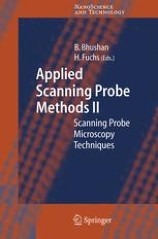
Applied scanning probe methods II : Scanning probe microscopy techniques
The sc- ning probes emerged as a new - strument for imaging with a p- cision suf?cient to delineate single atoms. At first there were two – the Scanning Tunneling Microscope, or STM, and the Atomic Force Mic- scope, or AFM. The STM relies on electrons tunneling between tip and sample whereas the AFM depends on the force acting on the tip when it was placed near the sample. These were quickly followed by the M- netic Force Microscope, MFM, and the Electrostatic Force Microscope, EFM. The MFM will image a single magnetic bit with features as small as 10nm. With the EFM one can monitor the charge of a single electron.
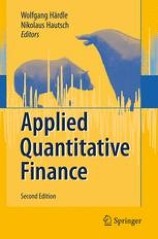
Applied Quantitative Finance
Applied Quantitative Finance (2nd edition) provides a comprehensive and state-of-the-art treatment of cutting-edge topics and methods. It provides solutions to and presents theoretical developments in many practical problems such as risk management, pricing of credit derivatives, quantification of volatility and copula modelling. The synthesis of theory and practice supported by computational tools is reflected in the selection of topics as well as in a finely tuned balance of scientific contributions on practical implementation and theoretical concepts. This linkage between theory and practice offers theoreticians insights into considerations of applicability and, vice versa, provides practitioners comfortable access to new techniques in quantitative finance.
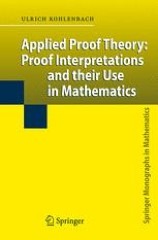
Applied Proof Theory : Proof Interpretations and Their Use in Mathematics
Ulrich Kohlenbach presents an applied form of proof theory that has led in recent years to new results in number theory, approximation theory, nonlinear analysis, geodesic geometry and ergodic theory (among others). This applied approach is based on logical transformations (so-called proof interpretations) and concerns the extraction of effective data (such as bounds) from prima facie ineffective proofs as well as new qualitative results such as independence of solutions from certain parameters, generalizations of proofs by elimination of premises. The book first develops the necessary logical machinery emphasizing novel forms of Gödel's famous functional ('Dialectica') interpretation. It then establishes general logical metatheorems that connect these techniques with concrete mathematics. Finally, two extended case studies (one in approximation theory and one in fixed point theory) show in detail how this machinery can be applied to concrete proofs in different areas of mathematics.

Applied Physical Pharmacy
Presents an introduction to physical pharmacy. This book begins with a review of key biopharmaceutics concepts of drug liberation, absorption, distribution, metabolism, and excretion
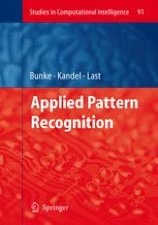
Applied Pattern Recognition
The main goal of this book is to cover some of the latest application domains of pattern recognition while presenting novel techniques that have been developed or customized in those domains.
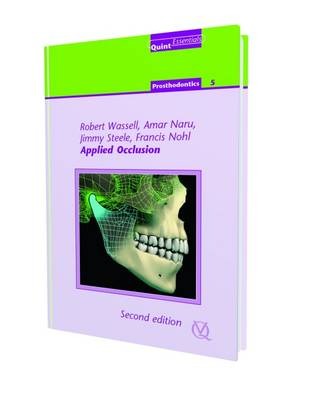
Applied Occlusion : QuintEssentials of Dental Practice ; Vol. 29
Includes many new illustrations, highlighted practical tips, and updates to the text with the most recent advances in the literature. The narrated 3D animations on the accompanying DVD clarify the effects of jaw movement, and comprehensive clinical videos demonstrate the process of investigating and managing real-life occlusal problems. The authors of this practical guide bring occlusal concepts and techniques to life and demystify them for dentists and students alike.
Applied mathematics and machine learning
The simultaneous availability of large datasets and high-performance computing capability in recent years has enabled the rapid development of powerful machine learning algorithms. On the one hand, state-of-the-art machine learning techniques have transformed many areas of science and engineering; on the other hand, theoretical discoveries in mathematical algorithms, differential equations, and statistical inferences, to name a few, have provided the foundation for the exploration of new multidisciplinary models for solving practical problems. This Special Issue endeavors to continue the journey that started in our previous Special Issue (Applied Mathematics and Computational Physics) by providing a platform for researchers from both academia and industry, as well as government, to present their new computational methods that have engineering and physics applications.
