



الصفحة 83
الصفحة 83

Object-Oriented Technology. ECOOP 2007 Workshop Reader ; ECOOP 2007 Workshops, Berlin, Germany, July 30-31, 2007, Final Reports
Contains the reports from the workshopsheld at the 21st European Conference on Object-Oriented Programming - ECOOP 2007 - at Technische Universit] at Berlin. Nineteen workshops were heldin the courseofthis conference on July 30 and July 31, 2007, covering a large spectrum of hot research topics. As in previous editions of ECOOP, numerous scientists from academia and industry took the chance to present innovative and topical ideas in an environment ofering optimal conditions for exciting discussions and fruitful interactions. The Workshop Reader which contains the reports from the workshops has been a substantial part of the ECOOP conference for more than10 years
Object-Oriented Technology ; ECOOP 2006 Workshop Reader ; ECOOP 2006 Workshops, Nantes, France, July 3-7, 2006, Final Reports
ECOOP Workshop Reader, a c- pendium of workshop reports pertaining to the ECOOP 2006 conference, held in Nantes during July 3–7, 2006. ECOOP 2006 hosted 19 high-quality research workshops covering a large spectrum of hot research topics. These workshops were chosen through a tight peer review process following a speci?c call for proposals.
Object-Oriented Technology ; ECOOP 2001 Workshops, Panel, and Posters, Budapest, Hungary, June 18-22, 2001. Proceedings
For the ?fth time in its history, in cooperation with Springer-Verlag, the European C- ference on Object-Oriented Programming (ECOOP) conference series is glad to offer the object-oriented research community the ECOOP 2001 Workshop Reader, a c- pendium of workshop reports, panel transcripts, and poster abstracts pertaining to the ECOOP 2001 conference, held in Budapest from 18 to 22 June, 2001. ECOOP 2001 hosted 19 high-quality workshops covering a large spectrum of - search topics. The workshops attracted 460 participants on the ?rst two days of the conference. Originally 22 workshops were chosen from 26 proposals by a workshop selection committee, following a peer review process. Due to the overlaps in the areas of interest and the suggestions made by the committee six of the groups decided to merge their topicsintothreeworkshops.

Nutrition, diet and healthy aging
Over the last 100 years, the numerous advances in science, the improved sanitary conditions and a decline in poverty have led to an increase in life expectancy. As a result, in the coming years, the number of over-65s will triple, and the over-80s will be the fastest growing portion of the population. However, an increased lifespan is associated with an increase in chronic diseases, such as cardiovascular disease, diabetes, cancer, sarcopenia, and degenerative disorders. Therefore, ideally, increased lifespan should be associated to a better healthspan, which is the period one individual is living in good health

Nutrition, chemistry, and health effects of sugar, salt, and milkfat
Covers sugar, salt and milk fat from a chemical perspective, and presents an overview of the role of these ingredients in our food, focusing on their flavors, satiety-inducing properties, nutritional impact, and health effects. The book begins with a chapter devoted to the chemical composition of these taste enhancers and satiety-inducing components, followed by a chapter that sheds light on the persuasive tactics employed by the food industry and their impact on consumer behavior, ultimately discussing the complex relationship between marketing strategies and public health. In Chapter 3, the author presents case studies and explores the nutritional requirements of these ingredients, while considering their physiological effects ad potential implications for human health. In Chapter 4, the author evaluates current consumption patterns and their implications, analyzing trends, policies, and opportunities to shape healthier dietary choices.

Nutrition in Kidney Disease
The field of kidney disease has evolved over the years to encompass a broad and sophisticated knowledge base. There has been a proliferation of scientific information and technical advances in the field. In Nutrition in Kidney Disease, the authors provide a comprehensive perspective of the emerging science in nutrition in kidney disease. This important book is written by a collaborative group of distinguished dietitians and physicians in the specialized field of kidney disease and clinical nutrition, who have devoted their careers to the care of patients with kidney disease. At the end of key chapters, case studies assess knowledge of the subject within the context of didactic curriculums.

Nutrition and Rheumatic Disease
It is difficult, if not impossible, for health care providers to remain at the forefront of knowledge for all aspects of nutrition and rheumatic diseases. In Nutrition and Rheumatic Disease, experts provide a comprehensive review of current knowledge regarding nutrition and dietary management for the complex set of rheumatic conditions. Within the disease-specific chapters, the authors present a historical perspective, a discussion of the major clinical features, current management and treatment, a review of the literature related to nutritional status and diet, and dietary recommendations, based on current scientific evidence. The field of rheumatic diseases includes a wide variety of pathologic processes. Adequate reviews of the scientific literature on each of the rheumatic diseases in Nutrition and Rheumatic Disease alleviate the inherent confusion surrounding the risks and benefits of various dietary therapies.
Nutrition and dietary interventions in cancer
Presents the most up-to-date information on the effects of nutrition and food on cancer prevention and management. The book will provide clinicians and other healthcare practitioners with an educational source on how to educate cancer patients and their families on nutrition and dietary during cancer treatment. Recent nutritional epidemiology studies have occasionally produced controversial or unexpected results and highlight the need for additional research on diet and cancer risk. Chapters within the book focus among others on the role of natural antioxidants in cancer, the importance of micronutrients in cancer prevention and nutritional genomics and their role in cancer prevention.

Nutrition and diet in health: Principles and applications
Food provides us with essential nutrients involved in many physiological activities and biological processes in the body including growth and development, metabolism, immune function, and overall well-being. Nutrition and Diet in Health: Principles and Applications reviews and discusses the issues related to the roles of nutrition and diets in human health and diseases. The book contains two sections - one section features principles, the other, covers applications. Part One provides information on sustainable use of nutrition and diets in health and diseases; advanced biotechnological approaches to improve nutritional content of food; trace elements in nutrition; drug and nutrient interactions; functional foods and nutraceuticals in health maintenance; and Bio markers of functional foods and nutraceuticals in health maintenance. Part Two discusses the significance of nutrition in selected human diseases, including cardiovascular diseases, cancer, infection, neurodegenerative diseases, and metabolic co-morbidities. It also discusses optimal nutrition for wellness, fitness, pregnancy, mental health, aging, and longevity.

Nutrigenomics and nutraceuticals
Provides an authoritative and comprehensive overview of the field of nutraceuticals and genomics—also called nutrigenomics, a rapidly growing field. It discusses both nutrigenomic and nutrigenetic techniques to investigate the nutritional basis of several health disorders because scientists have found that diet can affect gene expression. The book covers the nutrigenomic tools for the prevention of disease conditions such as cancer, viral infection, microbial infection, COVID-19, HIV/AIDS, tuberculosis, hypertension, neurodegenerative disease, obesity, baldness, and anemia. Some nutrigenomic tools that can also be used for brain health, weight loss, human nutrition, skin care, and maintaining health during pregnancy are also explored.

Nutrient Acquisition by Plants : An Ecological Perspective
Adaptation and evolution of terrestrial plants depend, to a large extent, on their ability to acquire nutrients. This is a modern and integrative treatment of the mechanisms controlling plant nutrient uptake and how plants respond to changes in the environment. The following key topics are covered: soil nutrient bioavailability; root responses to variations in nutrient supply; nitrogen fixation; regulation of nutrient uptake by internal plant demand; root characteristics; kinetics of nutrient uptake; root architecture; life span; mycorrhizae; responses to climate change. This integrated view helps us to understand the mechanisms that govern present-day plant communities and is indispensable in models designed to predict the response of plants to a changing climate.

Nutraceuticals in obesity management and control
Provides detailed information on nutraceuticals that can be helpful in the control and management of obesity. It clarifies key aspects of nutraceuticals that include sources, extraction, chemistry, mechanisms of action, pharmacology, bioavailability, safety, and various applications. Beginning with a concise overview of the prevalence of obesity, complications related to obesity, and current treatment regimens, the volume delves into the roles of functional foods and nutraceuticals for the management of body weight and for alleviating obesity comorbidities. It goes on to discuss the effect of some of the most commonly and frequently used naturally occurring nutraceutical substances, along with their mechanisms of action in controlling obesity. The volume looks at the role of nutraceutical fruits as well as the beneficial aspects of carotenoids in fruits and vegetables and explores antioxidant-rich nutraceuticals, the role of vitamins and supplements, the use of green tea, and the potential of pseudocereals and spices in the management of metabolic syndrome.

Nutraceuticals for the treatment and prevention of sexual disorders
Covers diverse aspects of sexual dysfunctions and the role of nutraceutical therapeutics, applying both traditional knoweldge and modern evidence-based research. The new book focuses on the use of nutraceuticals on sexual disorders, highlighting the working solutions as well as open problems and future challenges in the use of nutraceuticals in sexual disorder research. Disucssing state-of-the-art developments and trends in this field, the book covers the use of antioxidants in stress-induced male infertility, the role of nutraceuticals in prostate cancer, male sex hormone disturbances, and the impact of nutraceuticals on male accessory organs. The book also addresses the use of nutraceuticals on female sexual disorders and remedial measures in treating breast cancer, cervical complications, pregnancy health and disorders, menstrual disturbances, female sex hormones, female infertility, and prevention of vaginal infections. The book also covers the use of nutraceuticals to combat general sexual disorders such as urinogenital complications, geriatric sexual functions, traditional nutraceuticals use for sexual disorders, the use of nutritional spices for sexual disorders, and the role of nutraceuticals on transgendered individuals.
Nutraceuticals and obesity strategies for weight management
his comprehensive volume explores the role that nutraceuticals can play in addressing obesity, shedding light on their potential as tools to promote sustainable weight management strategies as well as addressing associated health risks. Delving into the intricate interplay between nutrition, health, and obesity, the book provides a compelling account that illustrates how nutraceutical interventions can be incorporated into holistic obesity management strategies. It begins with an account of the mechanisms by which nutraceuticals function before featuring chapters on their efficacy and safety, how they can be integrated with other therapeutic interventions, and how they can be tailored for individuals with comorbidities. Offering a global perspective on the issue, there is also coverage of the various regulatory contexts in which nutraceuticals are sold and used.

Nurturing Science-based Ventures : An International Case Perspective
The challenge is to nurture entrepreneurial skills and ambitions in science and engineering academic students in the hope that they will consider the starting of a new business based on their research as a compelling alternative to more traditional employment opportunities. The book by Seifert, Leleux and Tucci addresses this challenge. … designed as a teaching support for courses on science-based entrepreneurship and it primarily targets engineering and science students. The book focuses on science based ventures that originate in technological break throughs, but entrepreneurs from all backgrounds can learn from it. Nurturing Science-Based Ventures charts the development of a new venture through five chapters.

Numerical solution of Variational Inequalities by Adaptive Finite Elements
Franz-Theo Suttmeier describes a general approach to a posteriori error estimation and adaptive mesh design for finite element models where the solution is subjected to inequality constraints. This is an extension to variational inequalities of the so-called Dual-Weighted-Residual method (DWR method) which is based on a variational formulation of the problem and uses global duality arguments for deriving weighted a posteriori error estimates with respect to arbitrary functionals of the error. In these estimates local residuals of the computed solution are multiplied by sensitivity factors which are obtained from a numerically computed dual solution. The resulting local error indicators are used in a feed-back process for generating economical meshes which are tailored according to the particular goal of the computation.
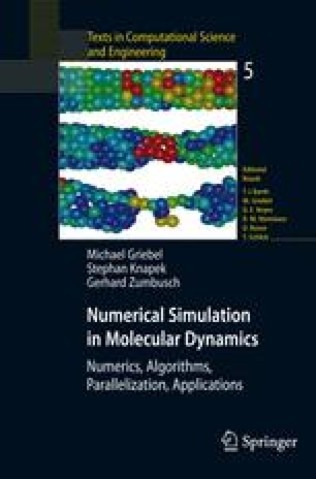
Numerical Simulation in Molecular Dynamics : Numerics, Algorithms, Parallelization, Applications
Particle models play an important role in many applications in physics, chemistry and biology. They can be studied on the computer with the help of molecular dynamics simulations. This book presents in detail both the necessary numerical methods and techniques (linked-cell method, SPME-method, tree codes, multipole technique) and the theoretical background and foundations. It illustrates the aspects modelling, discretization, algorithms and their parallel implementation with MPI on computer systems with distributed memory. Furthermore, detailed explanations are given to the different steps of numerical simulation, and code examples are provided.
Numerical partial differential equations for environmental scientists and engineers : A first practical course
This book concerns the practical solution of Partial Differential Equations (PDEs). It reflects an interdisciplinary approach to problems occurring in natural environmental media: the hydrosphere, atmosphere, cryosphere, lithosphere, biosphere and ionosphere. It assumes the reader has gained some intuitive knowledge of PDE solution properties and now wants to solve some for real, in the context of practical problems arising in real situations. The practical aspect of this book is the infused focus on computation. It presents two major discretization methods - Finite Difference and Finite Element. The blend of theory, analysis, and implementation practicality supports solving and understanding complicated problems. It is divided into three parts. Part I is an overview of Finite Difference Methods. Part II focuses on Finite Element Methods, including an FEM tutorial. Part III deals with Inverse Methods, introducing formal approaches to practical problems which are ill-posed.

Numerical Optimization : Theoretical and Practical Aspects
This book starts with illustrations of the ubiquitous character of optimization, and describes numerical algorithms in a tutorial way. It covers fundamental algorithms as well as more specialized and advanced topics for unconstrained and constrained problems. Most of the algorithms are explained in a detailed manner, allowing straightforward implementation. Theoretical aspects of the approaches chosen are also addressed with care, often using minimal assumptions. It's contains computational exercises in the form of case studies which help understanding optimization methods beyond their theoretical, description, when coming to actual implementation. Besides, the nonsmooth optimization part has been substantially reorganized and expanded.

Numerical Methods for General and Structured Eigenvalue Problems
The purpose of this book is to describe recent developments in solving eig- value problems, in particular with respect to the QR and QZ algorithms as well as structured matrices. Outline Mathematically speaking, the eigenvalues of a square matrix A are the roots of its characteristic polynomial det(A??I). An invariant subspace is a linear subspace that stays invariant under the action of A. In realistic applications, it usually takes a long process of simpli?cations, linearizations and discreti- tions before one comes up with the problem of computing the eigenvalues of a matrix. In some cases, the eigenvalues have an intrinsic meaning, e.g., for the expected long-time behavior of a dynamical system; in others they are just meaningless intermediate values of a computational method. The same applies to invariant subspaces, which for example can describe sets of initial states for which a dynamical system produces exponentially decaying states. Computing eigenvalues has a long history, dating back to at least 1846 when Jacobi [172] wrote his famous paper on solving symmetric eigenvalue problems. Detailed historical accounts of this subject can be found in two papers by Golub and van der Vorst [140, 327].
