



الصفحة 8
الصفحة 8

Mathematics teacher education in the Andean region and Paraguay : A comparative analysis of issues and challenges
This Open Access book is an excellent synthesis of the initial and continuing preparation for Mathematics Teaching in Bolivia, Ecuador, Paraguay and Peru, from which comparative analyses can be made that show similarities and differences, and highlight various perspectives. This book brings to the international Educational Community an important collection of experiences and ideas in the Mathematics Education of four Latin-American countries in the developing Andean region and Paraguay. The dissemination of these results can promote the search for international collaborative actions in a wider scale.

Mathematics for Life Science and Medicine
Dynamical systems theory in mathematical biology has attracted much attention from many scientific directions. The purpose of this volume is to present and discuss the many rich properties of the dynamical systems that appear in life science and medicine. The main topics include cancer treatment, dynamics of paroxysmal tachycardia, vector disease models, epidemic diseases and metapopulations, immune systems, pathogen competition and coexistence and the evolution of virulence and the rapid evolution of viruses within a host. Each chapter will serve to introduce students and scholars to the state-of-the-art in an exciting area, to present new results, and to inspire future contributions to mathematical modeling in life science and medicine.

Mathematics for Ecology and Environmental Sciences
Dynamical systems theory in mathematical biology has attracted much attention from many scientific directions. The purpose of this volume is to discuss the many rich and interesting properties of dynamical systems that appear in ecology and environmental sciences. The main topics include population dynamics with dispersal, nonlinear discrete population dynamics, structured population models, mathematical models in evolutionary ecology, stochastic spatial models in ecology, game dynamics and the chemostat model. Each chapter will serve to introduce students and scholars to the state-of-the-art in an exciting area, to present important new results, and to inspire future contributions to mathematical modeling in ecology and environmental sciences.

Mathematics Education in East Africa : Towards Harmonization and Enhancement of Education Quality
In the increasingly global and technological world mathematics is seen as a significant gatekeeper of opportunities for social and economic advancement and mobility. Hence, countries and development agencies in the broader sub-Saharan Africa region are looking towards increasing access to relevant and high-quality secondary education as a lever towards economic development. Policy makers and other key decision makers in education look towards improvement in mathematics teaching and learning as a key focus in education reform. In the East Africa region also a number of initiatives have been taken at the national level in the respective countries to improve the quality of mathematics education. This book provides an in-depth comparative analysis of the developments and issues in mathematics education in Kenya, Tanzania, Rwanda and Uganda, and advances our understanding of the state of secondary mathematics education in East Africa.

Mathematical Software - ICMS 2006 ; 2nd International Congress on Mathematical Software, Castro Urdiales, Spain, September 1-3, 2006, Proceedings
This volume contains the outstanding collection of invited papers and refereed papers selected for the Second International Congress on Mathematical Software, ICMS 2006, held in Castro Urdiales, Spain, September 1-3, 2006. This congress was devoted to all aspects of mathematical software, whose appearance is — in our opinion — one of the most important events in mathematics. Mathematical software systems are used to construct examples, to prove theorems, and to find new mathematical phenomena. Conversely, mathematical research often motivates developments of new algorithms and new systems. Beyond mathematics, mathematical software systems are becoming indispensable tools in many branches of science and technology.

Mathematical Problems from Applied Logic II : Logics for the XXIst Century
Mathematical Problems from Applied Logic II presents chapters from selected, world renowned, logicians. Important topics of logic are discussed from the point of view of their further development in light of requirements arising from their successful application in areas such as Computer Science and AI language. Fields covered include: logic of provability, applications of computability theory to biology, psychology, physics, chemistry, economics, and other basic sciences; computability theory and computable models; logic and space-time geometry; hybrid systems; logic and region-based theory of space.

Mathematical Problems from Applied Logic I : Logics for the XXIst Century
Mathematical Problems from Applied Logic I presents chapters from selected, world renowned, logicians. Important topics of logic are discussed from the point of view of their further development in light of requirements arising from their successful application in areas such as Computer Science and AI language. An overview of the current state as well as open problems and perspectives are clarified in such fields as non-standard inferences in description logics, logic of provability, logical dynamics and computability theory. The book contains interesting contributions concerning the role of logic today, including some unexpected aspects of contemporary logic and the application of logic. This should be of interest to logicians and mathematicians in general.

Isomorphisms Between H¹ Spaces
Presents a thorough and self-contained presentation of H¹ and its known isomorphic invariants, such as the uniform approximation property, the dimension conjecture, and dichotomies for the complemented subspaces. The necessary background is developed from scratch. This includes a detailed discussion of the Haar system, together with the operators that can be built from it (averaging projections, rearrangement operators, paraproducts, Calderon-Zygmund singular integrals). Complete proofs are given for the classical martingale inequalities of C. Fefferman, Burkholder, and Khinchine-Kahane, and for large deviation inequalities. Complex interpolation, analytic families of operators, and the Calderon product of Banach lattices are treated in the context of H^p spaces. Througout the book, special attention is given to the combinatorial methods developed in the field, particularly J. Bourgain's proof of the dimension conjecture, L. Carleson's biorthogonal system in H¹, T. Figiel's integral representation, W.B. Johnson's factorization of operators, B. Maurey's isomorphism, and P. Jones' proof of the uniform approximation property. An entire chapter is devoted to the study of combinatorics of colored dyadic intervals."

Irreversible Decisions under Uncertainty : Optimal Stopping Made Easy
In real life, as well as in economic models, individuals often make decisions in an uncertain environment. In many cases, a problem which an optimizing agent faces can be formulated or reformulated as a problem of optimal timing of a certain irreversible or partially reversible action or optimal stopping problem. In this book, the authors present an alternative approach to optimal stopping problems. The basic ideas and techniques of the approach can be explained much simpler than the standard methods in the literature on optimal stopping problems. The monograph will teach the reader to apply the technique to many problems in economics and finance, including new ones. From the technical point of view, the method can be characterized as option pricing via the Wiener-Hopf factorization.

IOT control and surveillance system
An automated system is a combination of both software and hardware which is designed and programmed to work automatically without the need of any human operator to provide inputs and instructions for each operation. The Internet of Things (IoT) is a network of connected things. These ‘things’ (devices) communicate with each other using machine to machine communication (M2M). Information is traversed between devices so that processes can be automated, without the need for human intervention. By reducing the number of people involved in a business process, several advantages arise, including improved accuracy and up-time. We will build an IoT automated system to control access of humans and vehicles to a warehouse based on biometrics and image recognition techniques.

IoT and AI Technologies for Sustainable Living : A Practical Handbook
Brings together all the latest methodologies, tools and techniques related to the Internet of Things and Artificial Intelligence in a single volume to build insight into their use in sustainable living. The areas of application include agriculture, smart farming, healthcare, bioinformatics, self-diagnosis systems, body sensor networks, multimedia mining, and multimedia in forensics and security. Provides a comprehensive discussion of modeling and implementation in water resource optimization, recognizing pest patterns, traffic scheduling, web mining, cyber security and cyber forensics. It will help develop an understanding of the need for AI and IoT to have a sustainable era of human living. The tools covered include genetic algorithms, cloud computing, water resource management, web mining, machine learning, block chaining, learning algorithms, sentimental analysis and Natural Language Processing (NLP).

Ionospheric Precursors of Earthquakes
Changes included changing my career from the field of space plasma physics to Earth sciences and geophysics, and changes in my personal life giving me h- piness and compliance in my present family.
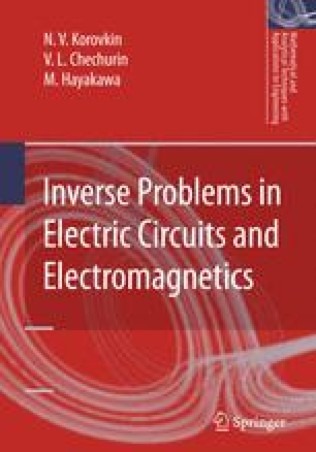
Inverse Problems in Electric Circuits and Electromagnetics
This text treats important new methods in inverse problems in electromagnetics. The inverse problems such as synthesis, diagnostics, fault detection, and identification are becoming one of the most important subjects in the field because of the significant practical applications to electric circuits and electromagnetics. This book introduces the recent achievements in mathematics and computing, while focusing on an approach to inverse problems that provides numerical solutions. The text systematically supplies descriptions of the most important practical inverse problems and the methods to solve them, thereby providing the reader with the best application for these intuitive processes. Also included are descriptions of the properties of inverse problems and known methods of their solution as well as the practical implementation of these methods in electric circuits theory and electromagnetic field theory.

Inventory and Supply Chain Management with Forecast Updates
Inventory and Supply Chain Management with Forecast Updates is concerned with the problems of inventory and supply chain decision making with information updating over time. The models considered include inventory decisions with multiple sources and delivery modes, supply-contract design and evaluation, contracts with exercise price, volume-flexible contracts allowing for spot-market purchase decisions, and competitive supply chains. Real problems are formulated into tractable mathematical models, which allow for an analysis of various approaches, and provide insights for better supply chain management. The book provides a unified treatment of these models, presents a critique of the existing results, and points out potential research directions. Attention is focused on solutions – that is, inventory decisions prior and subsequent to information updates and the impact of the quality of information on these decisions.

Invariant Manifolds for Physical and Chemical Kinetics
By bringing together various ideas and methods for extracting the slow manifolds the authors show that it is possible to establish a more macroscopic description in nonequilibrium systems. The book treats slowness as stability. A unifying geometrical viewpoint of the thermodynamics of slow and fast motion enables the development of reduction techniques, both analytical and numerical. Examples considered in the book range from the Boltzmann kinetic equation and hydrodynamics to the Fokker-Planck equations of polymer dynamics and models of chemical kinetics describing oxidation reactions. Special chapters are devoted to model reduction in classical statistical dynamics, natural selection, and exact solutions for slow hydrodynamic manifolds. The book will be a major reference source for both theoretical and applied model reduction. Intended primarily as a postgraduate-level text in nonequilibrium kinetics and model reduction, it will also be valuable to PhD students and researchers in applied mathematics, physics and various fields of engineering.

Introduction to wine laboratory practices and procedures
winemaking was a romanticized notion of putting grape juice into a barrel and allowing time to perform its magic as you sat on the veranda watching the sunset on a Tuscan landscape. For some small wineries, this notion might still ring true, but for the majority of wineries commercially producing quality wines, the reality of winemaking is far more complex. The persistent evolution of the wine industry demands continual advan- ments in technology and education to sustain and promote quality winem- ing. The sciences of viticulture, enology, and wine chemistry are becoming more intricate and sophisticated each year. Wine laboratories have become an integral part of the winemaking process, necessitating a knowledgeable staff possessing a multitude of skills. Science incorporates the tools that new-age winemakers are utilizing to produce some of the best wines ever made in this multibillion dollar trade. A novice to enology and wine chemistry can find these subjects daunting and intimidating. Whether you are a home winemaker, a new winemaker, an enology student, or a beginning-to-intermediate laboratory technician, p- ting all the pieces together can take time.

Introduction to the Classical Theory of Particles and Fields
This volume is intended as a systematic introduction to gauge field theory for advanced undergraduate and graduate students in high energy physics.

Introduction to space syntax in urban studies
This textbook is a comprehensive introduction to space syntax method and theory for graduate students and researchers. It provides a step-by-step approach for its application in urban planning and design. This textbook aims to increase the accessibility of the space syntax method for the first time to all graduate students and researchers who are dealing with the built environment, such as those in the field of architecture, urban design and planning, urban sociology, urban geography, archaeology, road engineering, and environmental psychology. Taking a didactical approach, the authors have structured each chapter to explain key concepts and show practical examples followed by underlying theory and provided exercises to facilitate learning in each chapter

Introduction to basics of pharmacology and toxicology ; Vol.2 : Essentials of systemic pharmacology : From principles to practice
Describes the pharmacology of drugs acting on different systems in the human body Analyses various human diseases and the pharmacological agents governing them Provides a valuable reference resource for academicians, researchers, and clinical practitioners Offers a comprehensive overview of the pharmacology concerning the autonomic, central, and peripheral nervous systems. Presenting up-to-date information on chemical mediators and their significance, it highlights the therapeutic aspects of several diseases affecting the cardiovascular, renal, respiratory, gastrointestinal, endocrinal, and hematopoietic systems. The book also includes drug therapy for microbial and neoplastic diseases. It also comprises sections on immunopharmacology, dermatological, and ocular pharmacology providing valuable insights into these emerging and recent topics.

Introducing Robotic Process Automation to Your Organization : A Guide for Business Leaders
Enables you, a novice to RPA, to successfully implement an RPA program at your company. RPA is rapidly growing in use, but is only starting to be taught at a university level. Many mid-level managers will be tasked with introducing an RPA program at their organizations as senior management learns of its efficacy, but will be unfamiliar with how to do so. This book provides you with the skills and information you need to make an informed decision. You will learn: Know the benefits of robotic process automation (RPA) / Understand the limitations of RPA / Ask the right questions to determine whether a process is a good candidate for automation / Obtain buy-in from skeptics at the senior and middle manager levels, and from line workers Be familiar with the structure required for success
