



الصفحة 8
الصفحة 8

Modeling and Simulation in Scilab
Scilab is a free open-source software package for scientific computation. It includes hundreds of general purpose and specialized functions for numerical computation, organized in libraries called toolboxes, which cover such areas as simulation, optimization, systems and control, and signal processing. One important Scilab toolbox is Scicos. Scicos provides a block diagram graphical editor for the construction and simulation of dynamical systems. The objective of this book is to provide a tutorial for the use of Scilab/Scicos with a special emphasis on modeling and simulation tools. The book is divided into two parts. The first part concerns Scilab and includes a tutorial covering the language features, the data structures and specialized functions for doing graphics, importing, exporting data and interfacing external routines. It also covers in detail Scilab numerical solvers for ordinary differential equations and differential-algebraic equations. Even though the emphasis is placed on modeling and simulation applications, this part provides a global view of Scilab. The second part is dedicated to modeling and simulation of dynamical systems in Scicos. This type of modeling tool is widely used in industry because it provides a means for constructing modular and reusable models. This part contains a detailed description of the editor and its usage, which is illustrated through numerous examples.

Modeling and Control of Discrete-event Dynamic Systems : with Petri Nets and Other Tools
Discrete-event dynamic systems (DEDs) permeate our world, being of great importance in modern manufacturing processes, transportation and various forms of computer and communications networking. Modeling and Control of Discrete-event Dynamic Systems begins with the mathematical basics required for the study of DEDs and moves on to present various tools used in their modeling and control. Among the instruments explained are many forms of Petri net, Grafcet (the sequential function chart), state charts, formal languages and max-plus algebra; all essential for control students to become proficient with DEDs and to make use of them in practical applications.

Model-Based Testing of Reactive Systems : Advanced Lectures
This book is based on a seminar held in Dagstuhl Castle, Germany, in January 2004. It presents 19 carefully reviewed and revised lectures given at the seminar in a well-balanced way ensuring competent complementary coverage of all relevant aspects. An appendix provides a glossary for model-based testing and basics on finite state machines and on labelled transition systems. The lectures are presented in topical sections on testing of finite state machines, testing of labelled transition systems, model-based test case generation, tools and case studies, standardized test notation and execution architectures, and beyond testing.

Model-based Process Supervision : A Bond Graph Approach
Model-based fault detection and isolation requires a mathematical model of the system behaviour. Modelling is important and can be difficult because of the complexity of the monitored system and its control architecture. The authors use bond-graph modelling, a unified multi-energy domain modelling method, to build dynamic models of process engineering systems by composing hierarchically arranged sub-models of various commonly encountered process engineering devices. The structural and causal properties of bond-graph models are exploited for supervisory systems design.

Model-based Fault Diagnosis Techniques : Design Schemes, Algorithms, and Tools
The objective of this book is to introduce basic model-based FDI schemes, advanced analysis and design algorithms and the needed mathematical and control theory tools at a level for graduate students and researchers as well as for engineers.

Model Driven Engineering Languages and Systems ; Vol. 4199 ; 9th International Conference, MoDELS 2006, Genova, Italy, October 1-6, 2006, Proceedings
This book constitutes the refereed proceedings of the 9th International Conference on Model Driven Engineering Languages and Systems (formerly the UML series of conferences), MoDELS 2006, held in Genova, Italy, in October 2006. The 51 revised full papers and 2 invited papers presented were carefully reviewed and selected from 178 initial submissions. The papers are organized in topical sections on evaluating UML, MDA in software development, concrete syntax, applying UML to interaction and coordination, aspects, model integration, formal semantics of UML, security, model transformation tools and implementation, analyzing dynamic models, specifying transformations, MOF, bridging models, risk, trust and dependability, tool environments, OCL, roundtrip engineering, real time and embedded systems, as well as workshops, tutorials and panels.
Model Driven Architecture and Ontology Development
Gaševic and his co-authors try to fill this gap by covering the subject of MDA application for ontology development on the Semantic Web. Part I of their book describes existing technologies, tools, and standards like XML, RDF, OWL, MDA, and UML. Part II presents the first detailed description of OMG’s new ODM (Ontology Definition Metamodel) initiative, a specification which is expected to be in the form of an OMG language like UML. Finally, Part III is dedicated to applications and practical aspects of developing ontologies using MDA-based languages.
Model Driven Architecture ; European MDA Workshops : Foundations and Applications, MDAFA 2003 and MDAFA 2004, Twente, The Netherlands, June 26-27, 2003, and Linköping, Sweden, June 10-11, 2004, Revised Selected Papers
Model-Driven Architecture (MDA) is an initiative proposedby the Object M- agement Group (OMG) for platform-generic software development. MDA s- arates the specification of system functionality from the implementation on a specific platform. It is aimed at making software assets more resilient to changes caused by emerging technologies. While stressing the importance of modeling, the MDA initiative covers a wide spectrum of research areas. Further efforts are required to bring them into a coherent approach based on open standards and supported by matured tools and techniques. This volume contains the selected papers of two workshops on “Model-Driven Architecture – Foundations and Applications” (MDAFA): MDAFA 2003 held at the University of Twente, Twente, The Netherlands, June 26–27, 2003, and MDAFA 2004 held at Linko ¨ping University, Link¨ oping, Sweden, June 10–11, 2004. The goal of the workshops was to understand the foundations of MDA, to share experience in applying MDA techniques and tools, and to outline future research directions. The workshops organizers encouraged authors of accepted papers to re-submit their papers to a post-workshop reviewing process; 15 of these papers were accepted to appear in this volume on MDA.
Model Checking Software ; Vol. 3925 ; 13th International SPIN Workshop, Vienna, Austria, March 30 - April 1, 2006, Proceedings
he name “SPIN” refers both to a workshopon model checking and to a famous model checking tool. The SPIN workshop is an annual forum for practitioners and researchersinterested in state space-based techniques for the validation and analysis of software and hardware systems, including communication protocols. It focuses on techniques based on explicit representations of state spaces, as implemented in the SPIN model checker or other tools, and techniques based on a combination of explicit representations with other representations. The SPIN model checker has proven to be particularly suited for the analysis of concurrent asynchronous systems. The workshop aims to encourage interaction and exchange of ideas with all related areas in software engineering.
Model Checking Software ; 15th International SPIN Workshop, Los Angeles, CA, USA, August 10-12, 2008 Proceedings
This book constitutes the refereed proceedings of the 15th International SPIN workshop on Model Checking Software, SPIN 2008, held in Los Angeles, CA, USA, in August 2008.The 17 revised full papers presented together with 1 tool paper and 4 invited talks were carefully reviewed and selected from 41 submissions. The main focus of the workshop series is software systems, including models and programs. The papers cover theoretical and algorithmic foundations as well as tools for software model checking and foster interactions and exchanges of ideas with related areas in software engineering, such as static analysis, dynamic analysis, and testing.
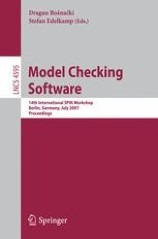
Model checking software ; 14th International SPIN Workshop, Berlin, Germany, July 1-3, 2007, Proceedings
This book presents the proceedings of the 14th International SPIN workshop on Model Checking Software, held in Berlin, Germany. The papers are organized into topical sections covering directed model checking, partial order reduction, program analysis, exploration advances, modeling and case studies, and tool demonstrations.

Mobile forensics : The file format handbook : Common file formats and file systems used in mobile devices
This book summarizes knowledge about several file systems and file formats commonly used in mobile devices. In addition to the fundamental description of the formats, there are hints about the forensic value of possible artefacts, along with an outline of tools that can decode the relevant data.

Mobile Ad-hoc and Sensor Networks ; Vol. 3794 : 1st International Conference, MSN 2005, Wuhan, China, December 13-15, 2005, Proceedings
Constitutes the refereed proceedings of the First International Conference on Mobile Ad-hoc and Sensor Networks held in 2005. The papers address topical areas in mobile ad hoc and sensor networks, such as network architecture and protocols, software platforms and development tools, self-organization and synchronization, and more

Misch's Contemporary Implant Dentistry
Uses a multidisciplinary approach to cover the industry’s most current processes and surgical procedures. The new edition of this text continues to provide comprehensive, state-of-the-art information on the science and discipline of contemporary implant dentistry. Covering the breadth of dental implant surgery, it includes full-color, in-depth coverage of both simple and complicated clinical cases, with practical guidance on how to apply the latest research, diagnostic tools, treatment planning, implant designs, and materials.

Mining Sequential Patterns from Large Data Sets
To meet the different needs of various applications, several models of sequential patterns have been proposed. This volume not only studies the mathematical definitions and application domains of these models, but also the algorithms on how to effectively and efficiently find these patterns. Mining Sequential Patterns from Large Data Sets provides a set of tools for analyzing and understanding the nature of various sequences by identifying the specific model(s) of sequential patterns that are most suitable. This book provides an efficient algorithm for mining these patterns.

Minimal English for a Global World : Improved Communication Using Fewer Words
This book introduces a new tool for improving communication and promoting clearer thinking in a world where the use of Global English can create numerous comprehension and communication issues. Based on research findings from cross-linguistic semantics, it contains essays and studies by leading experts exploring the value and application of ‘Minimal English’ in various fields, including ethics, health, human rights discourse, education and international relations.

Mindset matters : Developing mental agility and resilience to thrive in uncertainty
Resilience is the skill to master for the future of work. The capacity to overcome adversity and, crucially, to learn from experiences and grow, resilience is the tool to have in your business leadership arsenal. From an individual perspective, it will lead to better performance and wellbeing, and for your team, you can positively affect change and build a culture of resilience that permeates your business.

Mild Stress and Healthy Aging : Applying hormesis in aging research and interventions
Stress is a double edged sword. Whereas chronic stress has well known harmful effects, recent research shows that intermittent exposure of cells and organisms to mild stress can improve various biological parameters, including severe stress tolerance, health span and longevity. Mild stress-induced hormesis is potentially a powerful tool in gerontological research and interventions. This book brings together some of the world leaders in this area of research who present a critical analysis of the ongoing research with respect to the effects and mechanisms of action of various types of mild stress, such as irradiation, heat, physical exercise, hypergravity, pro-oxidants and nutritional components, on a variety of biological systems ranging from fruitflies to human cells and bodies. Their separate chapters and a final collective chapter open up a whole new world of possibilities for future research in aging, successful aging, and health span extension.

Mid-Infrared Coherent Sources and Applications
Coherent sources of mid-infrared (mid-IR) radiation are of great interest for a wide range of scienti?c and technological applications from spectroscopy and frequency metrology to information technology, industrial process control, pho- chemistry, photobiology and photomedicine. The mid-IR spectrum, which may be de?ned as wavelengths beyond ?2µm, covers important atmospheric windows, and numerous molecular gases, toxic agents, air, water, and soil pollutants, c- ponents of human breath, and several explosive agents have strong absorption ?ngerprints in this region. The development of practical coherent solid-state sources in the mid-IR can thus provide indispensable tools for a variety of - plications in environmental monitoring and pollution control, detection of water and soil contaminants, food quality control, agriculture and life sciences, and n- invasive disease diagnosis and therapy through breath analysis.

Micro-Tomographic Atlas of the Mouse Skeleton
Micro-Tomographic Atlas of the Mouse Skeleton serves as an essential guide containing unique systematic description of all calcified components of the mouse. This detailed atlas fulfils an emerging need for high resolution anatomical details as mice become a standard laboratory animal in skeletal research and the use of m CT technology is rapidly increasing as a key analytical tool in the study of bone.
