



الصفحة 8
الصفحة 8

Case-Based Reasoning Research and Development ; 7th International Conference on Case-Based Reasoning, ICCBR 2007 Belfast Northern Ireland, UK, August 13-16, 2007 Proceedings
It presented along with three invited talks. The sections address all aspects of case-based reasoning, featuring original theoretical research, applied research, and applications with practical, social, environmental, and economic significance.

Case-based reasoning research and development ; 6th International conference on case-based reasoning, ICCBR 2005, Chicago, IL, USA, August 23-26, 2005, Proceedings
This book constitutes the refereed proceedings of the 6th International Conference on Case-Based Reasoning, ICCBR 2005, held in Chicago, IL, USA, in August 2005. The 19 revised full research papers and 26 revised poster papers presented together with the abstracts of 3 invited talks were carefully reviewed and selected from 74 submissions. The papers address all current foundational, theoretical and research aspects of case-based reasoning as well as advanced applications either with innovative commercial deployment or practical, social, environmental or economic significance.
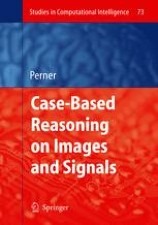
Case-Based Reasoning on Images and Signals
This book is the first edited book that deals with the special topic of signals and images within Case-Based Reasoning (CBR). It offers different learning capabilities, for all phases of a signal-interpreting system, that satisfy different needs during the development process of a signal-interpreting system.
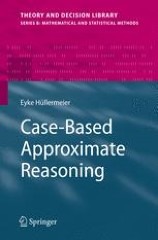
Case-Based Approximate Reasoning
Case-based reasoning (CBR) has received a great deal of attention in recent years and has established itself as a core methodology in the field of artificial intelligence. The key idea of CBR is to tackle new problems by referring to similar problems that have already been solved in the past. More precisely, CBR proceeds from individual experiences in the form of cases. The generalization beyond these experiences typically relies on a kind of regularity assumption demanding that 'similar problems have similar solutions'. Making use of different frameworks of approximate reasoning and reasoning under uncertainty, notably probabilistic and fuzzy set-based techniques, this book develops formal models of the above inference principle, which is fundamental to CBR. The case-based approximate reasoning methods thus obtained especially emphasize the heuristic nature of case-based inference and aspects of uncertainty in CBR. This way, the book contributes to a solid foundation of CBR which is grounded on formal concepts and techniques from the aforementioned fields. Besides, it establishes interesting relationships between CBR and approximate reasoning, which not only cast new light on existing methods but also enhance the development of novel approaches and hybrid systems.
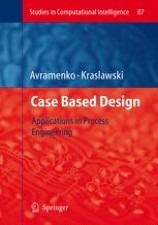
Case based design : Applications in process engineering
The book by Professors is an impressive and in-depth treatment of the essence of the case–based reasoning strategy and case-based design dwelling upon the algorithmic facet of the paradigm, the authors provided an excellent applied research framework by showing how this development can be effectively utilized in real word complicated environment of process engineering.
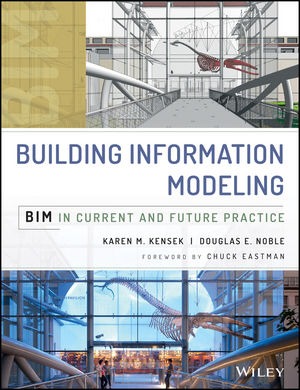
Building information modeling : BIM in current and future practice
"Thought leaders from universities and professional practice composed essays exploring BIM's potential to improve the products and processes of architectural design including the structure and content of the tools themselves. These authors provide insights for assessing the current practice and research directions of BIM and speculate about its future. Design Thinking and BIM / BIM Analytics / Comprehensive BIM / Reasoning with BIM / Professional BIM / BIM Speculations"
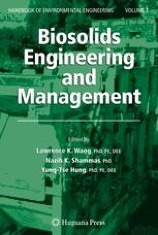
Biosolids engineering and management
Biosolids Engineering and Management, is a collection of methods of practical design, calculation and numerical examples that illustrate how organized, analytical reasoning can lead to the discovery of clear, direct solutions, especially in the areas of biosolids management, treatment, disposal and beneficial use. The book’s including sludge and biosolids transport, pumping and storage, sludge conversion to biosolids, chlorination, stabilization, regulatory requirements, costs, agricultural land application, landfill, ocean disposal, combustion, incineration and sludge treatment process selection.
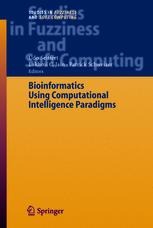
Bioinformatics Using Computational Intelligence Paradigms
Bioinformatics as well as Computational Intelligence are undoubtedly remarkably fast growing fields of research and real-world applications with enormous potential for current and future developments. "Bioinformatics using Computational Intelligence Paradigms" contains recent theoretical approaches and guiding applications of biologically inspired information processing systems(Computational Intelligence) against the background of bioinformatics. This carefully edited monograph combines the latest results of Bioinformatics and Computational Intelligence and offers a promising cross-fertilisation and interdisciplinary work between these growing fields.
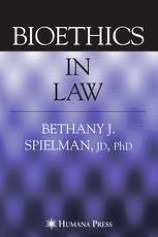
Bioethics in Law
The idea for Bioethics in Law began more than a decade ago, while I was studying social science and law. I was parti- larly interested in the collaborations that comprised social s- ence in law. Economic and social data in the pioneering Brandeis brief had been used to defend an early 20th-century labor law; surveys of consumer confusion had helped resolve trademark - fringement cases; psychologists’ predictions of future violence had informed capital sentencing decisions. Additionally, Kenneth Clark’s “doll studies,” cited by the Supreme Court in Brown v. Board of Education, had helped change the course of American 1 history.
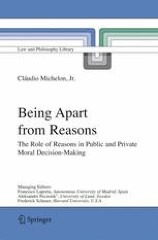
Being apart from reasons : The role of reasons in public and private moral decision-making
The book presents objections to the most common response given by contemporary legal and political theorists to the moral complexity of decision-making in modern societies, namely: the attempt to release public agents from their argumentative burden by insulating a particular set of reasons from the general.

Bayesian networks and Influence diagrams : A guide to construction and analysis
Probabilistic networks, also known as Bayesian networks and influence diagrams, have become one of the most promising technologies in the area of applied artificial intelligence, offering intuitive, efficient, and reliable methods for diagnosis, prediction, decision making, classification, troubleshooting, and data mining under uncertainty. Bayesian Networks and Influence Diagrams: A Guide to Construction and Analysis provides a comprehensive guide for practitioners who wish to understand, construct, and analyze intelligent systems for decision support based on probabilistic networks. Intended primarily for practitioners, this book does not require sophisticated mathematical skills or deep understanding of the underlying theory and methods nor does it discuss alternative technologies for reasoning under uncertainty.
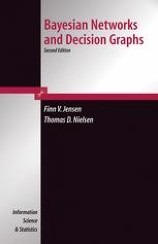
Bayesian Networks and Decision Graphs
Probabilistic graphical models and decision graphs are powerful modeling tools for reasoning and decision making under uncertainty. As modeling languages they allow a natural specification of problem domains with inherent uncertainty, and from a computational perspective they support efficient algorithms for automatic construction and query answering. This includes belief updating, finding the most probable explanation for the observed evidence, detecting conflicts in the evidence entered into the network, determining optimal strategies, analyzing for relevance, and performing sensitivity analysis. The book introduces probabilistic graphical models and decision graphs, including Bayesian networks and influence diagrams.It contians two parts. The first part focuses on probabilistic graphical models. Compared with the previous book, the new edition also includes a thorough description of recent extensions to the Bayesian network modeling language, advances in exact and approximate belief updating algorithms, and methods for learning both the structure and the parameters of a Bayesian network. The second part deals with decision graphs, and in addition to the frameworks described in the previous edition, it also introduces Markov decision processes and partially ordered decision problems.
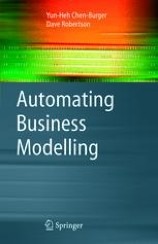
Automating business modelling : A guide to using logic to represent Informal methods and support reasoning
Enterprise Modelling (EM) methods are frequently used by entrepreneurs as an analysis tool for describing and redesigning their businesses. The resulting product, an enterprise model, is commonly used as a blueprint for reconstructing organizations and such effort is often a part of business process re-engineering and improvement initiatives. Automating Business Modelling describes different techniques of providing automated support for enterprise modelling methods and introduces universally used approaches. A running example of a business modelling method is included; providing a framework and detailed explanation as to how to construct automated support for modelling, allowing readers to follow the method to create similar support. Suitable for senior undergraduates and postgraduates of Business Studies, Computer Science and Artificial Intelligence, practitioners in the fields of Knowledge Management, Enterprise Modelling and Software Engineering, this book offers insight and know-how to both student and professional.
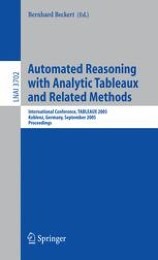
Automated reasoning with analytic tableaux and related methods ; International Conference, TABLEAUX 2005, Koblenz, Germany, September 14-17, 2005, Proceedings
This volume contains the research papers presented at the International C- ference on Automated Reasoning with Analytic Tableaux and Related Methods (TABLEAUX2005)heldSeptember 2005inKoblenz,Germany. which included conferences covering a broad spectrum of topics and intere- ing ?elds of application for tableau-based methods: arti?cial intelligence (KI), multi-agent systems (MATES), automated reasoning and knowledge represen- tion (FTP), and software engineering and formal methods (SEFM).
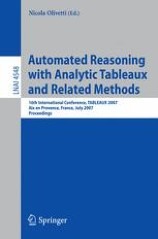
Automated Reasoning with Analytic Tableaux and Related Methods ; 16th International Conference, TABLEAUX 2007, Aix en Provence, France, July 3-6, 2007, Proceedings
It covers the wide range of logics, from intuitionistic and substructural logics to modal logics (including temporal and dynamic logics), from many-valued logics to nonmonotonic logics, and from classical first-order logic to description logics.
Automated reasoning ; 4th International Joint Conference, IJCAR 2008 Sydney, Australia, August 12-15, 2008 Proceedings
This book constitutes the refereed proceedings of the 4th International Joint Conference on Automated Reasoning, IJCAR 2008, held in Sydney, Australia, in August 2008.
Automated reasoning ; 3rd International Joint Conference, IJCAR 2006, Seattle, WA, USA, August 17-20, 2006, Proceedings
This book constitutes the refereed proceedings of the Third International Joint Conference on Automated Reasoning,The papers address the entire spectrum of research in automated reasoning including formalization of mathematics, proof theory, proof search, description logics, interactive proof checking, higher-order logic, combination methods, satisfiability procedures, and rewriting. The papers are organized in topical sections on proofs, search, higher-order logic, proof theory, search, proof checking, combination, decision procedures, CASC-J3, rewriting, and description logic.

Automated deduction in Geometry ; 6th International Workshop, ADG 2006, Pontevedra, Spain, August 31-September 2, 2006, Revised Papers
The book show the lively variety of topics and methods and the current applicability of automated deduction in geometry to different branches of mathematics and to other sciences and technologies.
Automated deduction – CADE-21 ; 21st International Conference on automated deduction, Bremen, Germany, July 17-20, 2007, Proceedings
All current aspects of automated deduction are addressed, ranging from theoretical and methodological issues to presentation and evaluation of theorem provers and logical reasoning systems. The papers are organized in topical sections on higher-order logic, description logic, intuitionistic logic, satisfiability modulo theories, induction, rewriting, and polymorphism, first-order logic, model checking and verification, termination, as well as tableaux and first-order systems.

Automated deduction – CADE-20 ; 20th International Conference on automated deduction, Tallinn, Estonia, July 22-27, 2005, Proceedings
This book constitutes the refereed proceedings of the 20th International Conference on Automated Deduction, CADE-20, held in Tallinn, Estonia, in July 2005. The 25 revised full papers and 5 system descriptions presented were carefully reviewed and selected from 78 submissions. All current aspects of automated deduction are addressed, ranging from theoretical and methodological issues to presentation and evaluation of theorem provers and logical reasoning systems.
