



الصفحة 8
الصفحة 8

Hereditary Peripheral Neuropathies
"Hereditary Peripheral Neuropathies" deals with the Charcot-Marie-Tooth group of neuropathies and related primary hereditary neuropathies. The knowledge in this field has grown exponentially during the last ten years. The book is divided into two sections. The first section deals with the clinical presentation, electrophysiological features and differential diagnosis of these disorders as well as with the general biology of the peripheral nerve. The second section gives a detailed account of the known disease entities. The book will be interesting for both the clinician with a special interest in PNS diseases as well as for the researcher.

Healthy Longevity in China : Demographic, Socioeconomic, and Psychological Dimensions
China is aging at an extraordinary speed and has the largest quantity of elderly persons in the world. Scholars utilize this unprecedented living experience of human being and the unique Chinese Longitudinal Healthy Longevity Survey (CLHLS) datasets with the aim to answer in this volume the following questions critical to the aging population world wide. Is the period of disability compressing or expanding with increasing life expectancy and what factors are associated with these trends in the recent decades? Is it possible to realize morbidity compression with a prolongation of the life span in the future?The first section of the book presents the CLHLS project’s study design, sample distribution, contents of data collected, and assessments of age reporting and data quality. The remaining chapters are grouped into sections dealing with the demographic, social, economic, familial and psychological dimensions of healthy longevity.
HCI related papers of Interacción 2004 ; Conference proceedings
The present book contains a collection of the best papers presented at the 5th International Conference on Interacción Persona Ordenador (IPO) (which is Human Computer Interaction in Spanish), which took place in th th Lleida on May 5 -7 , 2004. . The main goals of Interacción 2004 were: To expand the conference scope with internationally recognised invited speakers. The plenary talks were presented by Alan Dix, Yvonne Rogers, Geritt van der Veer, and Angel Puerta. To open the participation to Spanish speaker worldwide in order to be a point of reference of this discipline not only in Spain but also in the wider Spanish speaking community. This goal was reached through a very diverse program which included panels and posters sessions, where many different aspect of the Human Computer Interaction (HCI) were presented. All through the program, research from outside Spain was reflected through the contributions from people of other countries.
HCI and usability for medicine and health care ; 3rd Symposium of the Workgroup Human-computer interaction and usability engineering of the Austrian Computer Society, USAB 2007 Graz, Austria, November, 22, 2007, Proceedings
The work group Human–Computer Interaction & Usability Engineering (HCI&UE) of the Austrian Computer Society (OCG) serves as a platform for interdisciplinary exchange, research and development. Our 2007 topic was “Human–Computer Interaction for Medicine and Health Care” (HCI4MED), Medical information systems are already extremely sophisticated and technological performance increases exponentially.
HCI and usability for education and work ; 4th Symposium of the Workgroup Human-Computer Interaction and Usability Engineering of the Austrian Computer Society, USAB 2008, Graz, Austria, November 20-21, 2008. Proceedings
This book constitutes the refereed proceedings of the 4th Usability Symposium of the Human-Computer Interaction and Usability Engineering Workgroup of the Austrian Computer Society, USAB 2008, held in Graz, Austria, in November 2008.The 7 revised full papers and 26 revised short papers presented were carefully reviewed and selected from 85 submissions. The papers are organized in topical sections on cognitive processes and end user experience, social software and collaborative knowledge development, knowledge processing, assessment and human performance.

Has Latin American Inequality Changed Direction? : Looking Over the Long Run
In this book, a group of global experts gathered by the Institute for the Integration of Latin America and the Caribbean (INTAL), part of the Inter-American Development Bank (IDB), show readers how various types of inequality, such as economical, educational, racial and gender inequality have been practiced in countries like Brazil, Bolivia, Chile, Mexico and many others through the centuries.

Hardy Inequalities on Homogeneous Groups : 100 Years of Hardy Inequalities
This book provides an extensive treatment of Hardy inequalities and closely related topics from the point of view of Folland and Stein's homogeneous (Lie) groups. The place where Hardy inequalities and homogeneous groups meet is a beautiful area of mathematics with links to many other subjects.In this environment, the theory of Hardy inequalities becomes intricately intertwined with the properties of sub-Laplacians and subelliptic partial differential equations.

Handbook on Architectures of Information Systems
This book is the first volume of a running series under the title Inter- tional Handbooks on Information Systems. The series is edited by Peter Bernus, Jacek Blazewicz, Günter Schmidt and Mike Shaw. One objective is to give state of the art surveys on selected topics of information systems theory and applications. To this end, a distinguished international group of academics and practitioners are invited to provide a reference source not only for problem solvers in business, industry, and government but also for professional researchers and graduate students.

Handbook of Teacher Education : Globalization, Standards and Professionalism in Times of Change
This book provides an international review of the current state of teacher education, with chapters from an international group of teacher educators. It focuses on major issues that are confronting teacher educators now and in the next decade. These include the impact of globalization on the profession of teaching, and how teacher education must deal with changing accountability requirements from governments and establish a set of minimum standards acceptable to enable a person to teach.

Handbook of philosophical logic : Vol.12
The first edition of the Handbook of Philosophical Logic (four volumes) was published in the period 1983-1989 and has proven to be an invaluable reference work to both students and researchers in formal philosophy, language and logic. The second edition of the Handbook is intended to comprise some 18 volumes and will provide a very up-to-date authoritative, in-depth coverage of all major topics in philosophical logic and its applications in many cutting-edge fields relating to computer science, language, argumentation, etc. The volumes will no longer be as topic-oriented as with the first edition because of the way the subject has evolved over the last 15 years or so. However the volumes will follow some natural groupings of chapters. Audience: Students and researchers whose work or interests involve philosophical logic and its applications

Handbook of Pathogens and Diseases in Cephalopods
The aim of this book is to facilitate the identification and description of the different organs as well as pathogens and diseases affecting the most representative species of cephalopods focussed on Sepia officinalis, Loligo vulgaris and Octopus vulgaris. These species are valuable ‘morphotype’ models and belong to the taxonomic groups Sepioidea, Myopsida and Octopoda, which include most of the species with a high market value and aquaculture potential. The study is based on photographs at macroscopic and histological level in order to illustrate the role of the most important pathogens and related diseases from the view of a pathological diagnosis. The reader is able to familiarize with functional anatomy, necropsy and general histology of adults and paralarvae, as well as with the identification of different pathogens and pathologies. This work is thus an invaluable guide for the diagnosis of cephalopod diseases. Besides including pathogens for non-European cephalopod species, it also provides a useful contribution encouraging marine pathologists, parasitologists, veterinarians and those involved in fishery sanitary assessments, aquarium maintenance and aquaculture practices aiming to increase their knowledge about the pathology of cephalopods.

Handbook of Digital and Mutlimedia Evidence
Handbook of Digital and Multimedia Forensic Evidence presents an overview of computer forensics perfect for beginners. This volume will serve as a foundation and guide for: (a) students considering a career in this field; (b) the law enforcement investigator assigned to work cybercrimes; (c) establishing training programs for forensic examiners; (d) the IT professional; (e) the veteran forensic examiner; (f) the prosecutor faced with litigating cybercrime cases brought before a trier of fact. A distinguished group of specialist authors have crafted chapters rich with detail yet accessible for readers who are not experts in the field. Tying together topics as diverse as applicable laws on search and seizure, investigating cybercrime, and preparation for courtroom tesitmony, Handbook of Digital and Multimedia Forensic Evidence is the ideal overall reference for this multi-faceted discipline.

Hamiltonian Reduction by Stages
In this volume readers will find for the first time a detailed account of the theory of symplectic reduction by stages, along with numerous illustrations of the theory. Special emphasis is given to group extensions, including a detailed discussion of the Euclidean group, the oscillator group, the Bott-Virasoro group and other groups of matrices. Ample background theory on symplectic reduction and cotangent bundle reduction in particular is provided. Novel features of the book are the inclusion of a systematic treatment of the cotangent bundle case, including the identification of cocycles with magnetic terms, as well as the general theory of singular reduction by stages.

Guide to software systems development : Connecting novel theory and current practice
This book argues that the key problems of software systems development (SSD) are socio-technical rather than purely technical in nature. Software systems are unique. They are the only human artefacts that are both intangible and determinant. This presents unprecedented problems for the development process both in determining what is required and how it is developed. Primarily this is a problem of communications between stakeholders and developers, and of communications within the development team. Current solutions are not only inadequate in expressing the technical problem, they also evade the communications problems almost entirely.

Gruppi : Una introduzione a idee e metodi della Teoria dei Gruppi = Groups : An introduction to the ideas and methods of Group Theory
Born from the university courses of Group Theory held by the author for several years, this book deals with the fundamental arguments of the theory: abelian, nilpotent and solvable groups, free groups, permutations, representations and cohomology. After the first notions, Hölder's program for the classification of finite groups is exposed. A long chapter is dedicated to the action of a group on a set and to the permutations, both under the algebraic and combinatorial aspects, with references to the theory of equations. Some questions of a logical nature are also considered, such as the decidability of the word problem for certain classes of groups. An essential aspect of the book is the presence of a great variety of exercises, about 400, mostly solved.

Groupware : design, implementation, and use ; Vol. 4154 ; 12th International Workshop, CRIWG 2006, Medina del Campo, Spain, September 17-21, 2006, Proceedings
Topical sections include collaborative applications and group interaction, group awareness, computer supported collaborative learning, languages and tools supporting collaboration, groupware development frameworks and toolkits, collaborative workspaces, web-based cooperative environments, mobile collaborative work, and collaborative design.
Groupware : design, implementation, and use ; Vol. 3706 ; 11th International workshop, CRIWG 2005, Porto de Galinhas, Brazil, September 25-29, 2005, Proceedings
This book constitutes the refereed proceedings of the 11th International Workshop on Groupware, CRIWG 2005, held in Porto de Galinhas, Brazil in September 2005. The 16 revised full papers and 13 revised short papers presented together with a keynote paper were carefully reviewed and selected from 67 submissions. The papers are organized in topical sections on groupware development, collaborative applications, workflow management, knowledge management, computer supported collaborative learning, group decision support systems, mobile collaborative work, and work modeling in CSCW.
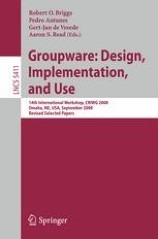
Groupware : Design, Implementation, and Use ; 14th International Workshop, CRIWG 2008, Omaha, NE, USA, September 14-18, 2008, Revised Selected Papers
This book constitutes the refereed post-conference proceedings of the 14th International Workshop on Groupware: Design, Implementation, and Use, held in Omaha, Nebraska, USA, during September 14-18, 2008.The 30 papers presented were carefully reviewed and selected from numerous submission. The topics covered are groupware solutions, co-located groups, groupware for health care, collaborative systems development, collaborative emergency response, groupware approaches, patterns of collaboration.

Groupware : Design, implementation, and use ; 13th International Workshop, CRIWG 2007, Bariloche, Argentina, September 16-20, 2007, Proceedings
This volume constitutes the proceedings of the 13th International Workshop on Groupware (CRIWG 2007). This workshop aims at providing a forum for academic researchers and professionals to exchange their experiences and their ideas about problems and solutions related to the design, development and use of groupware applications.

Groups of Galaxies in the Nearby Universe ; Proceedings of the ESO Workshop held at Santiago de Chile, December 5 - 9, 2005
In the cosmological context, groups trace large-scale structures better than clusters, and the evolution of groups and clusters appears to be related. All these aspects of research on groups of galaxies are summarized in this book.
