



الصفحة 8
الصفحة 8

Graph-theoretic concepts in computer science ; Vol. 4271 ; 32nd International Workshop, WG 2006, Bergen, Norway, June 22-23, 2006, Revised Papers
The workshop aims at uniting theory and practice by demonstrating how graph-theoretic concepts can be applied to various areas in computer s- ence, or by extracting new problems from applications. The goal is to present recent research results and to identify and explore directions of future research. The talks showed how recent researchresults from algorithmic graph theory can be used in computer science and which graph-theoreticquestions arisefrom new developments in computer science.

Graph-theoretic concepts in computer science ; Vol. 3787 ; 31st International Workshop, WG 2005, Metz, France, June 23-25, 2005, Revised Selected Papers
that aims to unite theory and practice by demonstrating how graph-theoretic concepts can be applied to various areas in Computer Science. This book provides results for various classes of graphs, graph computations, graph algorithms, and graph-theoretical applications in various fields.

Graph-theoretic concepts in computer science ; 34th International Workshop, WG 2008, Durham, UK, June 30 – July 2, 2008. Revised Papers
This book constitutes the thoroughly refereed post-conference proceedings of the 34th International Workshop on Graph-Theoretic Concepts in Computer Science, WG 2008, held in Durham, UK, in June/July 2008.The 30 revised full papers presented together with 3 invited paper were carefully reviewed and selected from 76 submissions. The papers feature original results on all aspects of graph-theoretic concepts in Computer Science, e.g. structural graph theory, sequential, parallel, and distributed graph and network algorithms and their complexity, graph grammars and graph rewriting systems.

Graph-theoretic concepts in computer science ; 33rd International workshop, WG 2007, Dornburg, Germany, June 21-23, 2007, Revised Papers
The WG conference traditionally aims at uniting theory and practice by demonstrating how graph-theoretic concepts can be applied to various areas in computer science, or by extracting new problems from applications. The goal is to present recent researchresults and to identify and exploredirections of future research.

Graph-theoretic concepts in computer science ; 30th International workshop, WG 2004, Bad Honnef, Germany, June 21-23, 2004, Revised Papers
During its 30-year existence, the International Workshop on Graph-Theoretic Concepts in Computer Science has become a distinguished and high-quality computer science event. The workshop aims at uniting theory and practice by demonstrating how graph-theoretic concepts can successfully be applied to v- ious areas of computer science and by exposing new theories emerging from applications. In this way, WG provides a common ground for the exchange of information among people dealing with several graph problems and working in various disciplines. Thereby, the workshop contributes to forming an interdis- plinary research community. The original idea of the Workshop on Graph-Theoretic Concepts in C- puter Science was ingenuity in all theoretical aspects and applications of graph concepts, wherever applied. Within the last ten years, the development has strengthened in particular the topic of structural graph properties in relation to computational complexity.

Graphs, networks and algorithms ; 3rd ed.
The third edition of this standard textbook contains additional material: two new application sections (on graphical codes and their decoding) and about two dozen further exercises (with solutions, as throughout the text). Moreover, recent developments have been discussed and referenced, in particular for the travelling salesman problem. The presentation has been improved in many places (for instance, in the chapters on shortest paths and on colorings), and a number of proofs have been reorganized, making them more precise or more transparent.

Graphs, networks and algorithms ; 2nd ed.
This book have a chapter on the network simplex algorithm and a section on the five color theorem; this also necessitated some changes in the previous order of the presentation (so that the numbering differs from that of the first edition,beginning with Chapter 8). In addition to this, numerous smaller changes and corrections have been made and several recent developments have been discussed and referenced. There are also several new exercises.
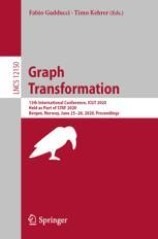
Graph Transformation ; 13th International Conference, ICGT 2020, Held as Part of STAF 2020, Bergen, Norway, June 25–26, 2020, Proceedings
This book constitutes the refereed proceedings of the 13th International Conference on Graph Transformation, ICGT 2020, in Bergen, Norway, in June 2020.* The 16 research papers and 4 tool paper presented in this book were carefully reviewed and selected from 40 submissions. One invited paper is also included. The papers deal with the following topics: theoretical advances; application domains; and tool presentations.

Graph theory
Graph theory is a flourishing discipline containing a body of beautiful and powerful theorems of wide applicability. Its explosive growth in recent years is mainly due to its role as an essential structure underpinning modern applied mathematics – computer science, combinatorial optimization, and operations research in particular – but also to its increasing application in the more applied sciences. The versatility of graphs makes them indispensable tools in the design and analysis of communication networks, for instance. The primary aim of this book is to present a coherent introduction to the subject, suitable as a textbook for advanced undergraduate and beginning graduate students in mathematics and computer science. It provides a systematic treatment of the theory of graphs without sacrificing its intuitive and aesthetic appeal. Commonly used proof techniques are described and illustrated, and a wealth of exercises - of varying levels of difficulty - are provided to help the reader master the techniques and reinforce their grasp of the material.

Graph drawing ; Vol. 3843 ; 13 th International symposium, GD 2005, Limerick, Ireland, September 12-14, 2005, Revised Papers
The 13th International Symposium on Graph Drawing (GD 2005) was held in Limerick, Ireland, September 12-14, 2005. One hundred and ?fteen participants from 19 countries attended GD 2005. In response to the call for papers the Program Committee received 101 subm- sions, each detailing original research or a system demonstration. Each submission was reviewed by at least three Program Committee members; each referee’s c- ments were returned to the authors. Following extensive discussions, the comm- tee accepted 38 long papers, 3 short papers and 3 long system demos, each of which were presented during one of the conference’s 12 sessions. Eight posters were also accepted and were on display throughout the conference.

Graph drawing ; 15th International symposium, GD 2007, Sydney, Australia, September 24-26, 2007. Revised Papers
The 16th International Symposium on Graph Drawing (GD 2008) was held in Hersonissos, near Heraklion, Crete, Greece, September 21-24, 2008, and was attended by 91 participants from 19 countries. In response to the call for papers the Program Committee received 83 s- missions,eachdescribing originalresearchand/or a systemdemonstration.Tamassia showed how graph drawing techniques can be used as an e?ective tool in computer security and pointed to future research directions in this area. Following what is now a tradition, the 15th Annual Graph Drawing Contest was held during the conference, also including a Graph Drawing Challenge to the conference attendees.

Graph drawing ; 14th International symposium, GD 2006, Karlsruhe, Germany, September 18-20, 2006, Revised Papers
The 33 revised full papers and 5 revised short papers presented together with 2 invited talks, 1 system demo, 2 poster papers address all current aspects in graph drawing, ranging from foundational and methodological issues to applications for various classes of graphs in a variety of fields.

Grammatical Picture Generation : A Tree-Based Approach
The book presents important types of picture generators, using a tree-based approach to stress their common algorithmic basis, the treatment influenced by the theory of computation, and the theory of formal languages in particular. It guides the reader through the basics of the tree-based approach on to dedicated chapters on line-drawing languages, collage grammars, iterated function systems, grid picture languages, languages of fractals, and languages of coloured collages, while presenting results about (un)decidable, NP-complete, or efficiently solvable problems, normal forms, hierarchies of language classes, and related phenomena.

Globalization and Regional Economic Modeling
Globalization is affecting regional economies in a broad spectrum of aspects, from labor market conditions and development policies to climate change. To understand better how this works, we need both conceptual and methodological contributions. We need new schemes to organize our thinking, direct our attention, and frame thought experiments on the basis of which guidance may be offered. And we need methodological innovations that enable us to carry out studies and thought experiments at levels of spatial and temporal resolution and formal complexity adequate to capture and account for the phenomena that characterize globalization. The chapters of this volume, written by an international cast of eminent regional scientists, represent contributions of both types, in many cases introducing and demonstrating the use of new tools for analyzing and understanding enormous changes underway in regional economies around the world.

Global Risk Governance : Concept and Practice Using the IRGC Framework
This book innovative risk governance framework, the careful reviews it received from internationally recognized scientists, and the results of several case studies in which the framework has been applied to a number of significant but different risks.

Global Product : Strategy, Product Lifecycle Management and the Billion Customer Question
In the early years of the 21st Century, as a result of many changes, it has become possible for the first time for tens of thousands of companies to offer manufactured products to customers across six continents. For many of these "global products", there are potentially more than a billion customers. In 2007, Wall Street hit new highs as the enormous opportunity for increased sales and profits became clear. However the new environment is not easy to manage and the risks are high. Meeting the various requirements of customers from a range of countries, choosing the most suitable locations for the different stages of development and manufacturing, deciding what can be global and what must be local, implementing suitable processes and systems, accommodating different national regulations, and efficiently dividing the workload between diverse sites are among the many challenges faced by providers of global products.

Genome editing in neurosciences
Innovations in molecular biology are allowing neuroscientists to study the brain with unprecedented resolution, from the level of single molecules to integrated gene circuits. Chief among these innovations is the CRISPR-Cas genome editing technology, which has the precision and scalability to tackle the complexity of the brain. This Colloque Médecine et Recherche has brought together experts from around the world that are applying genome editing to address important challenges in neuroscience, including basic biology in model organisms that has the power to reveal systems-level insight into how the nervous system develops and functions as well as research focused on understanding and treating human neurological disorders.

Genetic Programming Theory and Practice V
Genetic Programming Theory and Practice V was developed from the fifth workshop at the University of Michigan’s Center for the Study of Complex Systems to facilitate the exchange of ideas and information related to the rapidly advancing field of Genetic Programming (GP). Contributions from the foremost international researchers and practitioners in the GP arena examine the similarities and differences between theoretical and empirical results on real-world problems. The text explores the synergy between theory and practice, producing a comprehensive view of the state of the art in GP application.

Genetic Programming Theory and Practice IV
Genetic Programming Theory and Practice IV was developed from the fourth workshop at the University of Michigan’s Center for the Study of Complex Systems to facilitate the exchange of ideas and information related to the rapidly advancing field of Genetic Programming (GP). Contributions from the foremost international researchers and practitioners in the GP arena examine the similarities and differences between theoretical and empirical results on real-world problems.

Genetic Programming ; Vol. 3905 ; 9th European Conference, EuroGP 2006, Budapest, Hungary, April 10-12, 2006. Proceedings
This book constitutes the refereed proceedings of the 9th European Conference on Genetic Programming, EuroGP 2006, held in Budapest, Hungary, in April 2006, colocated with EvoCOP 2006. The 21 revised plenary papers and 11 revised poster papers were carefully reviewed and selected from 59 submissions. The papers address fundamental and theoretical issues, along with a wide variety of papers dealing with different application areas, such as computer science, engineering, machine learning, Kolmogorov complexity, biology and computational design.
