



الصفحة 8
الصفحة 8

Datatype-Generic Programming ; International Spring School, SSDGP 2006, Nottingham, UK, April 24-27, 2006, Revised Lectures
A leitmotif in the evolution of programming paradigms has been the level and extent of parametrisation that is facilitated — the so-called genericity of the paradigm. The sorts of parameters that can be envisaged in a programming language range from simple values, like integers and fioating-point numbers, through structured values, types and classes, to kinds (the type of types and/or classes).Datatype-generic programming is about parametrising programsby the structure of the data that they manipulate. To appreciate the importance of data type genericity,one need look no further than the internet. The internet is a massive repository of structured data, but the structure is rarely exploited. For example, compression of data can be much more efiective if its structure is known, but most compression algorithms regard the input data as simply a string of bits, and take no account of its internal organisation. Datatype-generic programming is about exploiting the structure of data when it is relevant and ignoring it when it is not. Programming languages most c- monly used at the present time do not provide efiective mechanisms for do- menting and implementing datatype genericity.

Data science and analytics ; 5th International conference on recent developments in science, engineering and technology, REDSET 2019, Gurugram, India, November 15–16, 2019, Revised Selected Papers, Part II
This two-volume set (CCIS 1229 and CCIS 1230) constitutes the refereed proceedings of the 5th International Conference on Recent Developments in Science, Engineering and Technology, REDSET 2019, held in Gurugram, India, in November 2019. The 74 revised full papers presented were carefully reviewed and selected from total 353 submissions. The papers are organized in topical sections on data centric programming; next generation computing; social and web analytics; security in data science analytics; big data analytics

Data science and analytics ; 5th International conference on recent developments in science, engineering and technology, REDSET 2019, Gurugram, India, November 15–16, 2019, Revised Selected Papers, Part I
This two-volume set (CCIS 1229 and CCIS 1230) constitutes the refereed proceedings of the 5th International Conference on Recent Developments in Science, Engineering and Technology, REDSET 2019, held in Gurugram, India, in November 2019. The 74 revised full papers presented were carefully reviewed and selected from total 353 submissions. The papers are organized in topical sections on data centric programming; next generation computing; social and web analytics; security in data science analytics; big data analytics.

Data parallel C++programming accelerated systems using C++ and SYCL
Full of practical advice, detailed explanations, and code examples to illustrate key topics. SYCL enables access to parallel resources in modern accelerated heterogeneous systems. Now, a single C++ application can use any combination of devices–including GPUs, CPUs, FPGAs, and ASICs–that are suitable to the problems at hand. This book teaches data-parallel programming using C++ with SYCL and walks through everything needed to program accelerated systems. The book begins by introducing data parallelism and foundational topics for effective use of SYCL. Later chapters cover advanced topics, including error handling, hardware-specific programming, communication and synchronization, and memory model considerations.

Cryptography in C and C++
This book covers everything you need to know to write professional-level cryptographic code. This expanded, improved second edition includes about 100 pages of new material as well as numerous improvements to the original text. The chapter about random number generation has been completely rewritten, and the latest cryptographic techniques are covered in detail. Furthermore, this book covers the recent improvements in primality testing.

Cours doptique : Simulations et exercices résolus avec Maple, Matlab, Mathematica, Mathcad = Optics course: Simulations and exercises solved with Maple, Matlab, Mathematica, Mathcad
Intended for students at the L and M levels of the university as well as for engineers wishing to study certain subjects in greater depth. It covers all the themes of a traditional optics course, from geometric optics to holography, interference, diffraction, coherence and the use of the Fourier transform for spectroscopy. The presentation is developed from mathematical models deriving from typical situations and fundamental examples which are presented in the form of computer programs ready to be implemented. These programs are also available on the CD accompanying the book, for each of the following scientific programming environments: Matlab, Maple, Mathematica and Mathcad. Thus, the reader will be able to modify the parameters of the examples proposed to adapt them to new situations.

Coping with Uncertainty : Modeling and Policy Issues
Ongoing global changes bring fundamentally new scientific problems requiring new concepts and tools. A key issue concerns a vast variety of practically irreducible uncertainties, which challenge our traditional models and require new concepts and analytical tools. The complexity of new problems does not allow to achieve enough certainty by increasing the resolution of models or by bringing in more links. Hence, new tools for modeling and management of uncertainty are needed, as given in this book.

Coordination models and languages ; 9th International Conference, COORDINATION 2007, Paphos, Cyprus, June 6-8, 2007, Proceedings
he volume examines how to increase modularity, simplify reasoning, and ultimately enhance today's software development by exploring the spectrum of languages, middleware, services, and algorithms. The papers are organized in topical sections on middleware, logic programming, formal approaches, concurrency, components and services, as well as MANets.

Controlled Markov Processes and Viscosity Solutions
This book is intended as an introduction to optimal stochastic control for continuous time Markov processes and to the theory of viscosity solutions. Stochastic control problems are treated using the dynamic programming approach. It approachs stochastic control problems by the method of dynamic programming. The fundamental equation of dynamic programming is a nonlinear evolution equation for the value function. For controlled Markov diffusion processes, this becomes a nonlinear partial differential equation of second order, called a Hamilton-Jacobi-Bellman (HJB) equation. Typically, the value function is not smooth enough to satisfy the HJB equation in a classical sense. Viscosity solutions provide framework in which to study HJB equations, and to prove continuous dependence of solutions on problem data. The theory is illustrated by applications from engineering, management science, and financial economics.

Constraint solving and language processing
Contains selected and thoroughly revised papers plus contributions from invited speakers presented at the First International Workshop on C- straint Solving and Language Processing, held in Roskilde, Denmark, September 1–3, 2004. Constraint Programming and Constraint Solving, in particular Constraint Logic Programming, appear to be a very promising platform, perhaps the most promising present platform, for bringing forward the state of the art in natural language processing, this due to the naturalness in speci?cation and the direct relation to e?cient implementation. Language, in the present context, may - fer to written and spoken language, formal and semiformal language, and even general input data to multimodal and pervasive systems, which can be handled in very much the same ways using constraint programming. The notion of constraints, with slightly differing meanings, apply in the characterization of linguistic and cognitive phenomena, in formalized linguistic m- els as well as in implementation-oriented frameworks. Programming techniques for constraint solving have been, and still are, in a period with rapid devel- ment of new eficient methods and paradigms from which language processing can prompt. A common metaphor for human language processing is one big c- straint solving process in which the differently specified linguistic and cognitive phases take place in parallel and with mutual cooperation, which ?ts quite well with current constraint programming paradigms.

Constraint handling rules : Current research topics
The Constraint Handling Rules (CHR) language is a declarative concurrent committed-choice constraint logic programming language consisting of guarded rules that transform multisets of relations called constraints until no more change occurs. The aim of this volume was to attract high-quality research papers on these recent advances in Constraint Handling Rules.
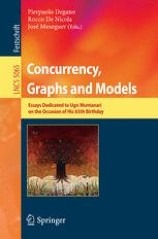
Concurrency, Graphs and Models : Essays Dedicated to Ugo Montanari on the Occasion of His 65th Birthday
The volume consists of seven sections, six of which are dedicated to the main research areas to which Ugo Montanari has contributed: Graph Transformation; Constraint and Logic Programming; Software Engineering; Concurrency; Models of Computation; and Software Verification.

CONCUR 2005 - Concurrency Theory
This volume contains the papers presented at CONCUR 2005, the 16th - ternational Conference on Concurrency Theory. The purpose of the CONCUR series of conferences is to bring together researchers,developers, and students in order to advance the theory of concurrency and to promote its applications. The Program Committee selected 38 papers for presentation. Because of the format of the conference and the high number of submissions, many good papers could not be included. Although submissions werereadand evaluated, the papers that appear in this volume may di?er in form and contents from the corresponding submissions.

Computer vision systems ; 6th International conference, ICVS 2008 Santorini, Greece, May 12-15, 2008 Proceedings
This book constitutes the refereed proceedings of the 6th International Conference on Computer Vision Systems, ICVS 2008, held in Santorini, Greece, May 12-15, 2008.

Computer science logic ; Vol. 4207 ; 20th International Workshop, CSL 2006, 15th Annual Conference of the EACSL, Szeged, Hungary, September 25-29, 2006, Proceedings
Coverage includes automated deduction and interactive theorem proving, constructive mathematics and type theory, equational logic and term rewriting, automata and formal logics, modal and temporal logic, model checking, finite model theory, and more.

Computer Science Logic ; Vol. 3634
This book constitutes the refereed proceedings of the 19th International Workshop on Computer Science Logic, CSL 2005, held as the 14th Annual Conference of the EACSL in Oxford, UK in August 2005. The 33 revised full papers presented together with 4 invited contributions were carefully reviewed and selected from 108 papers submitted. All current aspects of logic in computer science are addressed ranging from mathematical logic and logical foundations to methodological issues and applications of logics in various computing contexts. The volume is organized in topical sections on semantics and logics, type theory and lambda calculus, linear logic and ludics, constraints, finite models, decidability and complexity, verification and model checking, constructive reasoning and computational mathematics, and implicit computational complexity and rewriting.

Computer Science Logic ; 22nd International Workshop, CSL 2008 , 17th Annual Conference of the EACSL, Bertinoro, Italy, September 16-19, 2008. Proceedings
This book constitutes the refereed proceedings of the 22nd International Workshop on Computer Science Logic, CSL 2008, held as the 17th Annual Conference of the EACSL in Bertinoro, Italy, in September 2008.

Computational logic in multi-agent systems ; Vol. 3487 ; 5th International Workshop, CLIMA V, Lisbon, Portugal, September 29-30, 2004, Revised Selected and Invited Papers
The notion of agency has recently increased its in?uence in the research and - velopment of computational logic based systems, while at the same time sign- cantly gaining from decades of research in computational logic. Computational logic provides a well-de?ned, general, and rigorous framework for studying s- tax, semantics and procedures, for implementations, environments, tools, and standards, facilitating the ever important link between speci?cation and ver- cation of computational systems. The purpose of the Computational Logic in Multi-agent Systems (CLIMA) international workshop series is to discuss techniques, based on computational logic, for representing, programming, and reasoning about multi-agent systems in a formal way. Former CLIMA editions were conducted in conjunction with other major computational logic and AI events Thesubmittedpapersshowedthatthelogicalfoundationsofmulti-agent systems are felt by a large community to be a very important research topic, upon which classical AI and agent-related issues are to be addressed.

Computational logic in multi-agent systems ; 8th International Workshop, CLIMA VIII, Porto, Portugal, September 10-11, 2007. Revised Selected and Invited Papers
This book constitutes the thoroughly refereed post-conference proceedings of the 8th International Workshop on Computational Logic for Multi-Agent Systems, CLIMA VIII, held in Porto, Portugal, in September 2007 - co-located with ICLP 2008, the International Conference on Logic Programming.

Computational logic in multi-agent systems ; 4th International Workshop, CLIMA IV, Fort Lauderdale, FL, USA, January 6-7, 2004, Revised Selected and Invited Papers
Though multiagent systems (MASs) are being increasingly used, few methods exist to ensure survivability of MASs. All existing methods suffer from two flaws. First, a centralized survivability algorithm (CSA) ensures survivability of the MAS – unfortunately, if the node on which the CSA exists goes down, the survivability of the MAS is questionable. Second, no mechanism exists to change how the MAS is deployed when external factors trigger a re-evaluation of the survivability of the MAS. In this paper, we present three algorithms to address these two important problems. Our algorithms can be built on top of any CSA. Our algorithms are completely distributed and can handle external triggers to compute a new deployment. We report on experiments assessing the efficiency of these algorithms.
