



الصفحة 73
الصفحة 73

Andrology for the Clinician
Andrology for the Clinician consists of two parts: In Part One, the busy clinician can easily find the problem-orientated information he or she needs on such issues as * Male factor fertility problems * Male contraception * Male genital tract infection and tumours Part Two contains in-depth subject-orientated information and adds important scientific background information to the recommendations received in Part One. Several leading experts have contributed to this work, which has been extensively subedited by world-renowned editors to ensure a well-structured didactic design and homogeneous content.
Anatomy of the forehead, face, and neck: a dissection manual
Provides a detailed step-by-step approach to the dissection of the forehead, face, and neck, in a structural, layered approach. This dissection manual follows an atlas format, with color photographs from past professional lectures and classroom courses, as well as line drawings, enhancing descriptions. Clinical correlations are also interjected throughout to highlight the importance of individual anatomic structures. Chapters describe the preparation and storage of specimens and the dissection of the forehead and eyebrows, the midface, nose, ear, and lower face, and the neck.
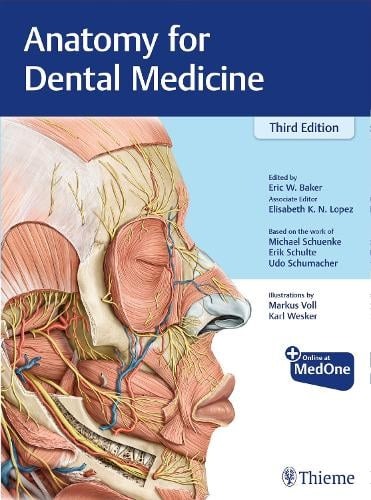
Anatomy for Dental Medicine
Strikes an optimal balance between systemic and regional approaches to complex head and neck anatomy. Award-winning full-color illustrations, succinct text, summary tables, and questions put anatomical structures and knowledge into a practical context. NEW! Additional radiologic images and landmark features throughoutNEW! Reorganized brain/nerve sectionsNEW! Expanded clinical question appendix including patient box questions in the style of the INBDENEW! Factual question appendix places greater emphasis on areas including the skull, larynx, cross sectional anatomy, body below the neck, and local anesthesia

Anatomical Variations in Clinical Dentistry
This excellently illustrated book aims to equip dentists, oral surgeons, and trainees with the detailed knowledge of anatomical variations in the oral region that is now required for optimal daily clinical practice.

Anand's Human Anatomy for Dental Students
Presents with six sections. The initial part of first section deals with general anatomy, a must for laying foundation of body structure, chapter 4 is ""organization of body"", gives a comprehensive overview of composition of body, its various parts with essentials of regional anatomy of limbs, thorax and abdomen. Subsequent chapters till chapter no. 17 deals with systemic anatomy, i.e. anatomy of various systems of body with their clinical significance.

Analyzing the availability of fin tech and its role in enhancing the strategic : Performance of Syrian banks using the balanced scorecard
Aims to examine the role of financial technology (FinTech) in enhancing the strategic performance of Syrian banks by analyzing its impact on the four dimensions of the balanced scorecard : financial performance, customer satisfaction, internal process quality, and learning and growth. Amid economic and technological challenges, integrating fintech emerges as a strategic tool to boost operational efficiency, reduce costs, and promote financial inclusion. The study explores the experiences of several Syrian banks in implementing modern financial technologies, such as digital banking and smart payment systems, while evaluating key financial indicators like return on assets (ROA) and return on equity (ROE).
Analysis, Modeling and Simulation of Multiscale Problems
This book reports recent mathematical developments in the Programme "Analysis, Modeling and Simulation of Multiscale Problems", which started as a German research initiative in 2006. Multiscale problems occur in many fields of science, such as microstructures in materials, sharp-interface models, many-particle systems and motions on different spatial and temporal scales in quantum mechanics or in molecular dynamics. The book presents current mathematical foundations of modeling, and proposes efficient numerical treatment.
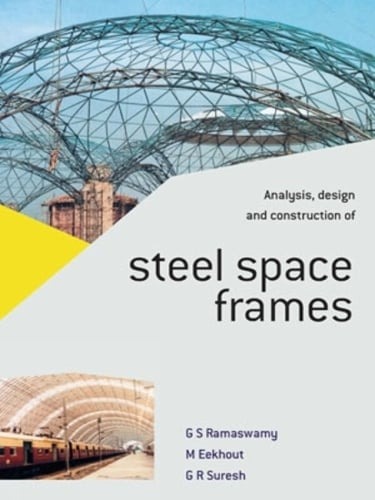
Analysis, design and construction of steel space frames
Space frames provide a lightweight solution to the problem of creating large span enclosures free from obstructions. They are employed in many major constrcution projects across the world, as documented in this authoritatively written volume.This is the first in-depth book to present all instances and applications of space frames in various engineering schemes. It uses case studies and numerous illustrations to examine steel space frames from their design to their structural engineering performance.

Analysis, design and construction of foundations
Outlines methods for analysis and design the construction of shallow and deep foundations with particular reference to case studies in Hong Kong and China, as well as a discussion of methods used in other countries. It introduces the main approaches used by geotechnical and structural engineers, and the precautions required for planning and designing foundation structures. Some computational methods and computer programs are reviewed to provide tools for performing more realistic analysis of foundation systems.

Analysis of Structures by Matrix Methods
Deals with the analysis of engineering structures made of skeletal members and covers the type of structures that are commonly used in practice. It builds up on the subject matter dealing with matrix algebra, analysis of bar elements, special forms of members, stability and vibration of structures, and pin-connected, rigid-plane, and 3D frames. It treats the important step of formulating the overall stiffness matrix of a structure in a systematic and straightforward manner and uses simple mathematical approaches wherever possible.

Analysis I
Logical thinking, the analysis of complex relationships, the recognition of und- lying simple structures which are common to a multitude of problems — these are the skills which are needed to do mathematics, and their development is the main goal of mathematics education. Of course, these skills cannot be learned ‘in a vacuum’. Only a continuous struggle with concrete problems and a striving for deep understanding leads to success. A good measure of abstraction is needed to allow one to concentrate on the essential, without being distracted by appearances and irrelevancies. The present book strives for clarity and transparency. Right from the beg- ning, it requires from the reader a willingness to deal with abstract concepts, as well as a considerable measure of self-initiative. For these e?orts, the reader will be richly rewarded in his or her mathematical thinking abilities, and will possess the foundation needed for a deeper penetration into mathematics and its applications.

Analysis and Synthesis of Logics : How to Cut and Paste Reasoning Systems
Starting with simple examples showing the relevance of cutting and pasting logics, the monograph develops a mathematical theory of combining and decomposing logics, ranging from propositional and first-order based logics to higher-order based logics as well as to non-truth functional logics. The theory covers mechanisms for combining semantic structures and deductive systems either of the same or different nature (for instance, two Hilbert calculi or a Hilbert calculus and a tableau calculus). The important issue of preservation of properties is extensively addressed. For instance, sufficient conditions are provided for a combined logic to be sound and complete when the original component logics are known to be sound and complete.
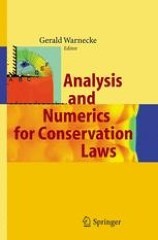
Analysis and Numerics for Conservation Laws
The physical and chemical mechanisms as well as the sizes of these processes are quite different. So are the motivations for studying them scientifically.The super- 8 nova is a thermo-nuclear explosion on a scale of 10 cm. Astrophysicists try to understand them in order to get insight into fundamental properties of the universe. In hows around airfoils of commercial airliners at the scale of 3 10 cm shock waves occur that influence the stability of the wings as well as fuel consumption in ight. This requires appropriate design of the shape and structure of airfoils by engineers. Knocking occurs in combustion, a chemical 1 process, and must be avoided since it damages motors. The scale is 10 cm and these processes must be optimized for efficiency and environmental conside- tions. The common thread is that the underlying ?uid ?ows may at a certain scale of observation be described by basically the same type of hyperbolic s- tems of partial differential equations in divergence form, called conservation laws. Astrophysicists, engineers and mathematicians share a common interest in scientific progress on theory for these equations and the development of computational methods for solutions of the equations. Due to their wide applicability in modeling of continua. A substantial portion of mathematical research is related to the analysis and numerical approximation of solutions to such equations. Hyperbolic conservation laws in two or more space dimensions still poseone of the main challenges to modern mathematics.
Analysis and Development of Sustainable Urban Production Systems
Manufacturing of products in urban production sites is connected to unique potentials, yet also to specific challenges. Urban factories can provide functional diversity and contribute positive impacts to a city. The concept of urban production receives rising attention in research and industry and it is recognized in its interdisciplinary nature. With a holistic approach from both the urban perspective and the factory perspective, negative impacts can be minimized, positive effects enabled and mutually beneficial, symbiotic combinations created. The presented framework and methods for the evaluation and implementation of sustainable urban production systems allow the assessment of impacts and provide the means to control and utilize the unique strengths of urban factories for cities and industry. This will allow a structured derivation of methods and measures from the concept of urban production for producing enterprises and the urban stakeholders.
Analysis and Design of Information Systems : Third ed.
This third edition of the successful Analysis and Design of Information Systems provides a comprehensive introduction and user-friendly survey to all aspects of business transformation and analysis, and aims to provide the complex set of tools covering all types of systems, including legacy, transactional, database, and web/e-commerce topics.
Analog Design Centering and Sizing
This book represents a compendium of fundamental problem formulations of analog design centering and sizing. It provides a differentiated knowledge about the tasks of analog design centering and sizing. In particular the worst-case problem will be formulated. It stands at the interface between process technology and design technology.Analog Design Centering and Sizing wants to point out that and how both process and design technology are required for its solution. The intention is to enable analog and mixed-signal designers to assess CAD solution methods that are presented to them. On the other side, the intention is to enable developers of analog CAD tools to formulate and develop solution approaches for analog design centering and sizing.The structure of Analog Design Centering and Sizing is geared towards a combination of a reference book and a textbook. The formulations of tasks and solution approaches by mathematical means makes the book suitable as well for students dealing with analog design and design methodology.
An Ottoman Era Town in the Balkans : The Case Study of Kavala
Presents the town of Kavala in Northern Greece as an example of Ottoman urban and residential development, covering the long period of Kavala’s expansion over five centuries under Ottoman rule. Kavala was part of the Ottoman Empire from 1387 to 1912. In the middle of the sixteenth century, Ibrahim Pasha, grand vizier of Suleiman the Magnificent, contributed to the town's prosperity and growth by the construction of an aqueduct. The Ottomans also rebuilt and extended the existing Byzantine fortress.

An Oral History of the Special Olympics in China ; Vol.3 : Finding and Keeping a Job
This book brings together oral histories that record the experiences of individuals with intellectual disabilities in Shanghai as they participate in their careers. Employees with intellectual disabilities describe their experiences seeking, attaining, and maintaining employment.

An Oral History of the Special Olympics in China ; Vol.2 : The Movement
This book contains the oral histories that were inspired by the work of the Special Olympics in conjunction with the 50th anniversary of its founding. The foreword and prefatory materials provide an overview of the Special Olympics and its growth in the People’s Republic of China.

An oral history of the Special Olympics in China ; Vol.1 : Overview
This book is unique in presenting the first oral history of individuals with an intellectual disability and their families in China.
