



الصفحة 71
الصفحة 71

An illustrated guide to oral histology
Delivers a collection of high-definition histological and pathological images, presenting both diseased and normal oral tissues. also includes core topics such as: An introduction to tooth development, including the bud, cap, early bell, and late bell stages A thorough exploration of enamel, dentin, cementum and dental pulp A discussion of the periodontal ligament, including alveolar crest fibers, horizontal, oblique, apical, and inter-radicular fibers, transseptal fibers, and gingival fibers A guide to alveolar bone, oral mucosa, and salivary glands Perfect for postgraduate dental students, An Illustrated Guide to Oral Histology will also be useful to undergraduate dental students, and those looking to improve their understanding of the microscopic structure of dental tissues and their pathologies.

An annotated timeline of operations research: An informal history
An Annotated Timeline of Operations Research: An Informal History recounts the evolution of Operations Research (OR) as a new science - the science of decision making. Arising from the urgent operational issues of World War II, the philosophy and methodology of OR has permeated the resolution of decision problems in business, industry, and government. The Timeline chronicles the history of OR in the form of self-contained, expository entries. Each entry presents a concise explanation of the events and people under discussion, and provides key sources where further relevant information can be obtained. In addition, books and papers that have influenced the development of OR or helped to educate the first generations of OR academics and practitioners are cited throughout the book.

Alternative Education : Global Perspectives Relevant to the Asia-Pacific Region
Alternative streams of education have been and remain an important but difficult theme for teachers, parents, policy-makers, and scholars. By focusing on case studies of six countries (Bolivia, Thailand, Australia, USA, The Netherlands, and Denmark), and by comprehensively analysing these by means of international comparative methodologies, the author approaches the nuts and bolts issues of alternative and mainstream education systems. The case studies include Charter Schools in the USA and Waldorf Schools in Australia. The study presents not only an insightful analysis of alternative forms of education with regard to actual issues in societies and also legal and administrative features of education. It provides insights into the kind of school development that could be appropriate in the 21st century and the types of educational communities we should seek to create in the age of globalisation.
Alternative breast imaging : Four model-based approaches
Medical imaging has been transformed over the past 30 years by the advent of computerized tomography (CT), magnetic resonance imaging (MRI), and various advances in x-ray and ultrasonic techniques. An enabling force behind this progress has been the (so far) exponentially increasing power of computers, which has made it practical to explore fundamentally new approaches. In particular, what our group terms "model-based" modalities-which produce tissue property images from data using nonlinear, iterative numerical modeling techniques-have become increasingly feasible. Alternative Breast Imaging: Four Model-Based Approaches explores our research on four such modalities, particularly with regard to imaging of the breast: (1) MR elastography (MRE), (2) electrical impedance spectroscopy (EIS), (3) microwave imaging spectroscopy (MIS), and (4) near infrared spectroscopic imaging (NIS).
Algorithms on Trees and Graphs : With Python Code
Introduces graph algorithms on an intuitive basis followed by a detailed exposition using structured pseudocode, with correctness proofs as well as worst-case analyses. Centered around the fundamental issue of graph isomorphism, the content goes beyond classical graph problems of shortest paths, spanning trees, flows in networks, and matchings in bipartite graphs. Advanced algorithmic results and techniques of practical relevance are presented in a coherent and consolidated way. Numerous illustrations, examples, problems, exercises, and a comprehensive bibliography support students and professionals in using the book as a text and source of reference. Furthermore, Python code for all algorithms presented is given in an appendix. Topics and features: Algorithms are first presented on an intuitive basis, followed by a detailed exposition using structured pseudocode / Correctness proofs are given, together with a worst-case analysis of the algorithms / Full implementation of all the algorithms in Python / An extensive chapter is devoted to the algorithmic techniques used in the book / Solutions to all the problems
Algorithms in Bioinformatics ; Vol.4175 : 6th International Workshop, WABI 2006, Zurich, Switzerland, September 11-13, 2006, Proceedings
This book constitutes the refereed proceedings of the 6th International Workshop on Algorithms in Bioinformatics, WABI 2006, held in Zurich, Switzerland in September 2006 in the course of the ALGO 2006 conference meetings. The 36 revised full papers presented were carefully reviewed and selected from 100 submissions. All current issues of algorithms in bioinformatics are addressed, ranging from mathematical tools to experimental studies of approximation algorithms and reports on significant computational analyses. Numerous biological problems are dealt with, including genetic mapping, sequence alignment and sequence analysis, phylogeny, comparative genomics, and protein structure. For the first time also machine-learning approaches along with combinatorial optimization are covered.

Algorithms in Bioinformatics ; 7th International Workshop, WABI 2007, Philadelphia, PA, USA, September 8-9, 2007, Proceedings
All current issues of algorithms in bioinformatics are addressed, ranging from mathematical tools to experimental studies of approximation algorithms and reports on significant computational analyses. Numerous biological problems are dealt with, including genetic mapping, sequence alignment and sequence analysis, phylogeny, comparative genomics, and protein structure. Furthermore the papers feature high-performance computing approaches to computationally hard learning and optimization problems in bioinformatics and cover methods, software and dataset repositories for development and testing of such algorithms and their underlying models.
Algorithms – ESA 2007 ; 15th Annual European Symposium, Eilat, Israel, October 8-10, 2007, Proceedings
This book presented submissions in the engineering and applications track. The papers address all current subjects in algorithmics reaching from design and analysis issues of algorithms over to real-world applicat.
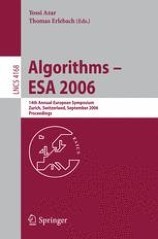
Algorithms - ESA 2006 ; 14th Annual European Symposium, Zurich, Switzerland, September 11-13, 2006, Proceedings
This book constitutes the refereed proceedings of the 14th Annual European Symposium on Algorithms, ESA 2006, held in Zurich, Switzerland, in the context of the combined conference ALGO 2006. The book presents 70 revised full papers together with abstracts of 3 invited lectures. The papers address all current subjects in algorithmics, reaching from design and analysis issues of algorithms over to real-world applications and engineering of algorithms in various fields.
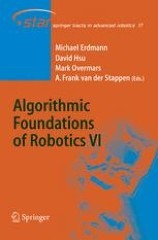
Algorithmic Foundations of Robotics VI
Robot algorithms are abstractions of computational processes that control or reason about motion and perception in the physical world. Because actions in the physical world are subject to physical laws and geometric constraints, the design and analysis of robot algorithms raises a unique combination of questions in control theory, computational and differential geometry, and computer science. Algorithms serve as a unifying theme in the multi-disciplinary field of robotics. This volume consists of selected contributions to the sixth Workshop on the Algorithmic Foundations of Robotics. This is a highly competitive meeting of experts in the field of algorithmic issues related to robotics and automation.

Algorithm Theory - SWAT 2006 ; 10th Scandinavian Workshop on Algorithm Theory, Riga, Latvia, July 6-8, 2006, Proceedings
This book constitutes the refereed proceedings of the 10th Scandinavian Workshop on Algorithm Theory, SWAT 2006, held in Riga, Latvia, in July 2006. The proceedings includes 36 revised full papers presented together with 3 invited papers, addressing issues of theoretical algorithmics and applications in various fields including graph algorithms, computational geometry, scheduling, approximation algorithms, network algorithms, data storage and manipulation, combinatorics, sorting, searching, online algorithms, optimization, amd more.
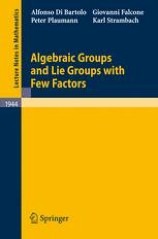
Algebraic Groups and Lie Groups with Few Factors
Algebraic groups are treated in this volume from a group theoretical point of view and the obtained results are compared with the analogous issues in the theory of Lie groups. The main body of the text is devoted to a classification of algebraic groups and Lie groups having only few subgroups or few factor groups of different type. In particular, the diversity of the nature of algebraic groups over fields of positive characteristic and over fields of characteristic zero is emphasized. This is revealed by the plethora of three-dimensional unipotent algebraic groups over a perfect field of positive characteristic, as well as, by many concrete examples which cover an area systematically. In the final section, algebraic groups and Lie groups having many closed normal subgroups are determined.
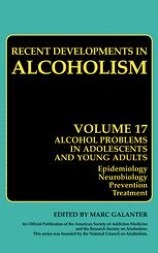
Alcohol problems in adolescents and young adults : Epidemiology. neurobiology. prevention. and treatment
Alcohol continues to be the substance of choice for today’s youth, leading to serious physical, psychological, and social consequences. Alcohol Problems in Adolescents and Young Adults ably addresses this growing trend. The latest entry in the Recent Developments in Alcoholism series, it comprehensively presents a wide-ranging clinical picture of teen drinking - epidemiology, neurobiology, behavioral phenomena, diagnostic and assessment issues, prevention and treatment data - in a developmental context. Fifty expert contributors display the scientific rigor, practical wisdom, and nuanced analysis that readers have come to expect from previous volumes.
AJCC Atlante per la stadiazione dei tumori maligni = Atlas for the Staging of Malignant Tumors
he atlas contains over 400 specially created black and white illustrations describing the anatomical extent of the malignant tumor in the primary site (T), regional lymph nodes (N) and distant metastases (M) for various sites, including the head and neck area, the digestive system, the thorax, the musculoskeletal system, the soft tissues, the breast, the urinary system and the genital system. Each illustration provides precise and detailed descriptions designed to clarify the crucial anatomical structures and to provide the reader with an immediate view of the progressive extension of the disease. The most important anatomical structures are identified by specific definitions.
Air, Water and Soil Quality Modelling for Risk and Impact Assessment
This book is the result of the Proceedings of the NATO Advanced Research Workshop on Air, Water and Soil Quality Modelling for Risk and Impact Assessment,The aim of the NATO Advanced Research Workshop on was to further joint environmental compartment modelling and applications of control theory to environmental management. The articles of the proceedings provide an overview of ongoing research in this field regarding assessment of environmental risks and impacts. Besides selected issues of practical application they address questions of forward and inverse modelling, integrated treatment of environmental changes and economic impacts as well as aspects of future development of numerical environmental modelling.
Air Pollution Modeling and Its Application XIX
The book is aimed at researchers and government policy makers who wish to keep abreast of the most recent developments in air pollution modelling and air quality issues. The book emphasizes the following key topics: 1. Local and urban scale modelling; 2. Regional and intercontinental modelling; 3. Data assimilation and air quality forecast; 4. Model assessment and verification; 5. Aerosols in the atmosphere; 6. Interactions between air quality and climate change; 7. Air quality and human health.
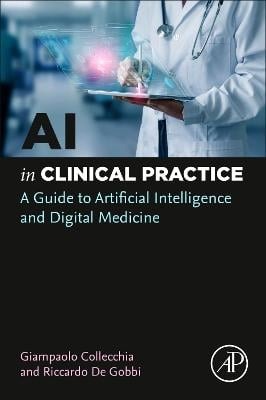
AI in clinical practice : A guide to artificial intelligence and digital medicine
Explains how artificial intelligence is applied to medicine, illustrating not only its enormous potential but also ancillary issues and the limits and risks inherent in its use on a large scale. The book focuses on the intersection between medicine and AI and its implications on the impact of human health care delivery. Topics discussed include wearable devices, health data, Internet of Things, virtual reality, robotic assistance system, and digital intelligence in the health sector. Additionally, sections discuss diagnostics and decision-making systems and machine/deep learning in clinical setting.

Agroforestry in Europe : Current Status and Future Prospects
Brings together some of the most important current research in European agroforestry, and evaluates the current scope and future potential of agroforestry across the EU.While the majority of Europe’s agroforestry practices are currently focused in the Mediterranean, this volume draws together examples from a wide range of countries – including Greece, Spain, the UK, Hungary, Germany, Italy, the Netherlands, Switzerland, France and Slovenia. The book also covers a range of agroforestry types, including silvopastoralism – Europe’s predominant form of agroforestry – as well as alley cropping, forest farming, silvoarable systems and the use of trees for shelter. Through these examples the book also discusses the potential roles for these traditional land management systems in addressing both environmental issues such as water quality, biodiversity conservation, desertification, ecosystem services and socioeconomic issues such as rural population stabilization.
Agroecological transitions : From theory to practice in local participatory design
There is wide agreement on the need to change the prevalent agricultural models, given their negative impacts and their incompatibility with current societal issues. Agroecological transition has been promoted as a potential solution to the ecological, social and economic problems generated by these models. It however involves a systemic, multi-scale and transdisciplinary process. Due to this complexity, the overall picture of what farms and food systems “actually are” and “might be” may not be apparent at the individual level. Yet individuals’ knowledge and values provide complementary insights on how to proceed in deepening ecological modernisation. Expertise can also provide landmarks to be considered in that process. Because local stakeholders’ experience and skills are key resources in the adaptation and adoption of agroecological transition, new conceptual and methodological frameworks and tools have to be developed to support them in the design process of such a complex transition. This book presents feedback from the ‘Territorial Agroecological Transition in Action’- TATA-BOX research project, which was devoted to these specific issues.
Agrobacterium : From Biology to Biotechnology
Agrobacterium’ is a comprehensive book on Agrobacterium research, including its history, application, basic biology discoveries, and effects on human society. Although the book largely focuses on providing a detailed review of virtually all molecular events of the genetic transformation process, it also provides coverage of ethical and legal issues relevant to the use of Agrobacterium as a "genetic transformation machine". The result is an all-inclusive text which readers—including scientists and students involved in plant genetic engineering—will find useful as a reference source for all major aspects of the Agrobacterium-mediated genetic transformation of plant and non-plant organisms.
