



الصفحة 7
الصفحة 7

Beginning Java™ SE 6 Platform : From novice to professional
Beginning Java™ SE 6 Platform: From Novice to Professional steers you through the maze of Java Standard Edition (SE) 6 features. The first chapter sets the stage by introducing Java SE 6 in terms of its name change, themes, an overview, and a sampling of new features. It also briefly discusses the first two Java SE 6 updates.
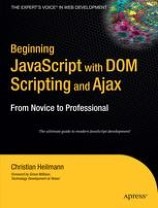
Beginning JavaScript with DOM Scripting and Ajax : From novice to professional
JavaScript is one of the most important technologies on the web. It provides the means to add dynamic functionality to your web pages and serves as the backbone of Ajax-style web development. Beginning JavaScript with DOM Scripting and Ajax is an essential guide for modern JavaScript programming; it's practical but comprehensive. It covers everything you need to know to get up to speed with JavaScript development and add dynamic enhancements to web pages and program Ajax-style applications.
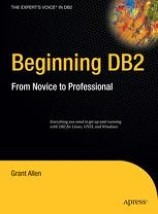
Beginning DB2 : From novice to professional
IBM’s DB2 Express Edition is one of the most capable of the free database platforms available in today’s marketplace. In Beginning DB2, author Grant Allen gets you started using DB2 Express Edition for web sites, desktop applications, and more. The author covers the basics of DB2 for developers and database administrators, shows you how to manage data in both XML and relational form, and includes numerous code examples so that you are never in doubt as to how things work.
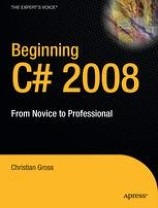
Beginning C# 2008 : From novice to professional
This book is for anyone who wants to write good C# 2008 code—even if you have never programmed before. Beginning C# 2008 has been written to teach you how to use the C# programming language to solve problems. Christian Gross is dedicated to helping his readers understand every detail of Beginning C# 2008.

Beginning ASP.NET 3.5 in VB 2008 : From novice to professional
The most up–to–date and comprehensive introductory ASP.NET book you'll find on any shelf, Beginning ASP.NET 3.5 in VB 2008 guides you through Microsoft's latest technology for building dynamic web sites. This book will enable you to build dynamic web pages on the fly, and it assumes only the most basic knowledge of Visual Basic 2008.

Beginning ASP.NET 3.5 in C# 2008 : From novice to professional
The most up–to–date and comprehensive introductory ASP.NET book you'll find on any shelf, Beginning ASP.NET 3.5 in C# 2008 guides you through Microsoft's technology for building dynamic web sites. This book will enable you to build dynamic web pages on the fly, and it assumes only the most basic knowledge of C#.

Beginning ASP.NET 2.0 in VB 2005 : From novice to professional
This book includes best practices and comprehensive discussions about key database and XML principles, which are essential for you to become effective with ASP.NET. The book also emphasizes the invaluable coding techniques of object orientation and code behind, which will enable you to build real-world websites immediately rather than just scraping by with simplified coding practices. By the time you've finished this book, you will have mastered the core techniques and possess the necessary knowledge to begin work as a professional ASP.NET developer.
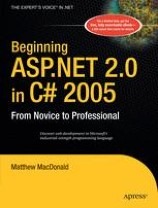
Beginning ASP.NET 2.0 in C# 2005 : From novice to professional
This book provides thorough coverage of ASP.NET, guiding you from beginning to advanced techniques, such as querying databases from within a web page and performance-tuning your site. You'll find tips for best practices and comprehensive discussions of key database and XML principles. The book also emphasizes the invaluable coding techniques of object orientation and code-behind, which will enable you to build real-world websites instead of just scraping by with simplified coding practices. By the time you finish this book, you will have mastered the core techniques essential to professional ASP.NET developers.

Beginning ASP.NET 2.0 Databases : From novice to professional
Beginning ASP.NET 2.0 Databases: From Novice to Professional is a comprehensive introduction to connecting a website to many different data sourcesnot just databases. You'll learn how to build a relational database, use SQL to communicate with it, and leverage both in your web applications. You'll also learn about the new features of ADO.NET and ASP.NET in .NET 2.0. The authors cover mission-critical issues, such as design, transactions, error handling, optimization, and scalability. They examine SQL Server, Jet, and MySQL databases, and highlight the differences among them.
Automated technology for verification and analysis ; 3rd International Symposium, ATVA 2005, Taipei, Taiwan, October 4-7, 2005, Proceedings
The Automated Technology for Veri?cation and Analysis (ATVA) international symposium series was initiated in 2003, responding to a growing interest in formal veri?cation spurred by the booming IT industry, particularly hardware design and manufacturing in East Asia. Its purpose is to promote research on automated veri?cation and analysis in the region by providing a forum for int- action between the regional and the international research/industrial commu- ties of the ?eld. ATVA 2005, the third of the ATVA series, was held in Taipei, Taiwan, 2005. The main theme of the symposium encompasses - sign, complexities, tools, and applications of automated methods for veri?cation and analysis. This book constitutes the refereed proceedings of the symposium .
Applications of Specification and Design Languages for SoCs : Selected papers from FDL 2005
This book provides detailed insights into recent works dealing with a large spectrum of issues in system-on-chip design, namely: assertion-based design, mapping on network-on-chip architectures, use of C/C++/SystemC design methodologies, hardware/software integration, mixing heterogeneous models of computation, analog/mixed-signal/mixed-technology system design and verification, UML/XML-based synthesis of analog and mixed-signal systems, UML to VHDL mapping, UML-based performance modeling, model transformation and formal verification, real-time system models, and Model Driven Architecture.

Android Essentials
Android Essentials is a no–frills, no–nonsense, code–centric run through the guts of application development on Google's Mobile OS. This book uses the development of a sample application to work through topics, focusing on giving developers the essential tools and examples required to make viable commercial applications work. Covering the entirety of the Android catalog in less than 150 pages is simply impossible. Instead, this book focuses on just four main topics: the application life cycle and OS integration, user interface, location–based services, and networking.
Ajax Patterns and Best Practices
Ajax is taking us into the next generation of web applications. Ajax has broken the client-server barrier by decoupling the client from the server, but an Ajax application still needs a server to extract content from. The most effective use of Ajax and the server requires an understanding of REST, an architectural style used to define Web services. Ajax Patterns and Best Practices explores dynamic web applications that combine Ajax and REST as a single solution. A major advantage of REST is that, like Ajax, it can be used with today's existing technologies.
Ajax in Oracle JDeveloper
The book covers web search and RSS Feed with Ajax as well as form validation with Ajax frameworks for Java, JSP, JSF, and PHP. It discusses using Ajax in Oracle JDeveloper and is IDE based. JDeveloper has the following advantages over Eclipse IDE.

Advances in XML information retrieval and Evaluation ; 4th International workshop of the initiative for the evaluation of XML retrieval, INEX 2005, Dagstuhl Castle, Germany, November 28-30, 2005. Revised and Selected Papers
Content-oriented XML retrieval has been receiving increasing interest due to the widespread use of eXtensible Markup Language (XML), which is becoming a standard document format on the Web, in digital libraries,and publishing. By exploiting the enriched source of syntactic and semantic information that XML markup provides, XML information retrieval (IR) systems aim to implement a more focused retrieval strategy and return document components, so-called XML elements – instead of complete documents – in response to a user query. This focused retrieval approach is of particular bene?t for collections containing long documents or documents covering a wide variety of topics (e.g., books, user manuals, legal documents, etc.), where users’ e?ort to locate relevant content can be reduced by directing them to the most relevant parts of the documents.

Advances in XML information retrieval ; 3rd International workshop of the Initiative for the evaluation of XML retrieval, INEX 2004, Dagstuhl Castle, Germany, December 6-8, 2004
The ultimate goal of many information access systems (e.g., digital libraries, the Web, intranets) is to provide the right content to their end-users. This content is increasingly a mixture of text, multimedia, and metadata, and is formatted according to the adopted –W3C standard for information repositories, the so-called eXtensible Markup L- guage (XML). Whereas many of today’s information access systems still treat do- ments as single large (text) blocks, XML offers the opportunity to exploit the internal structure of documents in order to allow for more precise access thus providing more specific answers to user requests. Providing effective access to XML-based content is therefore a key issue for the success of these systems. The aim of the INEX campaign (Initiative for the Evaluation of XML Retrieval), which was set up at the beginning of 2002, is to establish infrastructures, XML test suites, and appropriate measurements for evaluating the performance of information retrieval systems that aim at giving effective access to XML content. More precisely, the goal of the INEX initiative is to provide means, in the form of a large XML test collection and appropriate scoring methods, for the evaluation of content-oriented XML retrieval systems.

Advances in web-age information management ; Vol. 4016 : 7th International Conference, WAIM 2006, Hong Kong, China, June 17-19, 2006, Proceedings
This book constitutes the refereed proceedings of the 7th International Conference on Web-Age Information Management, WAIM 2006, held in Hong Kong, China in June 2006. The 50 revised full papers presented were carefully reviewed and selected from 290 submissions. The papers are organized in topical sections on, indexing, XML query processing, information retrieval, sensor networks and grid computing, peer-to-peer systems, Web services, Web searching, caching and moving objects, temporal database, clustering, clustering and classification, data mining, data stream processing, XML and semistructured data, data distribution and query processing, and advanced applications.

Advances in web-age information management ; Vol. 3739 ; 6th international conference, WAIM 2005, Hangzhou, China, October 11-13, 2005, proceedings
Constitutes the proceedings of the 6th International Conference, WAIM 2005, Hangzhou, China, October 11 – 13, 2005. including Topics Data Structures and Information Theory Popular Computer Science Database Management Information Storage and Retrieval Information Systems Applications (incl. Internet) Artificial Intelligence

Advances in Web Intelligence and Data Mining
The new Web-related research directions include intelligent methods usually associated with the fields of computational intelligence, soft computing, and data mining. This book presents state-of-the-art developments in the area of computationally intelligent methods applied to various aspects and ways of Web exploration and Web mining. Some novel data mining algorithms that can lead to more effective and intelligent Web-based systems are also described. Scientists, engineers, and research students are expected to find many inspiring ideas in this volume.
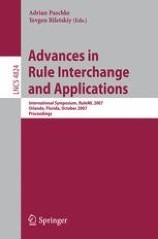
Advances in Rule Interchange and Applications ; International Symposium, RuleML 2007, Orlando, Florida, October 25-26, 2007, Proceedings
The goal of RuleM is to develop an open, general, XML-based family of rule languages as intermediaries between various ‘specialized’ rule vendors, applications, industrial and academic research groups, as well as standardization efforts such as OMG’s PRR or W3C’s RIF. A general advantage of using declarative rules is that they can be easily represented in a machine-readable and platform-independent manner, often governed by an XML schema. This fits well into today’s distributed, heterogeneous Web-based system environments. Rules represented in standardized Web formats can be discovered, interchanged and invoked at runtime within and across Web systems, and can be interpreted and executed on any platform.
